
Artificial Intelligence Ethics Guide and Ethics Conversion in MEB Training
Automatically translated
 Writer
Digitalization in education is reshaping the entire structure of the system by passing beyond a vehicle-based change. Specifically artificial intelligence-based systems, learning analytics, measurement-assessment and personalization Tags Training intensively used in areas. However, this conversion is not sustainable without a referral based on ethical principles. In this context MEB Training Artificial Intelligence Ethics Guide uIt stands out as an important reference text in terms of educational policies in Turkey.
Artificial intelligence technologies become increasingly visible in the educational field, not only pedagogical, but also bringing ethical, legal and social questions. Published in this context Home Artificial Intelligence Ethics Guide in Education is a basic policy document that aims to keep artificial intelligence in a principled ground in the educational system. The guide aims to protect the human-centered structure of training without being covered by the speed of technological development.

Artificial Intelligence Practices and Basic Ethics Principles in Education
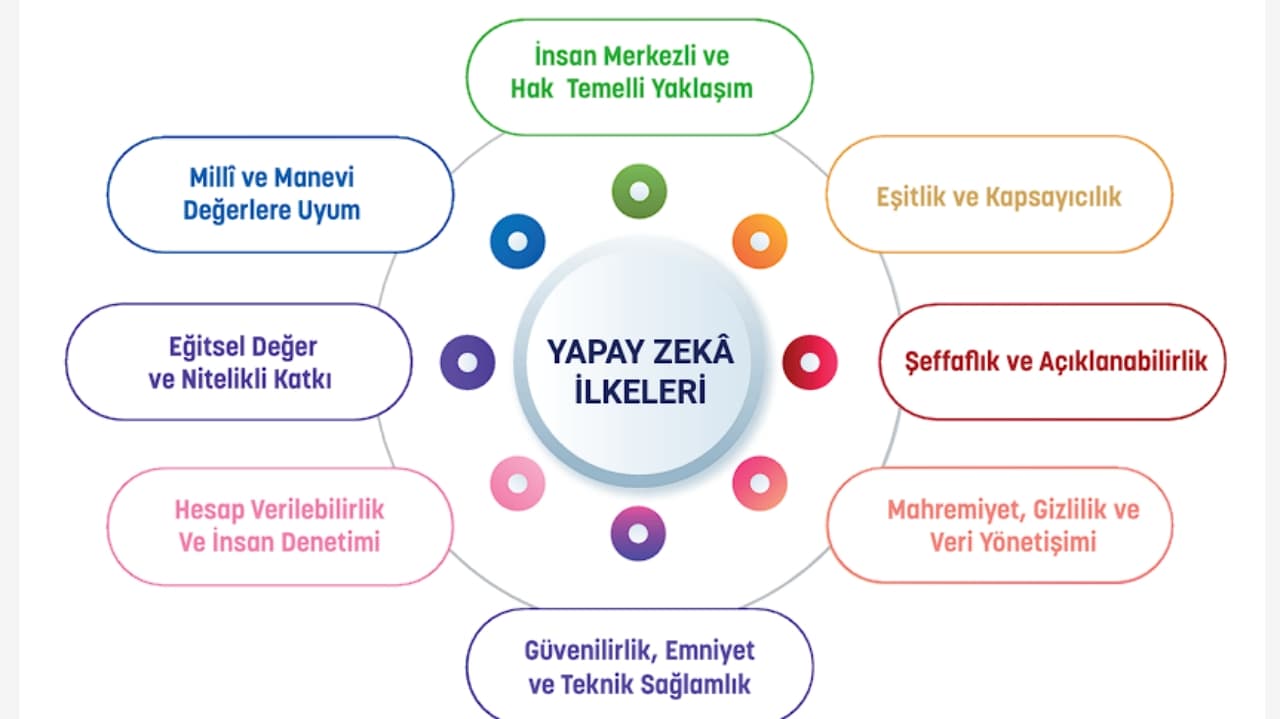
Artificial Intelligence Applications in education are used in many fields such as learning analytics, measurement and evaluation, guidance, content production and personalized learning. On the other hand, the prevalence of these applications brings critical issues such as protection of student data, algorithmic neutrality and transparency of decision-making processes. The principles of justice, privacy, transparency and accountability by clearly identifying the risk areas of this guide prepared by MEB.
This approach rejects an understanding that makes artificial intelligence into the essence of education. On the contrary, technology is open to pedagogical purposes and human audit Home location. Thus, the ability to decide in education is unlike algorithms educators ethical responsibility.
Artificial Intelligence Ethics for Teachers: Knowing Ethics from Digital Literacy
One of the important focal points of the guide is that we meet our teachers as artificial intelligence ethics. Teachers, artificial intelligence The supported tools are defined as ethical actors that can only use technically, not only evaluate the possible effects of these tools. The protection of psychological and social integrity as well as academic development of the student is shown among the basic responsibilities of the teacher.
In this context, the teacher is obliged to pass the pedagogical strainer rather than accepting the outputs provided by artificial intelligence systems. The guide aims to build a ethical consciousness that strengthens the professional autonomy of the teacher.
Corporate Role of MEB and SUMMER Ethical forms
ethical declaration form in the guide MEB and SUMMER ethical declaration formPay attention to the application of ethical principles as concrete tools. These forms record the commitment to compliance with ethical principles of stakeholders that develop or use artificial intelligence-based educational practices. Thus, ethical turns into a corporate responsibilities mechanism, only by being a theoretical say.
This declaration process also secures the protection of student rights while increasing the traceability of artificial intelligence in education. It also contributes to the establishment of social trust by providing transparency to the public.

Artificial Intelligence and Human Center Future in Education
Artificial Intelligence Ethics Guide in MEB Training exhibits a cautious and conscious posture against the appearance of artificial intelligence as an unlimited solution in education. The basic approach of the guide is to be meaningful and sustainable when the technological progress is directed only with ethical principles. The training is discussed only as a social structure that produces value, unlike a space that gives digital skills. With this direction, the guide can be assessed as a strategic text aimed at protecting the conscience of education in the era of artificial intelligence.
A New Education Paradigm With Ethics Oriented
The Artificial Intelligence Ethics Guide in MEB Training offers a visionary normative framework that integrates the ontological and axial dimensions of technological development with educational system. The guide is not only as an efficient instrument of artificial intelligence, but it is a part of educational application and a strong barrier against the risks that technological determinism can create by positioning it as a stakeholders subject to audit.
The embodying accountability mechanism with the SUMMER Ethics Declaration Form allows ethical principles to evade corporate responsibility culture from a theoretical plane. In this context, the effort to protect the human essence of education against the speed of digitalization is not only a pedagogical choice, but also the basic requirement to build a democratic and fair learning ecosystem. The development of future educational policies in the center of the "human control" principle, which arises in this guide, guarantees that digital transformation is maintained in social trust and ethical integrity.
WriterGoogle NotebookLM Data Tables ile Veriyi Anlamlandırma Yolu


ChatGPT Görsel Üretme Aracı Yenilendi