




Falcon-H1R 7B: The New Generation LLM Model Enters the Scene
Automatically translated
 Writer
As competition in the open-source ecosystem heats up, Falcon-H1R 7B stands out as a notable alternative. Optimized for both local setups and enterprise applications, this model has 7 billion parameters.

Recently, the focus has shifted from parameter count to ease of setup, hardware characteristics, and real-world performance. Falcon-H1R 7B is designed to meet these expectations. It also aims for high accuracy in areas such as code writing, summarization, multi-step reasoning, and enterprise data analysis.
Technical Specifications of Falcon-H1R 7B
Falcon-H1R 7B is built on a transformer-based architecture. It targets high accuracy in tasks such as text generation, summarization, question answering, and code writing. Thanks to its optimized mechanisms, it can run with lower memory capacity.
Its key technical features are:
7 billion parameters
Improved attention optimization
Ability to run with low VRAM
Structure suited to local inference performance
Fine-tuning support
Because of these features, Falcon-H1R 7B can easily be used by individual users as well as small and medium-sized businesses.
How to Set Up Falcon-H1R 7B?
Setting up Falcon-H1R 7B is fairly manageable for users with technical infrastructure experience. Proper configuration is also critical for performance.
Hardware Setup: At minimum, 16 GB of RAM is recommended, and for the graphics card, 8 GB of VRAM is advised. Given this hardware, these are features found in average computers today.
Environment Setup: Python 3.10 or a later version should be installed. Then install PyTorch or a similar framework. For GPU acceleration, check CUDA compatibility.
Model Download: Files like these are usually obtained from open-source platforms such as Hugging Face. They are then loaded through the library.
Running and Testing: The model is tested by tuning inference parameters such as top-p and max_tokens. Monitoring VRAM usage is important for performance.
Once the setup is complete, Falcon-H1R 7B will run as a local system without needing an internet connection.
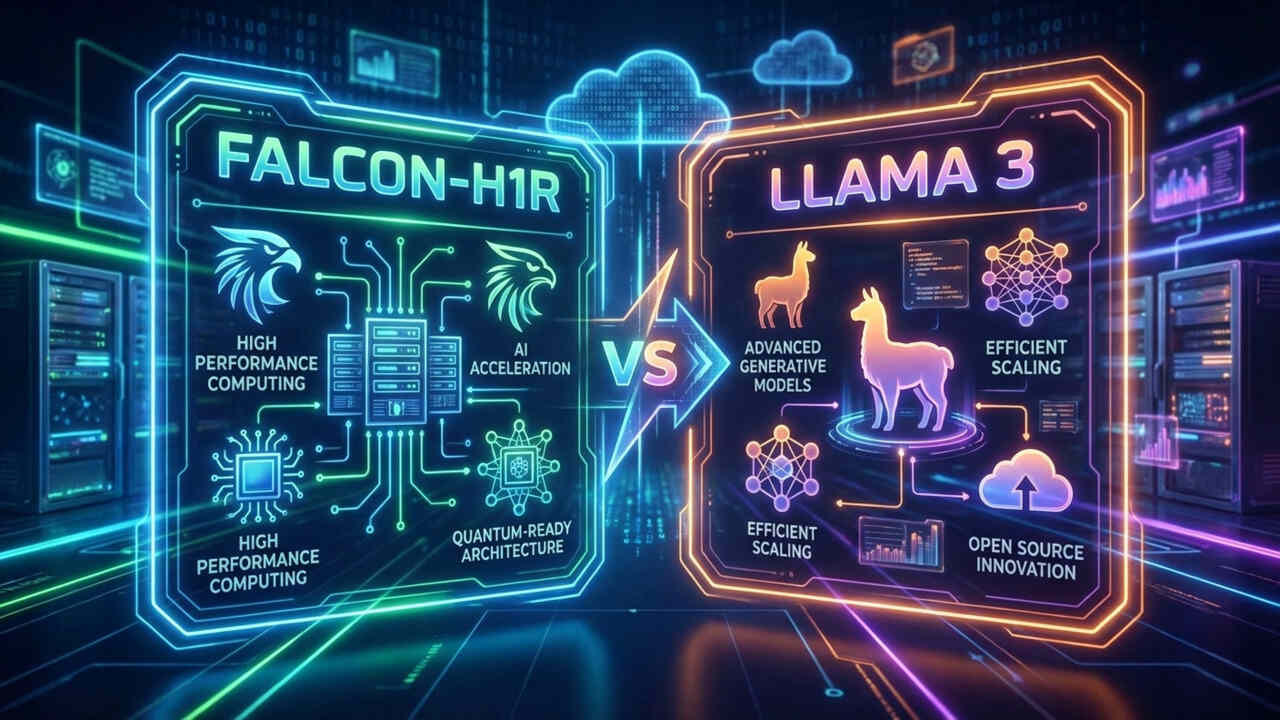
Falcon-H1R vs Llama 3: Performance Comparison
Criterion | Falcon-H1R 7B | |
|---|---|---|
Parameter Count | 7 billion | 8B, 70B (and larger variants) |
Architecture | Optimized transformer | Advanced transformer (Meta-optimized) |
Hardware Requirements | Mid-range GPU (8–12 GB VRAM is sufficient) | For 8B, mid-to-high-end GPU; for 70B, high-end GPU / server |
Memory Consumption | Lower VRAM usage | VRAM needs rise as parameters increase |
Ease of Local Setup | More accessible and lightweight | More complex for large models |
Quantization Support | Runs efficiently at 4-bit / 8-bit | Supported, but large models still consume a lot of resources |
Inference Speed | Low latency, balanced performance | Higher accuracy in large models, but longer processing time |
Fine-Tuning Cost | Lower hardware cost | Cost increases with large variants |
Edge Deployment | More suitable | Limited (except small variants) |
Enterprise Use | Ideal for SMEs and local data analysis | Strong in large-scale enterprise projects |
Benchmark Performance | Balanced and optimized | Higher scores in top-tier variants |
LLM AI Trends and Falcon-H1R's Position
In 2026, three main trends stand out in the LLM field: local model execution, model optimization, and enterprise customization. It is fair to say that Falcon-H1R 7B holds a strong position in two of these areas. Thanks to its lightweight architecture, it runs smoothly on many devices.
On the other hand, hybrid architectures such as Hybrid Transformer-Mamba are becoming critical for models in the Falcon-H1R 7B segment. This approach combines Mamba-based state space models' efficiency advantages with transformers. In this way, it aims to optimize the balance between performance and efficiency in AI.
The Mamba architecture processes sequential data with linear complexity. This provides a significant performance gain in long-context sequences. The features of the Hybrid Transformer-Mamba architecture can be described as lower memory consumption, high efficiency on long sequences, lower latency, and a hardware-friendly design. Of course, there are also scenarios where this approach alone cannot provide contextual relationship modeling.
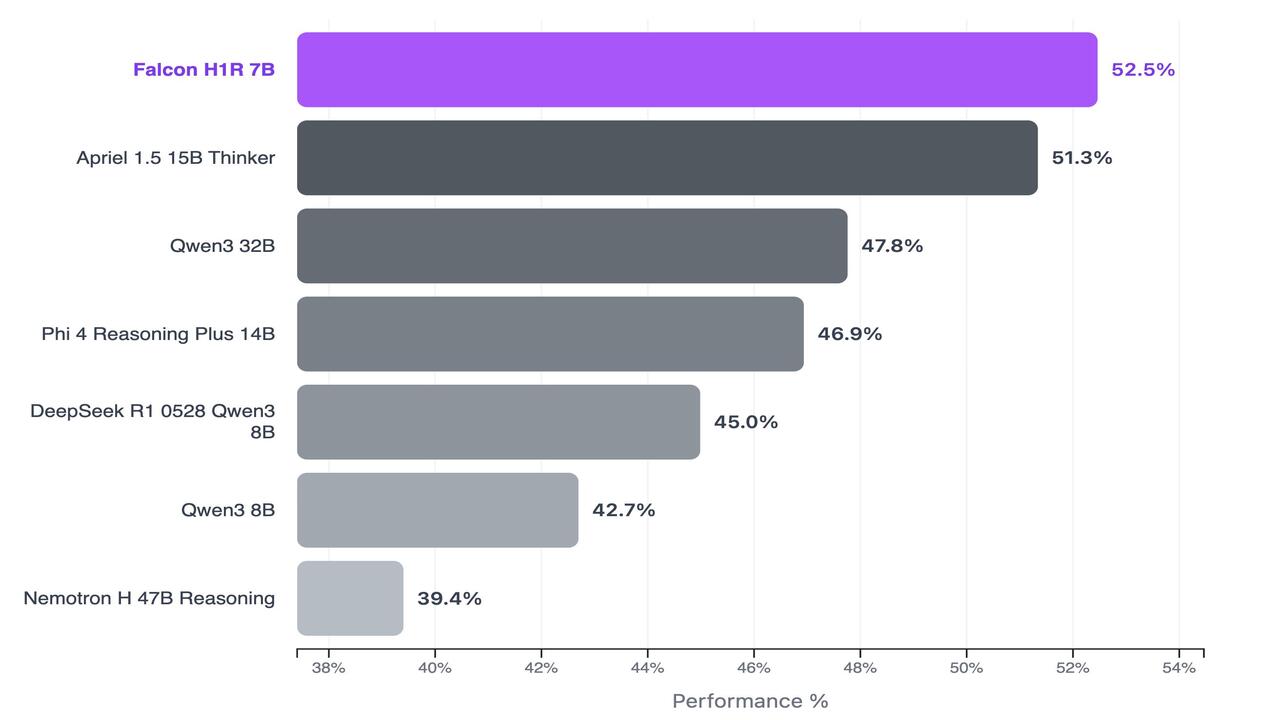
Future Outlook: The Era of Efficiency-Focused LLMs
In the LLM race, parameter size alone is not enough. Alongside everything else, efficiency and hardware optimization have become among the most emphasized topics in 2026. Falcon-H1R 7B is positioned as one of the representatives of this shift. This model brings high performance together with hardware savings, offering sustainable LLM solutions for enterprises and SMEs. In the coming period, LLM competition will shape the market by offering more accessible and customizable solutions. Falcon-H1R is drawing attention as a new member of this emerging paradigm.
WriterGPT-5.4: OpenAI’nin Yeni Nesil Yapay Zeka Modeli


Alibaba, Quark AI Adlı Yapay Zeka Destekli Gözlüğü Tanıttı


