




Perplexity Search API: Real-Time AI Search Engine for Developers
Automatically translated
Perplexity Search API has launched a real-time AI search engine. The AI search API lets developers interact directly with hundreds of billions of web pages. It also stands out with source-backed responses, filtering features and promises of low cost. However, limits on licensing, copyright and performance remain open for debate.
What Is the Perplexity Search API?
Introduced publicly on September 25, 2025, the Perplexity Search API, an AI search engine, gives access to real-time data on the internet. An API, or Application Programming Interface, is an interface that allows different software to communicate with each other. The Perplexity Search API works on this principle. Developers can integrate the current, source-backed information that Perplexity collects from the web into their own applications. This way, users on a website or mobile app can get instant answers based on data from the internet. The company states that this API runs on the same index as the infrastructure Perplexity uses in its own answer engine, and that it is opening this power to developers.
This announcement is seen as the start of a new era for AI-powered search technologies. Beyond the limits of traditional search engines, it promises an alternative in terms of AI-friendly output, source attribution and cost.
Perplexity API: Background and Developer Vision
Perplexity was previously known for its identity as an answer engine: it received user queries and generated text-based answers using its web index and language model infrastructure. However, this structure was not open as an infrastructure layer that developers could use directly.
With the Perplexity API, the backbone of this answer engine is now directly opened up. In addition, the search_evals open-source benchmark framework was also announced, allowing developers to compare the performance of different search APIs using objective criteria. This move is seen as an important step toward increasing the transparency of "black box" search infrastructures.

How to Use the Perplexity Search API
To use the Perplexity Search API, you first need to create a developer account and get an API key. You can think of this key as a password required to use the system. Then, with commonly used programming languages such as Python or JavaScript, you can connect to the API by writing a few lines of code.
When a query is sent to the API, the results come back in JSON format; in other words, the data arrives in a structured package that can be easily integrated into applications. For small projects, integration can be completed within minutes, while larger projects may require performance optimizations.
In short, with this API, you can add a real-time, source-backed search engine feature directly to your own website or application.
Technical Features and Integration
SDK (Software Development Kit) support is available for using the API. The Python and JavaScript/TypeScript SDKs allow developers to integrate the Perplexity Search API into their projects with just a few lines of code.
For example, a Python usage example looks like this:
from perplexity import Perplexity client = Perplexity() results = client.search.create( query="latest AI developments 2025", max_results=5, max_tokens_per_page=1024 ) for r in results.results: print(r.title, r.url)This structure makes basic integration possible with just a few lines of code.
Integration times vary depending on the use case:
Trial or Proof of Concept: Can be running within minutes.
Medium-scale projects: May take hours or a few days.
Enterprise and high-traffic systems: Require optimization, error handling and performance testing.
Core API Parameters and Filtering
API parameters allow both general and targeted searches. According to the Perplexity documentation, the core parameters of the Search API are as follows:
Required parameters:
• query (the search query)
• max_results (how many results are requested)
• max_tokens_per_page (how many tokens to extract from each page)Optional filtering parameters:
• country — limiting results to a specific country
• search_domain_filter — getting results only from specific domains
• search_recency_filter — limiting to recently published content (day, week, month)
• search_after_date_filter / search_before_date_filter — date range limitation
These filtering options give developers the flexibility to get both broad and targeted results.
Benchmarks and Performance Comparisons
A benchmark is a test used to measure an API's performance and compare it with competitors. For this purpose, Perplexity offers the search_evals benchmark. The Perplexity search_evals benchmark allows comparative evaluation against rivals such as Google on criteria like speed, accuracy, source attribution and user experience across different query types.
Some early reviews and user evaluations show that Perplexity performs strongly on certain query types:
Performance | Perplexity API | |
Response Time: |
| Generally fast, but some special and complex queries may experience delays. |
Accuracy and sources: | Produces concise, source-cited answers for "how-to" style queries that require direct information. | Limited source citation; provides more information for long, exploratory content. |
Content Variety: | Web-based, focused on short and concise answers, with limited multimedia support. | Wide content pool, multimedia support, and suited to long-tail queries. |
Cost-Performance Balance: | 5 USD per 1000 queries, economical for small and medium-scale projects. | Generally higher-cost API options, especially at large volumes. |
Ease of Integration: | Easy integration with Python and JavaScript/TypeScript SDKs, flexible filtering parameters. | Limited SDK support; integration can sometimes be more complex. |
Freshness: | Provides source-backed and current answers, with real-time data access. | Content freshness varies, sometimes relying on indexes that update with a delay. |
Transparency and Trust: | Clearly shows sources; the search_evals benchmark is open source. | Limited source citation; benchmark transparency is generally absent. |
Multilingual Support: | Limited multilingual content support, but improving. | Strong multilingual content support, on a global scale. |
Scalability: | Optimization may be needed for large data and high traffic. | Google's infrastructure is optimized for large-scale data and traffic. |
Still, these measurements are generally based on specific test sets; each application should evaluate according to its own query profile.
Pricing and Economic Advantages
The Perplexity Search API is priced at 5 USD per 1000 queries, especially for small and medium-sized startups, with no additional token-based fees. This system offers a predictable and economical cost for small and medium-sized projects. The economic advantage becomes clear when compared with the Google Custom Search API and the Bing Search API.
However, in high-volume use, quota limits and price increases may come up. For this reason, it is important to estimate usage before starting a project and to consider custom commercial agreements if necessary.
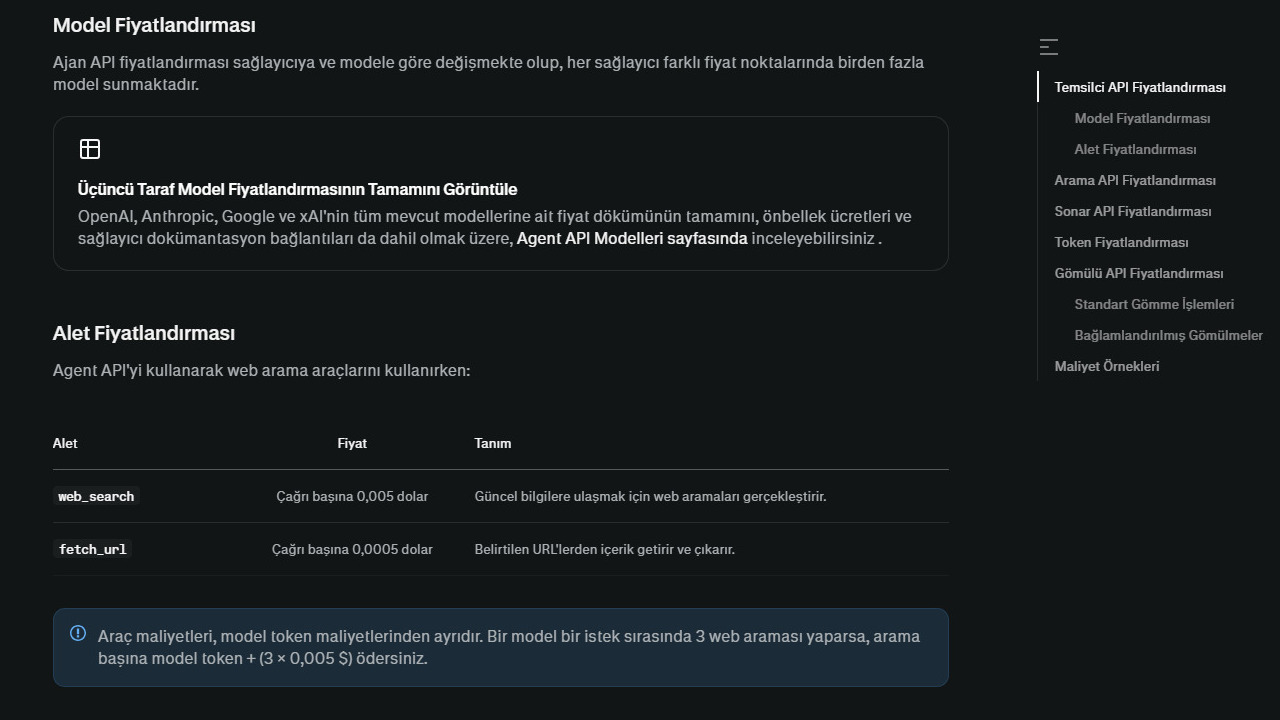
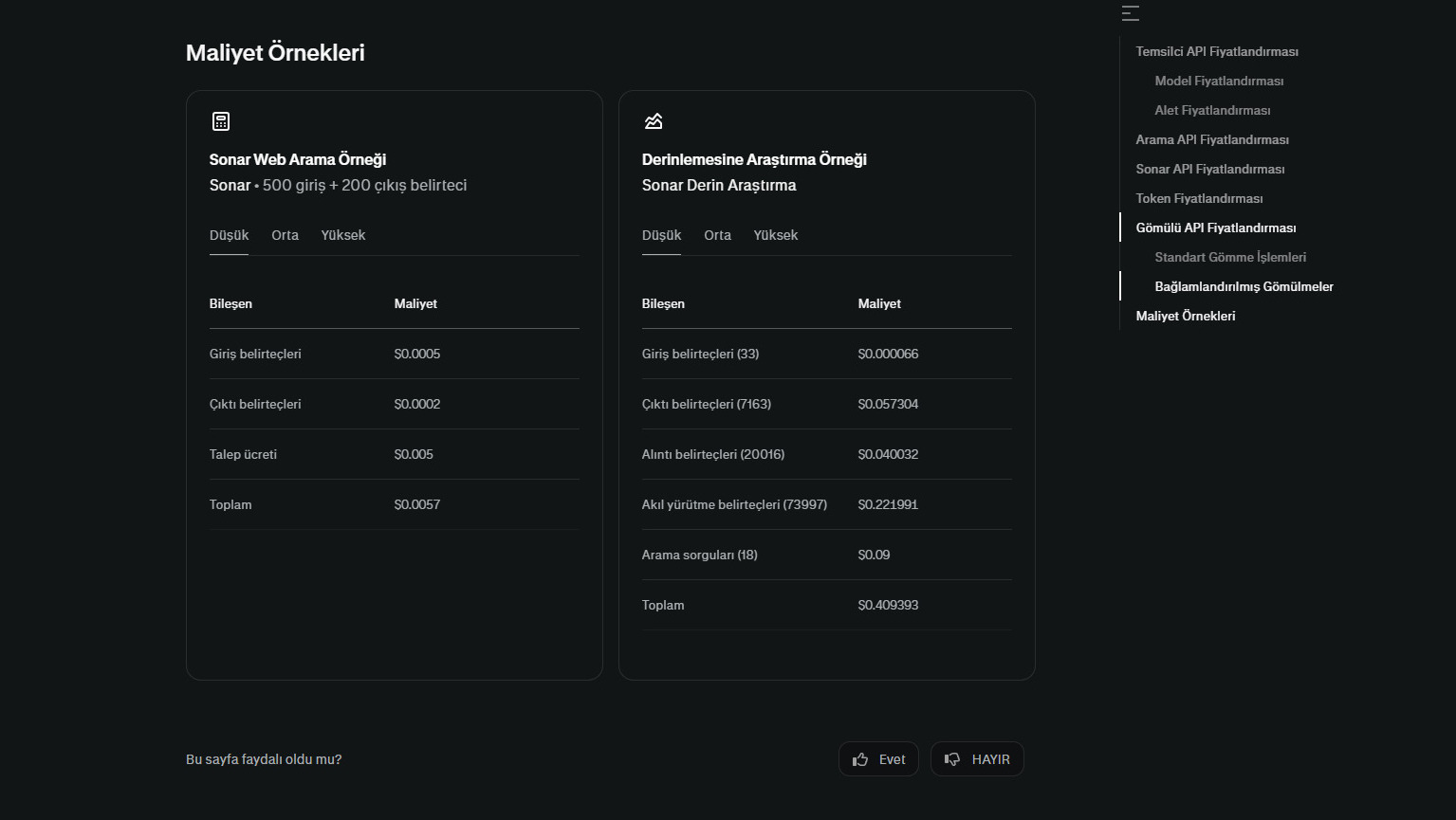
Perplexity also offers AI-powered search-based answers with its Sonar models. These models have a token-based cost structure:
Input tokens: Charged based on the queries and contexts sent to the API.
Output tokens: Charged based on the number of tokens the model uses when generating a response.
Citation tokens: Specific to the Sonar Deep Research model, which produces source-cited content.
Reasoning tokens: Used for complex step-by-step analyses and logical inferences.
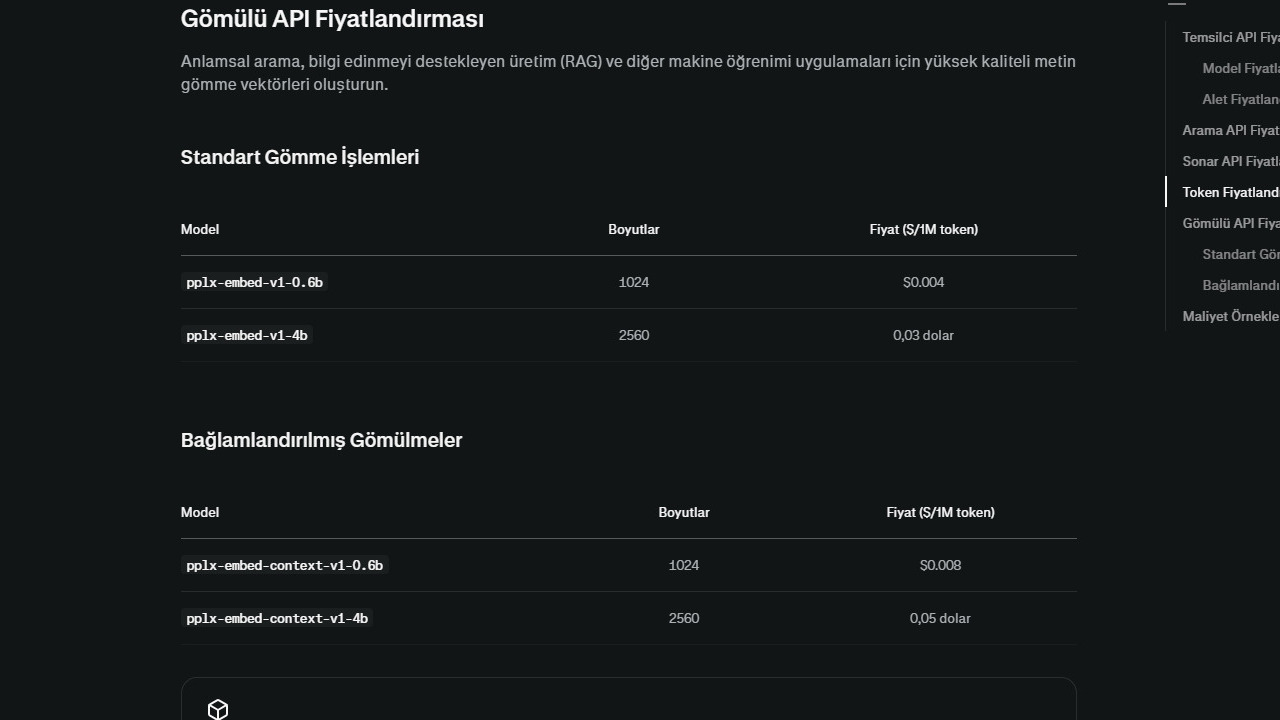
As an example, costs vary when a low-context query is run on the Sonar Deep Research model. This provides high accuracy and source-cited answers, especially for academic research and detailed reporting.
API Context Size and Search Depth
In the API, search context size determines how much web data will be retrieved. A higher context size provides more comprehensive and detailed results, but increases the cost:
Low context: Fast and cheap, ideal for basic queries
Medium context: Balanced cost and quality
High context: Maximum research depth, suitable for academic and strategic analyses
This structure gives developers the flexibility to choose between cost and performance. It is especially a suitable option for RAG (Retrieval-Augmented Generation) applications.
Security, Privacy and Legal Risks
Perplexity states that user queries are processed securely and that it complies with regulations such as the GDPR (General Data Protection Regulation). Since the infrastructure is US-based, you should pay attention to regional regulations when transferring data for global users.
In enterprise use, scalability can be achieved through high concurrent request management and SLA (Service Level Agreement) options to set up a service level agreement. This matters for systems with heavy information flow, such as large companies and news agencies.
Advantages and Risks
Advantages: | Risks: |
Source-cited answers | Gaps in exploratory and local queries |
Open-source benchmark (search_evals) | Latency compared with Google's infrastructure |
Flexible filtering and parameter use | Content licensing issues |
AI-friendly JSON output | AI errors (hallucinations) |
Low cost and fast integration | Price and quota limitations in high-volume use |
Use Cases
The Perplexity API offers a flexible solution that can be used in different areas:
Chatbots and Agent Systems: Customer support bots can provide instant answers in applications that require live information. |
Academic Research: Provides reliable, source-cited information for literature reviews and article summaries. |
Enterprise Knowledge Management: Combines internal company documents with web data to provide more comprehensive information. |
News and Media: Editors can use the API for tracking current data and automated content suggestions. |
SEO and Marketing: Trend analysis, long-tail query discovery and content gap analysis can be performed. |
RAG-Based Applications: Large language models can be supported with real-time web data. |

Future Outlook
The Perplexity Search API offers developers a current, source-backed and fast information search experience. The API is an important tool, especially for small and medium-sized startups and those building AI-based applications.
In the future, the API is expected to expand into multimodal search (images, video) and enterprise solutions. This could create a strategic advantage for both news agencies and large companies.
Perplexity's low-cost and developer-friendly approach may enable it to compete with giants like Google in the long run. However, issues such as licensing and high-volume use should still be watched closely.
İletişim ve Teknoloji Staj İlanları | 6-12 Nisan


Görsel Efektler İçin En İyi VFX Yapay Zeka Araçları 2026


