2025 Artificial Intelligence Status: What Does Work Power And Profitability Expect?
Automatically translated
 Admin
Artificial intelligence (AI) is now a trial stage in 2025 and is located in the center of corporate operations. Home Latest survey results of McKinsey Global Institute The two faces of this large transformation also reveal: Although the companies are using AI almost all, the majority are still struggling with the challenges of AI scaling and does not fully see the financial effect.
In this article, we will discuss in detail which strategies are followed to achieve the highest value of 2025 artificial intelligence status, contradictory expectations for business power and high performance companies. Data shows that success is not only adopting AI technology, but also redesigning workflows according to this technology.
Why Does AI Use Expand?
- What: The majority of companies participating in the survey (88) reports that AI uses regularly in a minimum work function. This rate refers to an important increase in (%78) according to the previous year.
- Why: AI is adopted to provide cost advantages in individual usage scenarios such as software engineering, production and IT, and bring revenue increase in areas such as marketing/sales. 64% of companies indicate that AI is a innovation catalyst.
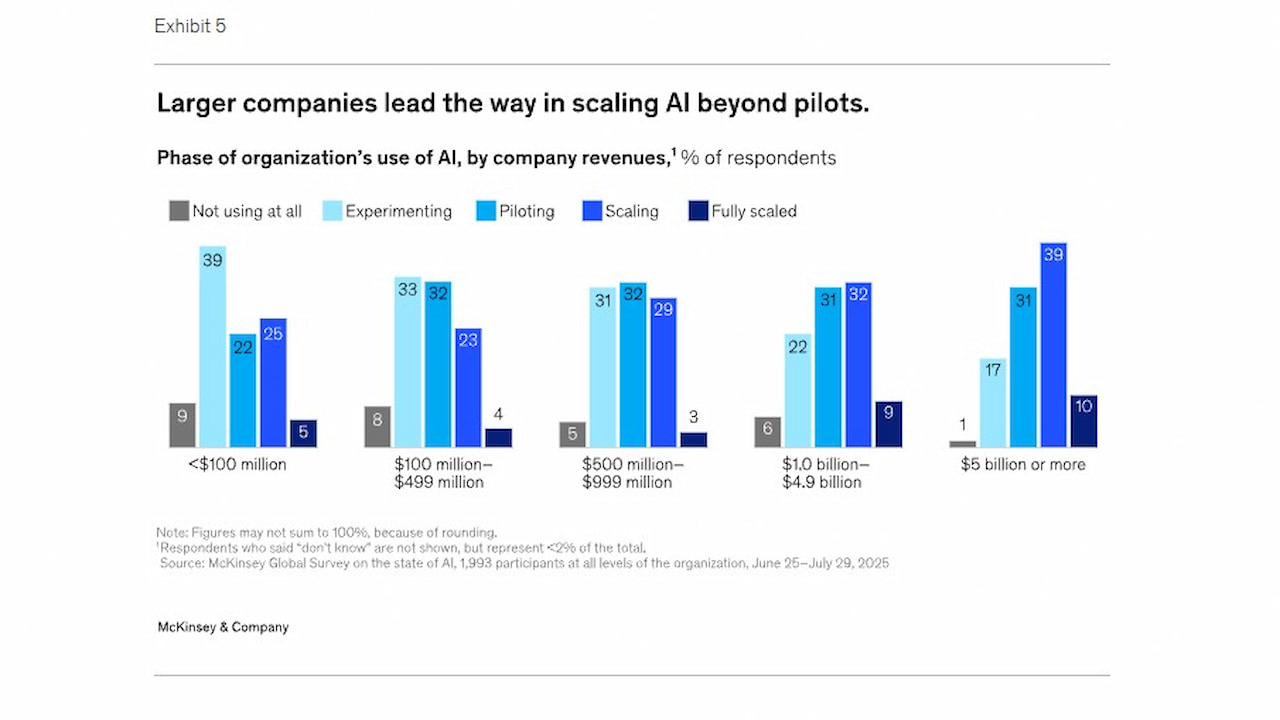
- How Cannot Scale: About three of the participants involved in the study (66) states that their organizations have not yet started to scale AI at corporate level or stay at the pilot stage. Scale, especially the turnover is more challenging for small companies under 100 million dollars (in the way of the world), large companies over 5 billion dollars have passed about half scale stage.
Where to Focus on Corporate AI Use?
The use of Corporate AI shows that companies are experimenting with the most data intensive and repeat-based tasks:
- High Interest in AI Agents (Agents): 62% of respondents, organizations Home AI agents (foundation model based systems that can perform planning and multi-step actions in the real world) says they are at least experimented with.
- Leader Functions: The main business functions of artificial intelligence agents scaled out as IT and information management (23). Service table management in IT, agent-based usage scenarios such as deep research in information management are quickly improved.
- Leading Industries: The most common sectors of the use of agents are technology, media, telecommunications and health sectors.
Artificial Intelligence and Workforce Effect: 2025 What to Expect?
The expectations of AI and labor force influence vary considerably, and we see that HR leaders create one of the largest incertainities in front of:
Expectations in Business Power Size:
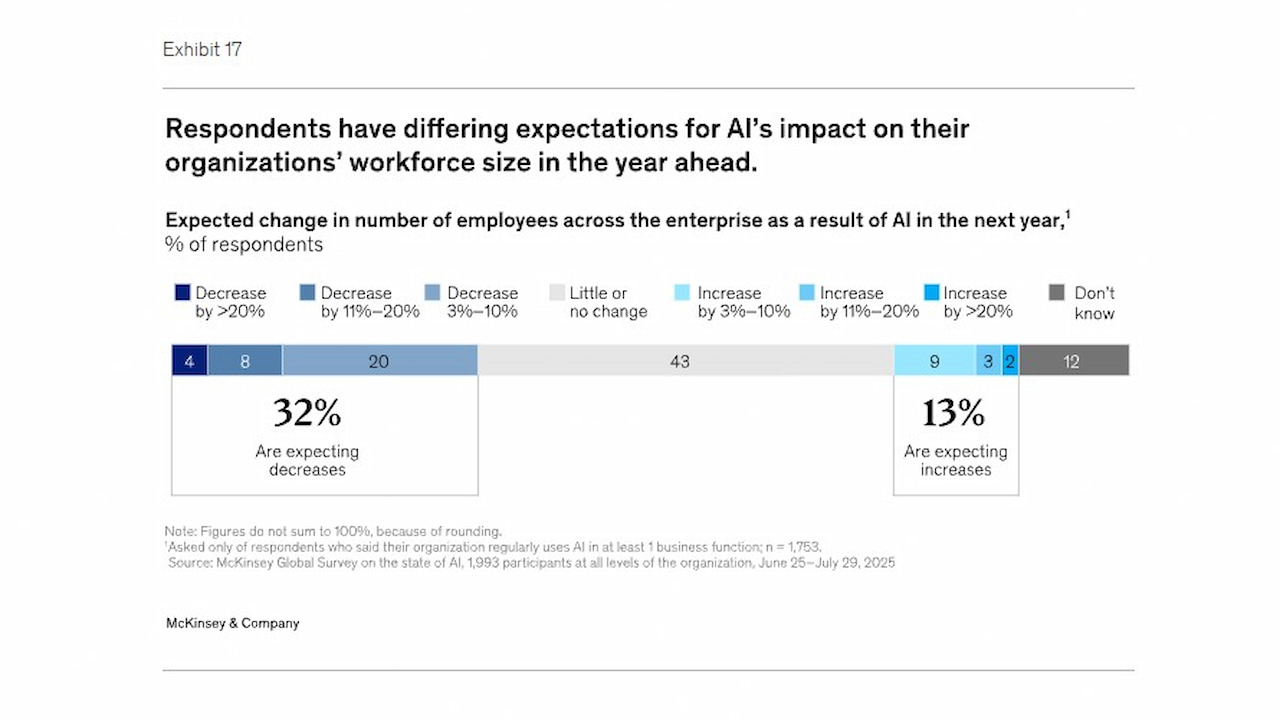
- 43% of participants do not expect a change due to artificial intelligence in the total number of upcoming year organizations.
- 32% with an important cut are waiting for 3% or more reduction in the number of employees.
- Only 13% predict that the number of employees will increase.
Functional Fall Expectation:
As a result of the use of AI last year, the ratio of those who report that the number of employees is reduced by 17%, the next year it is expected to rise to 30% of this rate. This shows that companies think that they will start using artificial intelligence from the test stage, concretely in business power optimization.
These contradictory expectations reveal that artificial intelligence and work force effect differ in the company size and strategic goals.
How Does High Performance Companies Make Difference?
The biggest value from artificial intelligence investments, i.e. Faiz and Prepaid Profit (Home) creates 5% or more impact on (McKinseyFits in the definition of 'AI high performance companies") companies are watching clear strategies that are separated from others:
- Strategic Goals: Most of the high-performance companies set not only efficiency gains in AI initiatives, but also growth and innovation as target.
- Workflow Redesign: Half of these companies states that AI is intended to use to convert their work, and in this direction, the workflow is redesigned. This intentional redesign stands out as one of the most powerful contributor factors to create meaningful work effect.
- Leadership Ownership: Leaders of high performance companies show three times more ownership and commitment to AI initiatives. They also encourage AI usage as part model in person.
- Risk Management: Although these companies have two times more AI usage scenarios than others, they have defined more processes to manage risks. Inaccuracy in particular (lack of accuracy) They have activated processes that determine when human validation is necessary to resolve AI risks.
What is AI Scale Challenges and Financial Impact?
2025 Artificial Intelligence Status shows that the effect of AI on corporate profits is still limited:
- EBIT Effect: Only 39% of participants, Faiz and Tax Pre-Visitor of AI usage (Home) reports any effect on it. Most of the influencers (Less than 5%) in a low level of effect observed.
- Cost/Expirsion Recovery: Despite that, companies have seen cost advantages in individual usage scenarios such as software engineering and manufacturing; they are aware of revenue increases in areas such as marketing, sales and corporate strategy.
Artificial intelligence risks (especially intellectual property breach and regulatory compliance) are seen to make companies more effort. On average, the number of risks that organizations work to manage is in 2022, today it has increased to four risks. This demonstrates the awareness of concrete hazards brought by technology.
2025 Artificial Intelligence Status shows that AI’s potential is largely ahead. Success is not only buying AI tools, but by adopting these tools, it is passing through basic transformation of workflows and focus on strategic goals. The experience of high performance companies clearly draws the road map for the future.
AdminGoogle Jules Nedir? Kodlamada Yeni Bir Dönem


Yapay Zeka Küresel Algısı: UNDP'den Kritik Bulgular