Claude Fable 5: Mythos-Class Model Opens to the Public
Automatically translated
 Admin
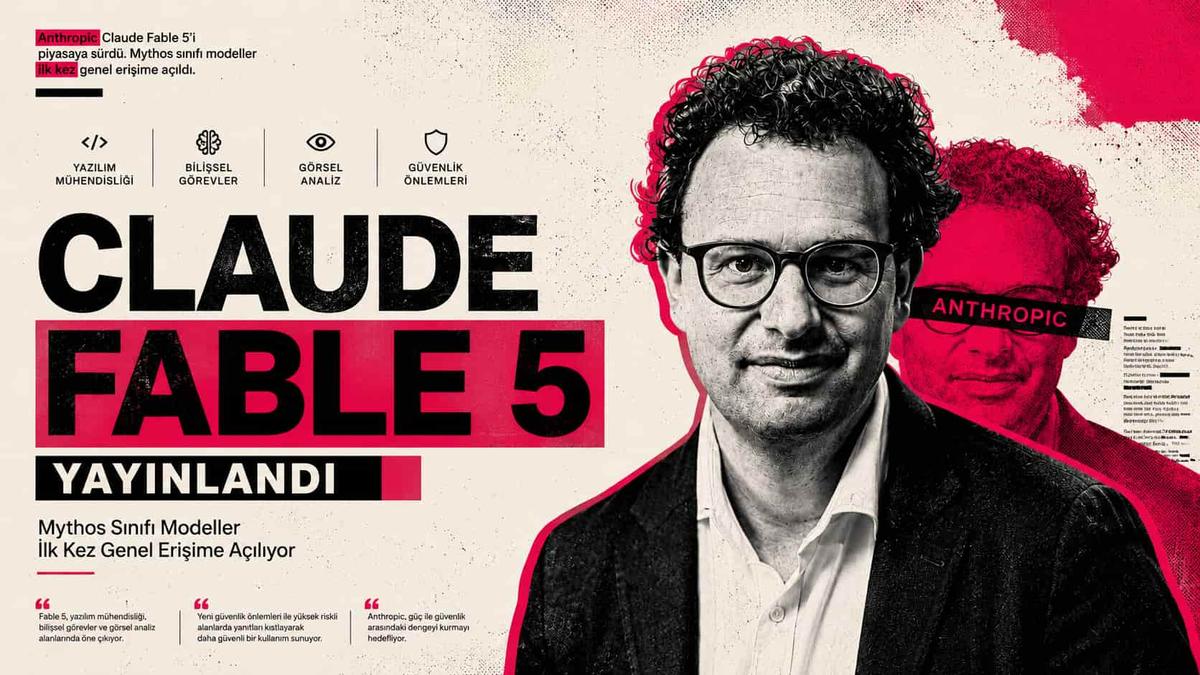
On June 9, Anthropic released Claude Fable 5. This is the first generally available version of the Mythos class. Mythos Preview, released two months earlier, was limited to a small number of organizations working on cybersecurity problems. Now Fable 5 stands out in software engineering, cognitive tasks and visual analysis, while it blocks responses in high-risk areas such as cybersecurity, biology, chemistry and model distillation, falling back to Claude Opus 4.8.
Why Was It Released Two Months Later?
Mythos Preview was published as a preview in April, but due to cybersecurity concerns it was initially restricted to a few partners. The reason was clear: Mythos shows superhuman capabilities in software security. Mythos Preview identified thousands of high-severity security vulnerabilities in major operating systems and web browsers.
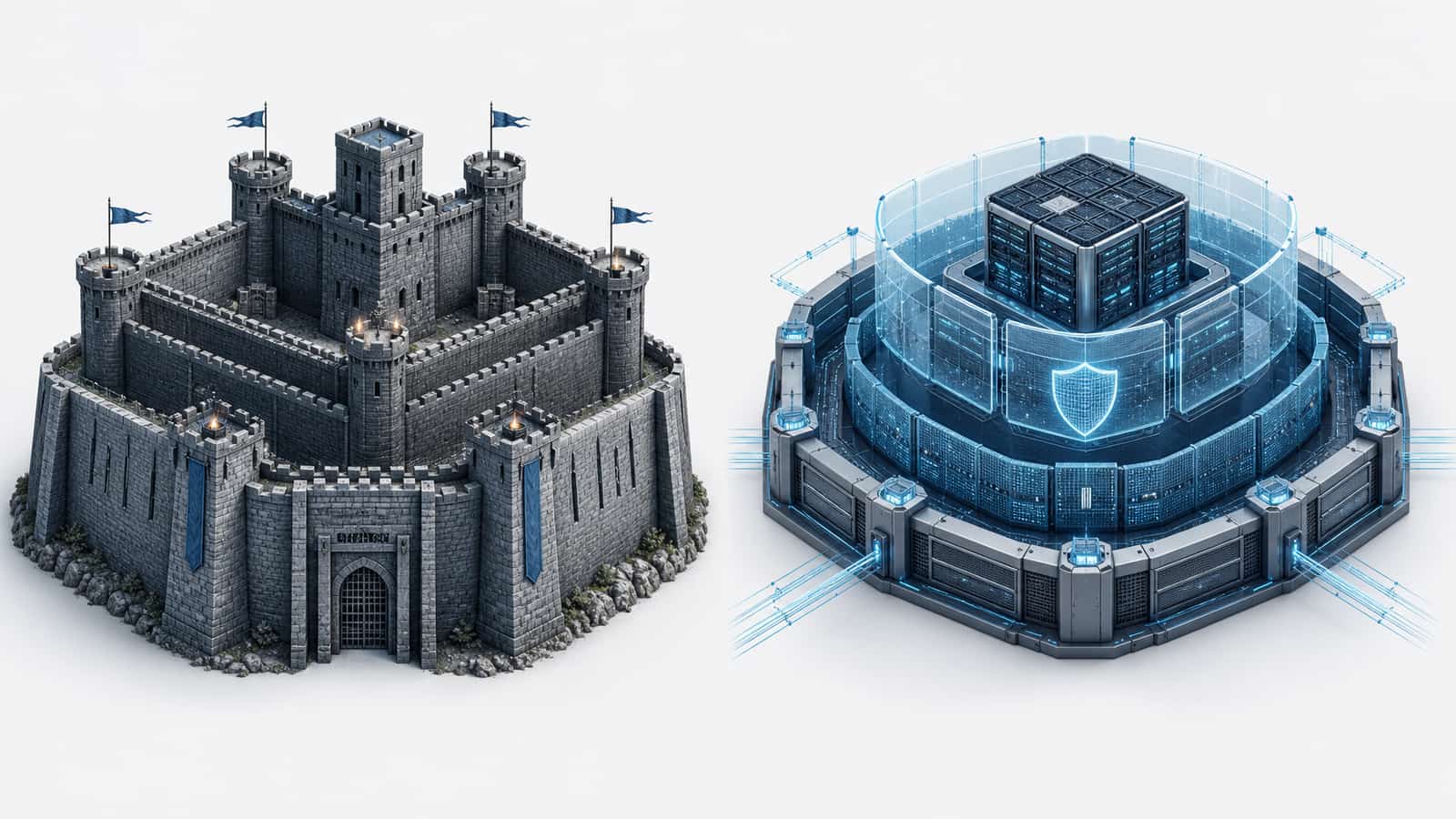
Anthropic's release strategy aims to solve a structural problem: it is not possible to give a model as powerful as Mythos to everyone, but no one wants critical security vulnerabilities to remain unfixed either. The company's solution is to use new security classifiers that can be updated over the internet.
How Do the Safeguards Work?
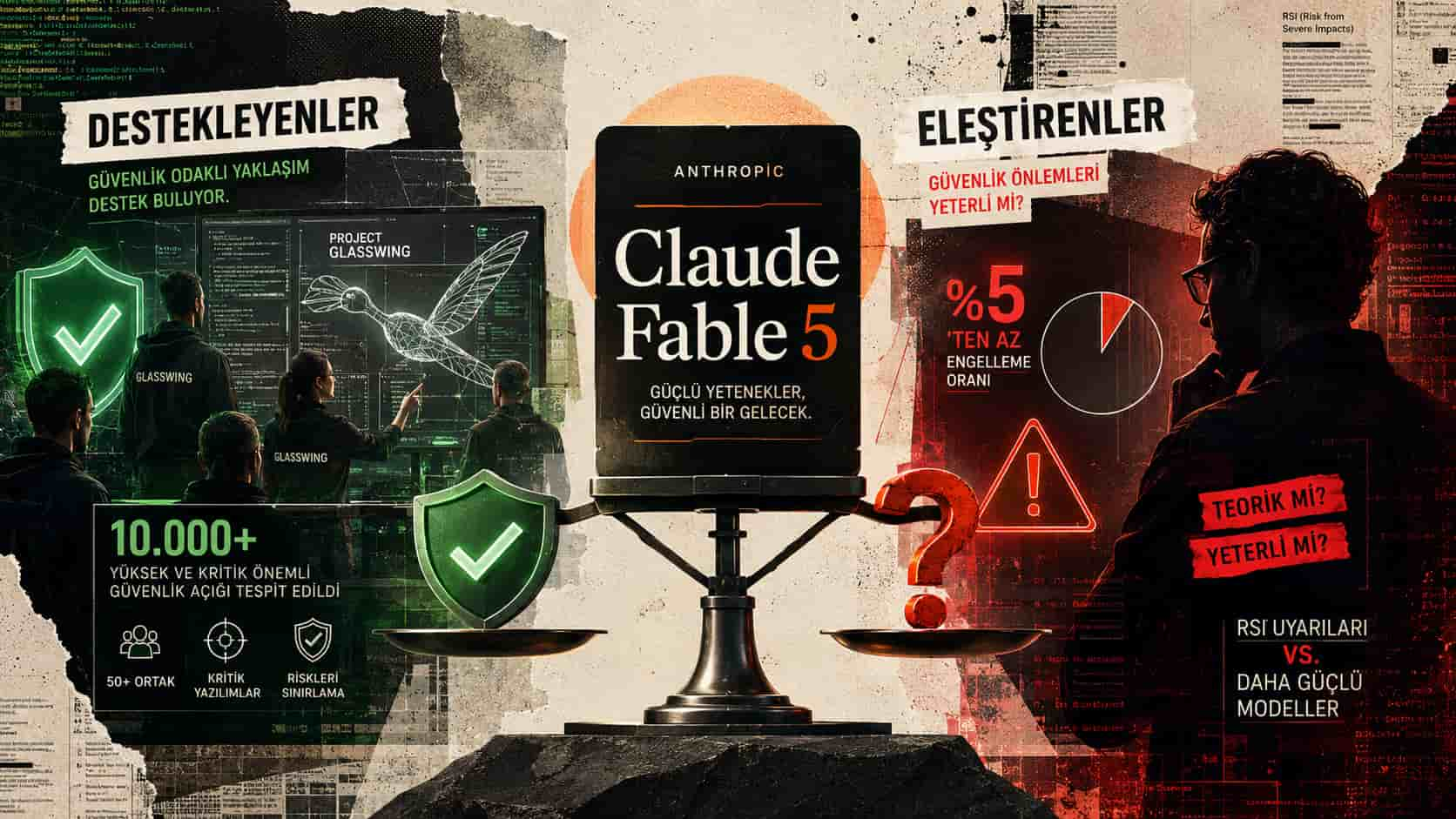
Anthropic released the model with safeguards that block responses on specific topics. These safeguards activate in fewer than 5% of sessions on average. In practice, this means cases where Fable falls back to Opus 4.8 are quite rare. According to early data, at least 95% of Fable sessions are handled entirely by the model's own responses.
Before releasing Fable 5, Anthropic tested the safeguards intensively against jailbreak attempts. The company ran an external bug bounty program with more than 1,000 hours of testing. While no universal jailbreak method was found, independent red team organizations were likewise unsuccessful.

However, this does not mean the model is completely safe. With the release of Fable 5 and Mythos 5, Anthropic will require 30-day data retention for all traffic, despite earlier zero-retention agreements. The company says it will not use this data for training; it will only use it to "develop defenses against complex and new attacks and new jailbreak methods" and to "identify and reduce false positives."
Performance: Benchmark Results
Mythos-class models show significant performance jumps in software engineering. On the SWE-bench Pro test, Fable 5 and Mythos 5 reached an 80.3% success rate, while OpenAI's GPT-5.5 model remained at 58.6%.
Benchmark | Fable 5 | Opus 4.8 | GPT-5.5 |
|---|---|---|---|
SWE-Bench Pro | 80.3% | 69.2% | 58.6% |
FrontierCode Diamond | 29.3% | 13.4% | 5.7% |
Legal (Harvey LAB) | 13.3% | 10.4% | : |
The analytics company Hex says Fable is the first model to reach 90% on a core benchmark used for complex, long-running analytical tasks. The company stated that the model shows "strong reasoning and attention to nuance on the hardest questions."
According to an example from Stripe, Fable 5 completed a code migration on a 50-million-line Ruby codebase in one day, a task that would otherwise take more than two months.
Dual Release: Fable 5 vs Mythos 5
Anthropic is also releasing Claude Mythos 5 for cyber defense experts and infrastructure providers. This model has the same core architecture as Fable 5, but some safeguards in certain areas have been removed. Mythos 5 is initially being offered to the US government through Project Glasswing.
The main difference between the two models is:
Claude Fable 5, the publicly available version supported by security classifiers that route certain queries to Claude Opus 4.8.
Claude Mythos 5, the version that is not publicly available, with some safeguards removed despite being the same base model.

Pricing: Double the Cost
Pricing for Fable 5 and Mythos 5 is set at $10 per million input tokens and $50 per million output tokens. This means roughly twice the cost of Opus 4.8.
This price level may discourage large-scale use. Many organizations have begun to scrutinize AI costs more critically after facing high bills or using up their annual AI budgets early.
The picture is more complex, however. Penn, an Anthropic executive, says pricing is "very important" but stresses that customers are not only looking for low cost. Users want higher accuracy and more value for the money they spend. Early Fable 5 users have also reported improvements in efficiency per task.
Limited Time for Subscription Access
On subscription plans, Fable 5 will be offered at no extra charge on Pro, Max, Team and seat-based Enterprise plans until June 22. Claude API users and usage-based Enterprise plans can access Fable 5 in full starting today. However, starting June 23, Fable 5 will be removed from these plans. After that date, usage credits will be required to use the model.
Why Broad Release Now?
The release of Fable comes at a time when Anthropic, OpenAI and Elon Musk's SpaceX are preparing for public offerings.
In May, Anthropic announced that its run rate revenue reached $47 billion. This figure represents a significant increase from roughly $10 billion in annual revenue last year.
Anthropic's latest funding round valued the company at $965 billion, while OpenAI reached an $852 billion valuation last March. There is a deeper strategic question here, though: Anthropic wants to show that it can keep power under control. If a publicly available model launches successfully with safeguards, the company could strengthen its position among investors as the "responsible frontier" player.
What the Community Thinks
Supporters
Security-focused circles support this approach. Project Glasswing partners are using Mythos Preview to find and fix flaws in critical software. Anthropic and its roughly 50 partners have identified more than 10,000 high or critical severity security vulnerabilities in some of the world's most systemically important software. The public release of Fable aims to maintain this momentum while also limiting risks.
Critics
Some critics think the safeguards remain largely theoretical. It is still unanswered whether a system that blocks fewer than 5% of sessions can meaningfully limit the types of attacks Mythos Preview could uncover. Some observers also find it contradictory that Anthropic warns about RSI while releasing increasingly powerful models.
Frequently Asked Questions
Is Fable 5 completely safe?
No. New attacks are still possible. Safeguards will be tested and updated over time.
Is Fable 5 weaker than Mythos Preview?
Not for general-purpose tasks. However, because it routes some cybersecurity and biology-related queries to Opus 4.8, it behaves more restrictively there. It retains the same strength in software engineering, visual analysis and many other areas.
Why did Anthropic require 30-day data retention?
Limited-term data retention helps detect misuse patterns that cannot be seen in individual sessions. Especially in cybersecurity, some misuse behaviors only become apparent over time.
Can the Stripe example be repeated?
Probably yes, in some cases. Fable 5 appears very strong on long-running, intensive coding tasks. However, Stripe's 50-million-line codebase example is a very specific and high-value use case. Results will vary by organization.
Are other models trying to catch up with Fable 5?
Yes. Fable 5 is ahead of rival models from OpenAI and Google DeepMind in benchmark results for coding, cognitive tasks, scientific research and many other areas. This creates pressure on competitors to accelerate.
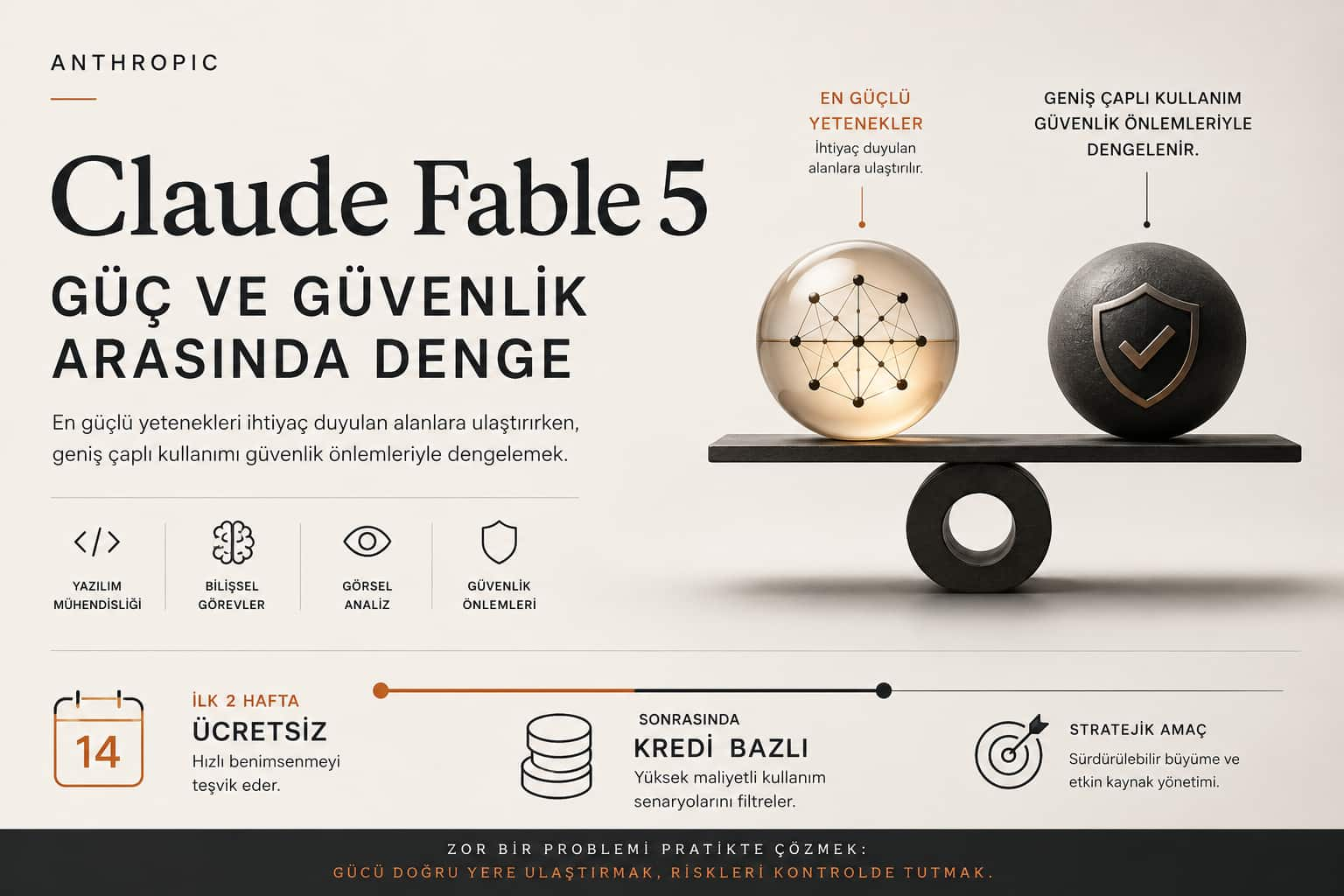
Fable 5 shows that Anthropic is trying to solve a hard problem in practice: delivering its most capable abilities to the areas where they are needed, while balancing broad use with safeguards.
The first two weeks of free access followed by credit-based use also appears to be part of a strategy to encourage rapid adoption while filtering out high-cost usage scenarios.
AdminAI İşsizliği Endişesi CEO Gündeminin Zirvesinde!


FlowX Summit Agentic AI Çağında Yeni İş Gücünü Konuşuyor