
Claude Sonnet 5 Is Out: Opus 4.8-Level Performance at a Lower Price
Automatically translated
 Admin
Agentic coding test: 63.2% versus 69.2%. The gap is a few points, but the price gap is much bigger. Anthropic announced Claude Sonnet 5 on June 30, 2026, bringing it close to Opus 4.8's performance and offering it at a price starting at $2 per million tokens. This article covers Sonnet 5's agent capabilities, its pricing structure, its safety profile, and its place in the race toward an IPO.

What Kind of Model Is Claude Sonnet 5?
According to Anthropic's official announcement, Claude Sonnet 5 is positioned as the company's most agentic Sonnet model so far. The model went live on Tuesday, June 30, 2026, and on the same day became the default model for Free and Pro plans. Max, Team, and Enterprise users can also access it.
Access is not limited to the chat interface. Sonnet 5 is available to developers through Claude Code and the Claude Platform; in the API, it is called with the claude-sonnet-5 string. According to the announcement shared on the AWS Machine Learning blog, the model is also available on Amazon Bedrock, which makes it possible to work with regional data storage in existing AWS environments.
The Sonnet line reflects Anthropic's push toward agents. The path that began with Claude Sonnet 4 continued with Sonnet 4.6, released in February 2026; Sonnet 5 is the latest link in that chain. According to Anthropic, the new model shows clear improvements over its predecessor in core components of agent performance such as reasoning, tool use, coding, and knowledge work.
What Changed in Agent Capabilities?
Sonnet 5's main claim centers on agent tasks. The model can make plans, use tools such as a browser and a terminal, and carry out work that, a few months ago, required larger models. According to Anthropic, the most notable difference is that the model sees tasks through to the end instead of abandoning them midway.
Observations from early access testers point the same way. According to a VentureBeat report, Cursor co-founder Sualeh Asif summarized Sonnet 5's impact on agent workflows this way:
"With Claude Sonnet 5, agents stick to the plan, follow our rules, and complete multi-step changes at an efficient cost." (Sualeh Asif, Cursor co-founder)
In an example shared in Anthropic's announcement, the Zapier team gave the model a two-stage task: updating Salesforce account tiers and sending an announcement to enterprise contacts. Sonnet 5 finished the job from start to finish. Earlier models abandoned tasks of this kind. There is also a new control on the user side: the effort level. With Sonnet 5, the effort setting can be adjusted to balance cost and performance between Sonnet 5 and Opus 4.8. Anthropic also raised rate limits in Chat, Cowork, and Claude Code to accommodate the token usage that higher effort levels require.

The Difference Between Sonnet 5 and Opus 4.8
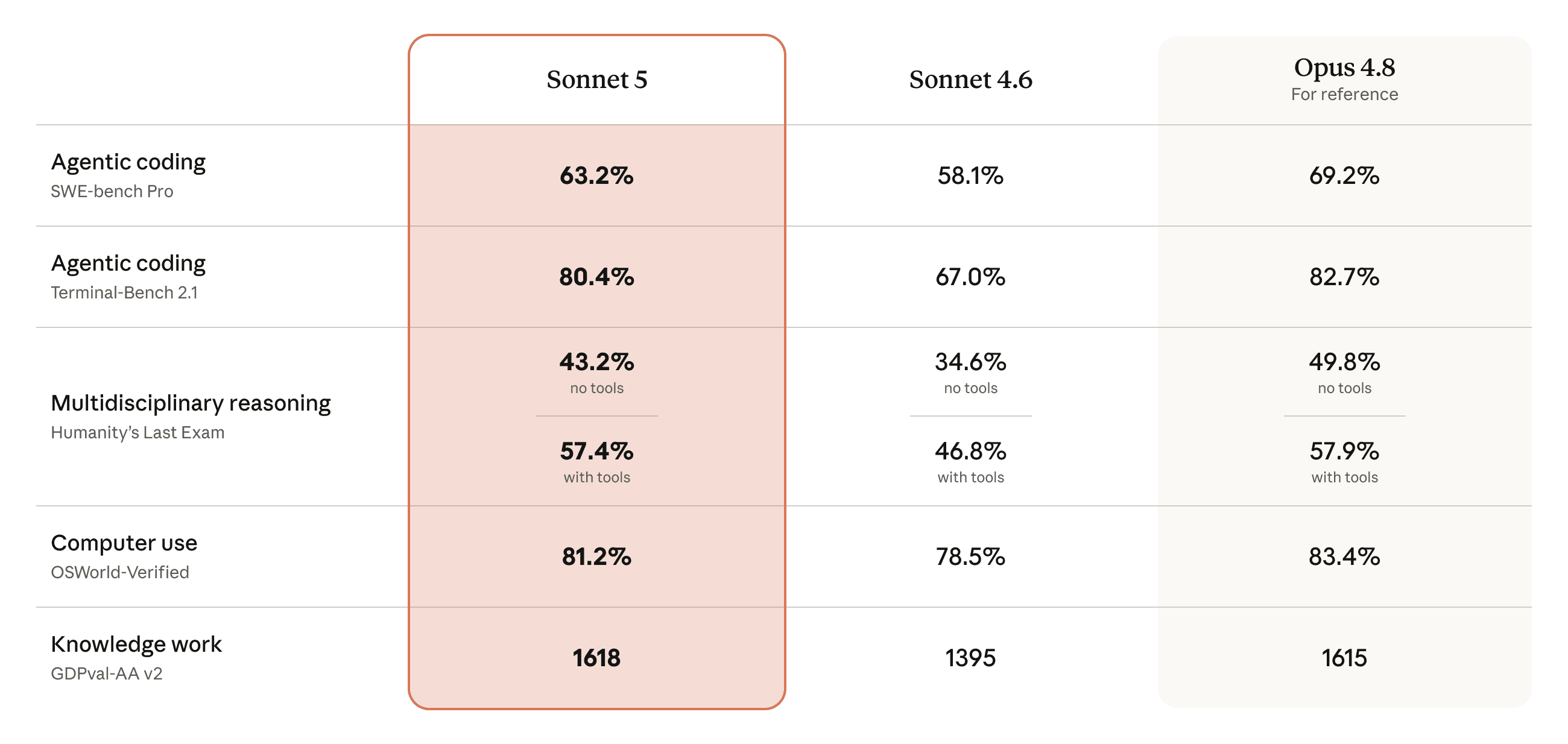
The benchmark table shows where the two models diverge. According to the results Anthropic shared, Sonnet 5 scored 63.2% on the agentic coding test, Opus 4.8 scored 69.2% on the same test, and its predecessor Sonnet 4.6 stayed at 58.1%.
Model | Agentic Coding |
|---|---|
Claude Opus 4.8 | 69.2% |
Claude Sonnet 5 | 63.2% |
Claude Sonnet 4.6 | 58.1% |
On the knowledge work side, the picture changes. According to Anthropic's data, Sonnet 5 narrowly beats Opus 4.8 on this test, and Sonnet 5 can even pull ahead on tasks requiring deep research and demanding reasoning. According to an analysis published in The New Stack, Sonnet 5 did not beat the latest Opus release, but it narrowed the gap enough to offer an affordable alternative to Opus 4.8. At the highest reasoning level (Extra High), Sonnet 5 produces results close to Opus 4.8 at its medium-high setting on the OSWorld-Verified and BrowseComp tests. However, because this level costs more to run than Opus 4.8, Opus is still preferred for some tasks.
How Is Pricing Structured?
Price is Sonnet 5's most visible advantage. The model launched with an introductory price of $2 input and $10 output per million tokens. This rate is valid until August 31, 2026; after that, the price rises to $3 input and $15 output per million tokens.
Model | Introductory Rate | Standard Rate |
|---|---|---|
Claude Sonnet 5 | $2 / $10 | $3 / $15 |
Claude Opus 4.8 | None | $5 / $25 |
(Prices are input / output values per million tokens.)
Compared with Opus 4.8, which costs $5 input and $25 output per million tokens, Sonnet 5 sits well below. According to a TechCrunch report, the model is also cheaper than OpenAI's GPT-5.5 and Google's Gemini 3.1 Pro, although Gemini 3.5 Flash is still priced below Sonnet 5. According to Anthropic, Opus 4.8 will remain the preferred choice for work requiring high accuracy, but Sonnet 5 offers a price-performance balance that was not previously possible. The pricing logic of the Claude product tiers is also built on this balance of speed, cost, and capability.

What About Safety?
According to Anthropic's safety evaluations, Sonnet 5 shows a lower rate of unwanted behavior than its predecessor Sonnet 4.6 and is considered safer in agent contexts. The model is also more successful at refusing malicious requests and fending off prompt injection attacks. Its hallucination and sycophancy rates are below those of Sonnet 4.6.
Cybersecurity is a separate topic. Sonnet 5 was released with cyber safeguards enabled by default, but these safeguards are not as strict as the tight restrictions that led to Fable 5 being withheld from access. According to VentureBeat, in an open-development exploit test with Mozilla on Firefox 147, neither Sonnet model could produce a working exploit and both scored 0.0%. On partial success, Sonnet 5 reached 13.2%, slightly above Sonnet 4.6's 8.8%. In the same test, Opus 4.8 reached a working exploit rate of 68.8%, and Mythos 5 reached 88.4%. According to Anthropic, Sonnet 5 was not specifically trained for cyber tasks, and its performance in this area trails the Opus models significantly.

Sonnet 5 in the IPO Race
The timing of Sonnet 5 overlaps with Anthropic's financial calendar. According to Yahoo Finance, the company confidentially filed for an IPO on June 1, and the launch came at a time when its valuation was moving toward roughly $1 trillion. Offering a cheaper flagship alternative is being read as part of a strategy to attract cost-focused enterprise developers.
Price pressure is not unique to Anthropic. Sonnet 5 is positioned with a price advantage against the top-tier models from OpenAI and Google. Anthropic's flagship line, which gained momentum with Claude Opus 4.5, has extended to Opus 4.8. Unlike earlier Sonnet launches, Sonnet 5 did not surpass the latest Opus release. In The New Stack's analysis, this was interpreted as a sign that Opus 5 may not be far away.

What Is the Community Saying?
Supporters
On the developer side, the standout point is the ability to use a model close to Opus-level performance at a lower cost. Lovable co-founder Fabian Hedin said the model refuses unsafe requests cleanly and consistently. Feedback from Zapier suggests the model has become the preferred choice for daily automation. Completing tasks without abandoning them is the most frequently cited benefit among teams building agent workflows.
Critics
Criticism centers on the fact that the model could not surpass the latest Opus; some users see this as gradual progress rather than a major leap. The rise in partial cyber capabilities compared with its predecessor raises the question of why default safeguards are kept on. The fact that the introductory price ends on August 31 also raises doubts about whether the cost advantage is lasting. Part of the open-source community, meanwhile, maintains its general distance from closed models.

Frequently Asked Questions
When was Claude Sonnet 5 released? Claude Sonnet 5 was released on Tuesday, June 30, 2026. The same day, it became the default model for Free and Pro plans, and it became available through Max, Team, Enterprise, Claude Code, and the Claude Platform. The model is also available on Amazon Bedrock.
How much does Claude Sonnet 5 cost? Sonnet 5 launched with an introductory price of $2 input and $10 output per million tokens. This rate is valid until August 31, 2026; after that, it rises to $3 input and $15 output per million tokens. It is priced below Opus 4.8's $5 input and $25 output.
Is Claude Sonnet 5 better than Opus 4.8? Not in most tests. On the agentic coding test, Opus 4.8 (69.2%) is still ahead, while Sonnet 5 scores 63.2%. On the other hand, Sonnet 5 narrowly beats Opus 4.8 on the knowledge work test, and its price is significantly lower.
Is Claude Sonnet 5 accessible in Turkey? Yes. Claude was previously opened for free use in Turkey, and since Sonnet 5 is the default model on the Free plan, users in Turkey can also access it. Developers can call the model through the API using the claude-sonnet-5 string.
What is Claude Sonnet 5's context window? The official announcement and system card did not share a clear context window figure. Claims of a 1 million token context and a January 2026 knowledge cutoff have circulated on social media, but Anthropic has not confirmed these details. For now, these claims remain speculation.
Is Claude Sonnet 5 safe from a cybersecurity standpoint? Anthropic released the model with default cyber safeguards. In the Firefox 147 exploit test, the model could not produce a working exploit and scored 0.0%. Because its cyber performance trails the Opus models, the safeguards were not kept as strict as those for Fable 5.
Developers are expected to test Sonnet 5 on real workloads before August 31, 2026, when the introductory price ends. How users will balance it against Opus 4.8 across different tasks will become clearer in the coming months. When Opus 5 will arrive remains an open question for now.
AdminClaude Code Kullanımı İçin Beklenmedik Verimlilik Dersi


Claude Fable 5 ve Mythos 5 Erişimi Yeniden Açılıyor