



GPT-5.5: A New Milestone in the Age of Autonomous AI
Automatically translated
 Creator
April 23, 2026 has been recorded as a new milestone for the technology world and the software ecosystem. OpenAI has officially announced GPT-5.5, its long-awaited next-generation flagship model, known during development by the codename "Spud." The traditional chatbot approach, which defined the past decade and required users to give step-by-step instructions, is giving way with this model to a truly autonomous AI system that can manage tasks end to end on its own.
For developers, technology leaders, and businesses, the focus is no longer on getting the smartest answer, but on being able to hand off the most complex and messy work to AI.
GPT-5.5 | GPT-5.4 | GPT-5.5 Pro | GPT-5.4 Pro | Claude Opus 4.7 | Gemini 3.1 Pro | ||
|---|---|---|---|---|---|---|---|
Terminal-Bench 2.0 | 82.7% | 75.1% | - | - | 69.4% | 68.5% | |
Expert-SWE(Internal | 73.1% | 68.5% | - | - | - | - | |
GDPval(wins or ties | 84.9% | 83.0% | 82.3% | 82.0% | 80.3% | 67.3% | |
OSWorld-Verified | 78.7% | 75.0% | - | - | 78.0% | - | |
Toolathlon | 55.6% | 54.6% | - | - | - | 48.8% | |
BrowseComp | 84.4% | 82.7% | 90.1% | 89.3% | 79.3% | 85.9% | |
FrontierMath Tier 1-3 | 51.7% | 47.6% | 52.4% | 50.0% | 43.8% | 36.9% | |
FrontierMath Tier 4 | 35.4% | 27.1% | 39.6% | 38.0% | 22.9% | 16.7% | |
CyberGym | 81.8% | 79.0% | - | - | 73.1% | - |
A Architecture Built From Scratch and a Native Omnimodal Design
GPT-5.5 is not just a polished version of the previous release; it is the first model since GPT-4.5 whose base weights were trained entirely from scratch. One of the most revolutionary aspects of the model is that it processes text, audio, images, and video natively as "omnimodal" within a single, unified architecture, rather than through separate modules.
At the same time, one of the innovations that excites users most is that the model has a full 1 million token context window. This capacity allows it to hold the entire codebase of a large software project, thousands of pages of contracts, or long video recordings in memory at once, and reason over them without loss.
On the hardware side, there is a significant collaboration. The model was optimized through hardware-software co-design directly on NVIDIA's latest GB200 and GB300 NVL72 server systems. As a result, despite a significant increase in the model's capacity and reasoning depth, its response speed was kept at the same level as GPT-5.4.
Head-to-Head With Rivals: Claude Opus 4.7 and Gemini 3.1 Pro
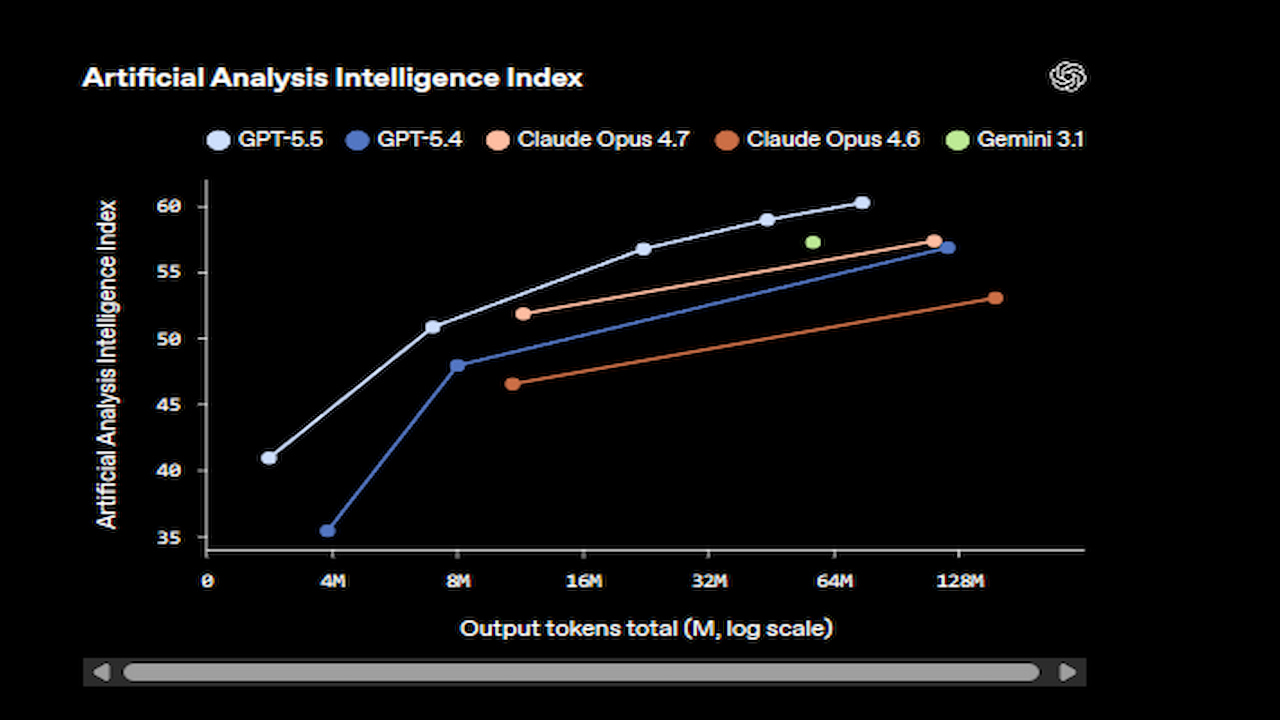
In today's AI ecosystem, the race for leadership is never one-sided. GPT-5.5 manages to outperform strong rivals such as Claude Opus 4.7 and Gemini 3.1 Pro, especially when it comes to managing complex workflows on a computer and autonomous coding.
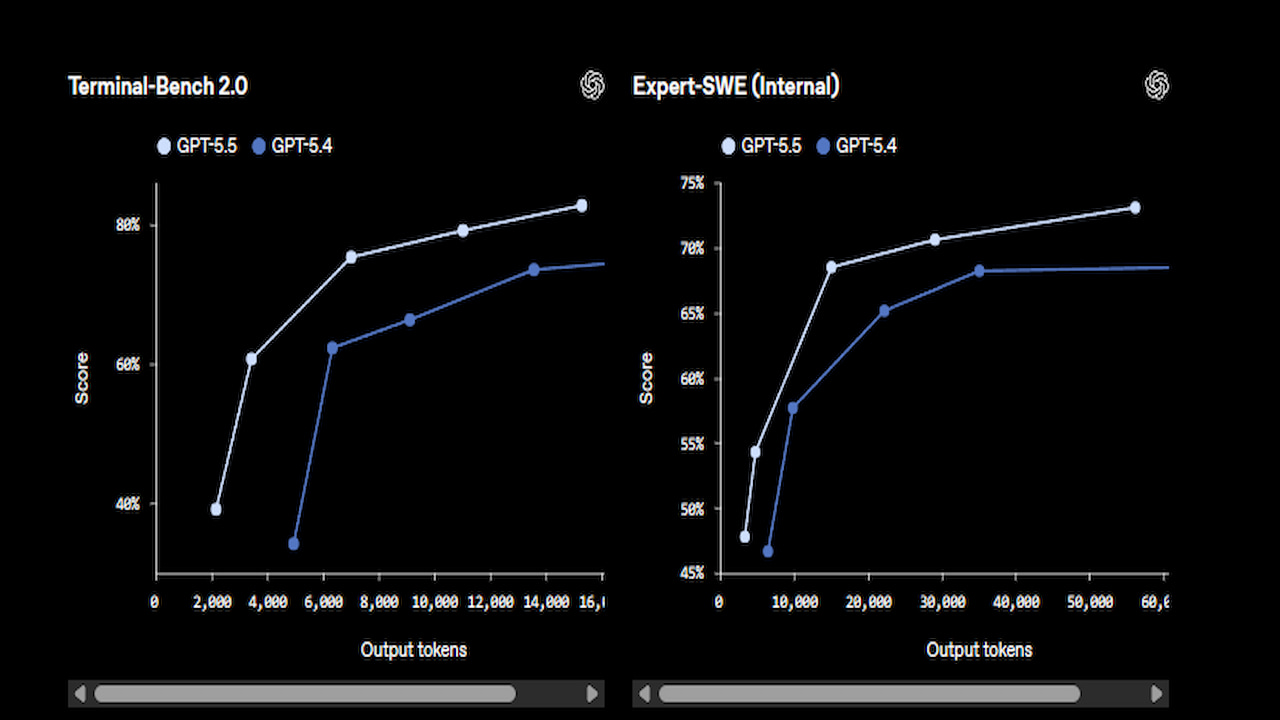
On the Terminal-Bench 2.0 test, which measures independent tool use and planning in a terminal, GPT-5.5 reached an impressive 82.7%, opening a significant gap over Claude Opus 4.7 at 69.4% and Gemini 3.1 Pro at 68.5%. On OSWorld-Verified, which measures real-world computer use, it scored 78.7%, surpassing human-level benchmarks and demonstrating how skilled it is at autonomous navigation across systems.
However, leadership changes hands on the SWE-bench Pro test, which requires solving real-world GitHub issues. In this area, Anthropic's flagship Claude Opus 4.7 leads with 64.3%, ahead of GPT-5.5 at 58.6%. According to experienced engineers in the industry, Claude Opus 4.7 offers sharper insight into strategic planning, designing the right architecture, and anticipating edge cases. GPT-5.5, on the other hand, stands out as an excellent implementer that integrates a given plan into the codebase with relentless speed and confidence, unafraid to take risks. For now, the most flawless autonomous coding experience is achieved with hybrid workflows that hand planning to Claude and implementation to OpenAI's new assistant.
A New Era in Cost, Efficiency, and Drug Discovery
The cost side of the latest technology also affects businesses. OpenAI doubled its API prices compared with the previous generation, setting a price of 5 dollars per million input tokens and 30 dollars per million output tokens. However, the company says that the model completes tasks successfully faster and falls into faulty loops less often, so with token savings of up to 40%, the actual cost of use has not risen as much as one might expect.
It is also worth noting that this launch wave is not limited to software. In the same period, OpenAI introduced another niche frontier model, GPT-Rosalind, developed specifically for life sciences, drug discovery, and genetics. Available only through special access, this model performs better than 95% of expert biologists on RNA function prediction, opening the door to dramatically shortening research and development processes that have taken decades in medicine.
In conclusion, GPT-5.5 transforms AI from a passive question-and-answer tool into a dynamic teammate that works on its own initiative, conducts research, and writes code. Although it still trails some rivals in pure knowledge recall and depth of planning, its 1 million token context window, built-in computer use, and speed advantage make it, without question, the most functional professional work engine of 2026. The question professionals should ask themselves is no longer "What should I ask the AI?" but "Which complex process should I fully hand over to it?"
CreatorYazılım ve Oyun Sektörüne %100 Vergi İstisnası Geldi!


Claude Opus 4.7: Yeni Nesil Yapay Zeka Ekosistemi


