




OpenAI's New Policy Agenda: Democracy and Safety
Automatically translated
 Admin
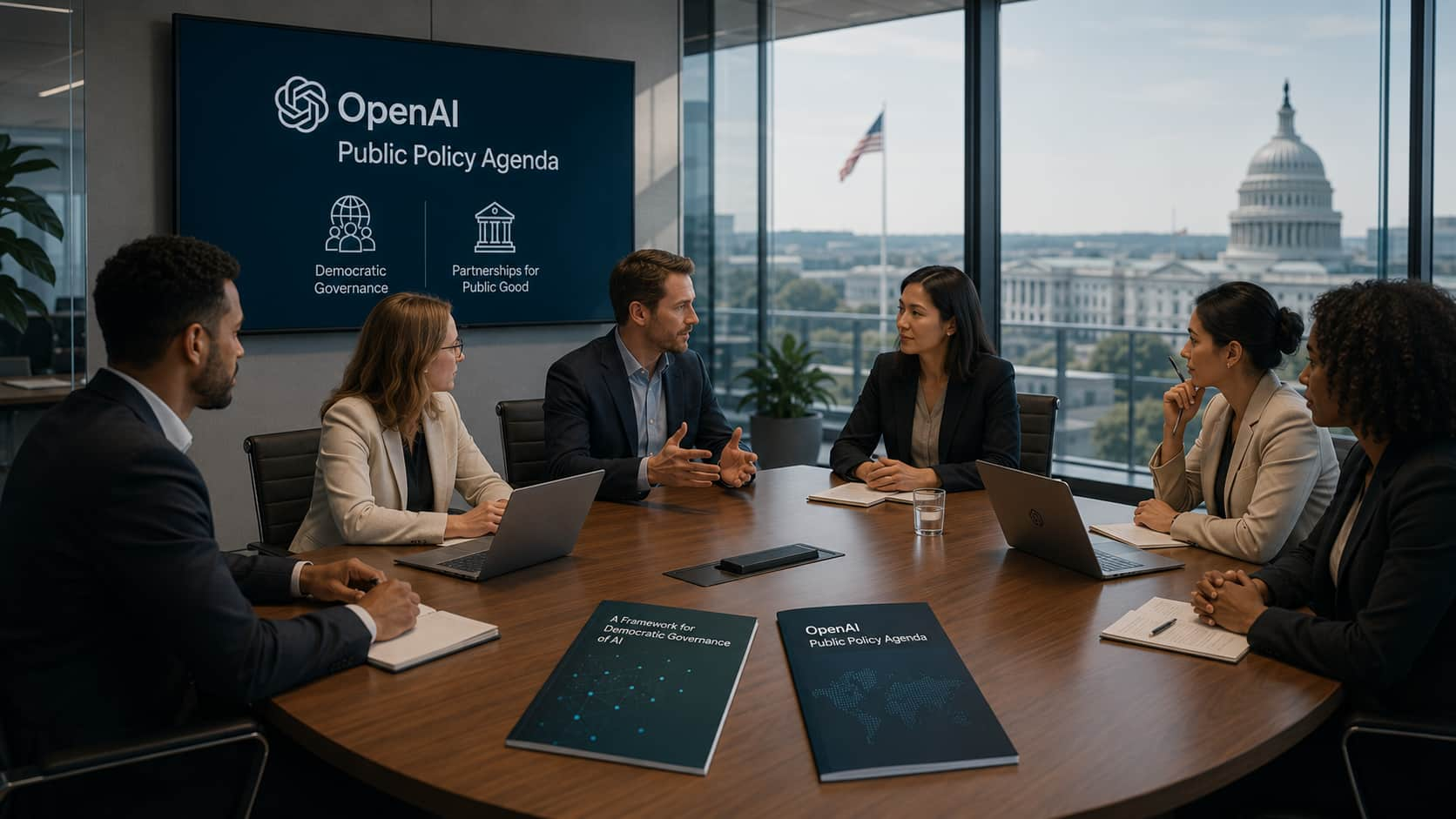
The public policy agenda OpenAI published in March 2026 marks a turning point in the AI industry. As the market leader, OpenAI is no longer content to only build technology: it is now writing the rules of the game. On June 3, two documents were announced: a framework for the democratic governance of AI and the public policy agenda that shows where the company wants to work with governments and civil society.
OpenAI's Mission Is Being Redefined
OpenAI's mission is to ensure that artificial general intelligence (AGI) benefits all of humanity. However, while the founding document from 2018 mentions AGI twelve times, the 2026 version mentions it only twice. This is not just an editorial change: there is a fundamental shift in how OpenAI sees itself. It is moving from a research lab racing toward AGI to a company that deploys AI systems at scale and can no longer postpone questions of governance and social impact.
Five Principles, a Much Broader Goal
Five core principles guide OpenAI's work.
Democratization: Resistance to power concentrating in the hands of a few companies.
Empowerment: Belief that AI can help everyone reach their goals.
Universal prosperity: A desire for a future in which everyone can live a flourishing life.
Resilience: AI will create new risks, and companies, ecosystems, governments and society need to cooperate to address them.
Adaptability: The only way to deal with a highly unpredictable future is to be ready to update positions as we learn.
Beyond the wording, these principles point to a set of strategic issues that are not purely commercial. The 2018 document was built on first-person plural commitments written in the language of "we will do it." The 2026 document speaks to a broader ecosystem: governments should consider new economic models, the world needs large investments in AI infrastructure, and fundamental decisions about AI should be made through democratic processes.

Youth Safety Is at the Heart of the Policy Agenda
A central topic on OpenAI's agenda is frontier AI safety, which the company treats as a national and public safety priority. It supports aligning standards for state-level frameworks, risk assessments, and accountability for advanced AI models.
Youth safety is another critical area. OpenAI advocates risk-based regulation that requires age-appropriate protections, age verification mechanisms that protect privacy, and accessible parental controls. It also supports strong safeguards against harmful content and manipulative interactions, as well as accountability mechanisms such as independent audits.
Distributing Power, Sharing Risk
OpenAI commits to providing access that helps workers gain practical AI skills and prepare for economic change. It also supports measures that increase transparency for workers and employers about how AI is reshaping work. OpenAI's workforce and economic transformation agenda includes collaboration on policies covering portable social benefits, tax modernization, public wealth funds, and strong social safety nets.

Democracy Theater, Institutional Architect
Reading between the lines of the research reveals a notable fact. OpenAI no longer just wants to comply with AI rules: it wants a say in designing the institutions that will enforce them.
Sam Altman's visits to Washington are part of this broader policy agenda. While promoting a vision of public-private collaboration on AI, the company is also discussing mechanisms to ensure that the large economic value created by AI reaches consumers.
What Is the Community Saying?
Supporters
Some views from the press, research institutions and civil society organizations argue that OpenAI's participation in policy processes could close a governance gap. Education and healthcare sectors believe that large-scale deployment of commercial AI tools needs this kind of public guidance. Some policymakers consider a shared framework better than having private companies write their own rules.
Critics
Others point to undisclosed risks. The statement "we have a first responsibility to humanity" from the 2018 document does not appear in the 2026 version. Some argue that this reflects a fundamental change in approach. Some observers also see OpenAI's emphasis on opposing any organization, including itself, concentrating AI power in one hand as a public response to growing criticism.
Frequently Asked Questions
What does OpenAI's "democratization" principle mean?
OpenAI says it opposes the concentration of AI power in a single hand. It also argues that fundamental decisions about AI should be made not only by labs but through democratic processes and in line with egalitarian principles. In other words, power must be shared; otherwise the risk of centralization will grow.
Could these policies halt AGI?
No. OpenAI views frontier AI safety as a matter of national and public security. It believes the most advanced AI models could pose serious risks in cybersecurity, chemistry, biology, radiology and nuclear (CBRN) domains. In the United States, it supports regulatory frameworks that include transparency, publicly available catastrophic risk assessments, and enforceable accountability mechanisms.
How closely does OpenAI work with governments?
The documents reference initiatives such as California's SB 53, New York's RAISE Act, Illinois' SB 315, the Center for AI Standards and Innovation (CAISI), and the President's Executive Order on Promoting the Development and Security of Advanced AI Innovation. OpenAI also states that it has voluntary agreements with both the US CAISI and the UK AI Security Institute, and that it has signed the EU AI Act Code of Practice.
What content areas do youth protection policies cover?
These include age verification requirements that protect privacy, regular youth safety risk assessments, accessible parental controls, and clear youth safety policies. They also cover harmful or age-inappropriate content young people may encounter when interacting with AI tools, serious safety incidents, and protective mechanisms against manipulative or misleading interactions.
Will this policy agenda turn into federal regulation?
It is not yet known. Government initiatives will depend on the political priorities of the Trump administration and on bipartisan negotiations in Congress. However, given the institutional governance structure OpenAI is aiming for, it seems likely that these ideas will eventually take shape through regulatory mechanisms.
At the very least, OpenAI is talking. In the long run, the conversation itself, and who is having it, may matter as much as the governance it produces.
AdminEndava'nın AI Ajanlarla Yazılım Teslimatı Dönüşümü


OpenAI Yapay Zekanın Yönetiminde Üç Adımlı Plan Sundu


