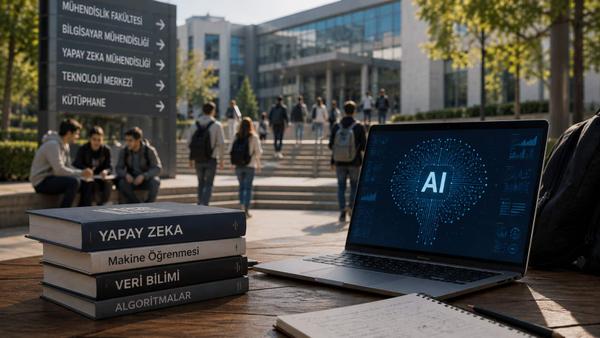
TEKNOFEST and Türkiye's AI Ecosystem
Automatically translated
 Writer
Türkiye's artificial intelligence ecosystem is evolving into a broad structure that brings together public policies, universities, research centers, technology startups, investment mechanisms, data infrastructure, and human resources. The growing use of artificial intelligence across various sectors, from manufacturing and finance to education and healthcare, makes Türkiye's capacity in this field important not only for technology companies but also for the overall transformation of the economy.
Türkiye's approach to artificial intelligence has expanded in recent years, moving from strategy documents toward implementation programs. The Türkiye Artificial Intelligence Action Plan, announced in 2026, established concrete targets across various areas, from human resources and data infrastructure to entrepreneurship and computing power. In addition, TEKNOFEST competitions, TÜBİTAK support programs, and university research stand out as mechanisms supporting different layers of the ecosystem.
What Is Türkiye's Artificial Intelligence Ecosystem?

The Türkiye artificial intelligence ecosystem consists of much more than AI companies alone. It brings together public institutions, universities, research centers, entrepreneurs, investors, technology providers, and companies that use AI solutions.
The ecosystem's primary goal is to move artificial intelligence technologies from the research stage into real-world applications. Achieving this requires establishing connections between qualified human resources, high-quality data, sufficient computing infrastructure, investment, academic knowledge, and the actual needs of businesses.
The Türkiye Artificial Intelligence Action Plan, published by the Ministry of Industry and Technology, includes important targets for developing this structure in the coming period. These include increasing AI literacy, training specialists and application professionals, improving access to public data, and expanding data center capacity.
From Türkiye's Artificial Intelligence Strategy to the Action Plan

Türkiye's artificial intelligence policies gained a more systematic framework with the National Artificial Intelligence Strategy covering the 2021-2025 period. As of 2026, the objectives for the new period have been expanded through the Türkiye Artificial Intelligence Action Plan 2026-2030. This action plan is also among the Ministry of Industry and Technology's current strategy documents.
The plan announced for the 2026-2030 period is built around four fundamental pillars: recognize, benefit, produce, and govern. This approach focuses not only on developing artificial intelligence but also on helping society understand it, promoting its use in the public and private sectors, producing domestic technologies, and governing the ecosystem.
One of the targets announced under the plan is to provide training to 5 million citizens within two years through AI literacy workshops in all 81 provinces. In addition, the goal is to train 10,000 advanced AI specialists and 100,000 AI application professionals.
On the data front, the plan aims to make at least 2,000 public datasets accessible through the National Data Library, particularly in fields such as healthcare, agriculture, defense, and e-commerce. Increasing the installed capacity of data centers to at least 1 GW by 2030 is also among the announced targets.
How Widely Do Companies in Türkiye Use Artificial Intelligence?
One way to measure the development of Türkiye's artificial intelligence ecosystem is to examine the extent to which companies use these technologies. According to the results of TÜİK's 2025 Information and Communication Technology (ICT) Usage Survey in Enterprises , 7.5 percent of enterprises with 10 or more employees reported using at least one artificial intelligence technology.
This rate stood at 2.7 percent in 2021. Looking at 2025 figures by employee count, AI adoption was measured at 6.6 percent among enterprises with 10-49 employees, 9.6 percent among those with 50-249 employees, and 24.1 percent among enterprises with 250 or more employees. In the information and communication sector, the rate reached 47.1 percent.
These figures show that artificial intelligence adoption is increasing among businesses in Türkiye. However, the differences in adoption rates according to company size and sector also reveal that the ecosystem has not yet reached the same level across all businesses.
For users looking to compare AI tools for business purposes, the Best Artificial Intelligence Platforms in Türkiye guide is an important resource for evaluating platforms designed for different use cases.
What Does TEKNOFEST Offer in the Field of Artificial Intelligence?

One of the most visible areas of Türkiye's artificial intelligence ecosystem for young people and developers is the TEKNOFEST competitions. The Artificial Intelligence Language Agents Competition, featured in the 2026 program, focuses on large language models, natural language processing, multimodal artificial intelligence, and intelligent agent technologies.
The competition revolves around three different real-world scenarios. One involves using multi-agent systems in public document processing and official correspondence workflows. The second scenario focuses on analyzing financial texts in participation banking and extracting meaningful information. The third scenario involves developing multimodal systems capable of detecting events and risks from video data and generating decision-support outputs.
This approach is important because participants are not expected to develop models that merely function from a technical perspective. The goal is to create solutions that address real problems, work with data, and result in practical, implementable systems.
What Do TEKNOFEST Artificial Intelligence Competitions Offer Students?

For students studying artificial intelligence, competitions offer an opportunity to turn theoretical knowledge into practical applications. There is a significant difference between developing a machine learning model as part of a course and preparing data, building a model, evaluating results, and delivering a working application to solve a real-world problem.
For this reason, competitions such as TEKNOFEST can also help students build their portfolios. GitHub projects, technical reports, and teamwork are particularly valuable in demonstrating not only what students know but also how effectively they can apply that knowledge.
How Does the Ecosystem Work for Turkish Artificial Intelligence Startups?

One of the most important factors in startup growth is the ability to turn a technical idea into a solution that addresses an actual customer need. Some of the support mechanisms in Türkiye are designed to strengthen this connection.
A current example of this is TÜBİTAK's 1711 Artificial Intelligence Ecosystem Call. The program envisions bringing together customer organizations that need AI solutions, technology provider companies, and universities or public research centers.
Five priority areas have been identified for the 2026 call: smart manufacturing systems, smart agriculture-food-livestock, financial technologies, climate change and sustainability, and smart education technologies.
An important aspect of this model is that AI research is directed toward problems directly encountered by businesses. This allows technical knowledge developed at a university to be applied to an actual business problem through a technology provider company.
Why Is the TÜBİTAK Artificial Intelligence Ecosystem Call Important?

The 1711 program is one of the mechanisms bringing together academia, businesses, and end users within Türkiye's artificial intelligence ecosystem. According to TÜBİTAK, the program aims to help transform AI technologies into products or solutions based on the needs of customer organizations.
An important update was also made to the application process for the 2026 call. In its announcement dated September 16, 2026, TÜBİTAK stated that the application deadline had been extended to October 2, 2026, at 23:59.
What Role Does the Artificial Intelligence Institute Play in the Ecosystem?
The TÜBİTAK Artificial Intelligence Institute is positioned as one of the key components of Türkiye's institutional research capacity in artificial intelligence. The institute plays a role in efforts to establish connections between academic knowledge and the needs of industry.
Türkiye's work in Turkish-language technologies is also noteworthy within this structure. According to TÜBİTAK sources, various foundation models have been developed using different architectures as part of the Turkish Large Language Foundation Model Project. At the current stage, the largest model has been trained on 300 billion Turkish tokens.
The importance of such projects goes beyond developing a new language model. Expanding research capacity in areas such as Turkish-language data, natural language processing, local terminology, and use cases specific to Türkiye can contribute to diversifying local AI applications.
Why Is Data Critical to the Artificial Intelligence Ecosystem?

Data plays a critical role in the performance of artificial intelligence systems. Just as important as model architecture and computing power are the quality, scope, and freshness of the data being used, as well as whether it can be accessed in compliance with applicable laws.
The Türkiye Artificial Intelligence Action Plan aims to make at least 2,000 public datasets accessible through the National Data Library. The specific emphasis on areas such as healthcare, agriculture, defense, and e-commerce demonstrates that public data is being considered a resource capable of supporting AI applications across different sectors.
The key issue here is not simply collecting more data. Standardizing and anonymizing data, establishing access conditions, and ensuring secure usage are also critical to the development of the ecosystem.
Why Are Computing Power and Data Centers Important?

Training and running large artificial intelligence models can require substantial computing power. Therefore, evaluating the AI ecosystem solely in terms of software and human resources is not sufficient.
Under the Türkiye Artificial Intelligence Action Plan, the goal is to increase the installed capacity of data centers to at least 1 GW by 2030. The plan also предусматриes regulations aimed at developing data centers in compliance with international standards and energy efficiency requirements.
Increasing computing capacity is important because it enables researchers, startups, and companies to train larger models or adapt existing models to their specific needs. However, this capacity must also be considered in terms of energy consumption, costs, and sustainability.
Why Are Human Resources Important to Türkiye's Artificial Intelligence Ecosystem?

Developing technological infrastructure alone is not enough. Skilled professionals are needed to design, develop, test, and integrate AI projects into business processes.
TÜİK's 2025 survey also highlights one of the major challenges in this area. Among enterprises that have considered using artificial intelligence but have not yet adopted it, one of the most prominent reasons is a lack of expertise. This creates a need for training at various levels, ranging from basic AI literacy to advanced model development.
The inclusion of targets to train 10,000 advanced AI specialists and 100,000 AI application professionals in Türkiye's 2026-2030 action plan also demonstrates that human resources are being addressed at the policy level.
How Can Students Get Started in Artificial Intelligence?
Learning just one programming language may not be enough for students who want to enter the field of artificial intelligence. Building a foundation in areas such as Python, data analysis, machine learning, natural language processing, computer vision, and large language models can provide a useful starting point.
Developing projects is equally important. Building a simple data analysis project, a text classification model, an image processing application, or a small AI agent helps students apply what they have learned to real-world problems.
What Does Türkiye's Artificial Intelligence Ecosystem Mean for Entrepreneurs?

For entrepreneurs, developments in Türkiye's artificial intelligence ecosystem indicate that different channels are emerging to help transform technical ideas into commercial products.
Some concrete AI use cases include quality control and predictive maintenance in manufacturing, productivity improvements and image analysis in agriculture, risk analysis in finance, personalized learning in education, route optimization in logistics, and automation in customer service.
The critical point here is to identify the problem before focusing on the technology itself. Simply claiming that a startup "uses artificial intelligence" is not enough. It must clearly demonstrate which problem its solution addresses, what data it requires, how its output will be measured, and how it will deliver value to customers.
For those interested in following developments in entrepreneurship, Masqot's Startup and Entrepreneurship community is also a place to follow entrepreneurship-focused content and community initiatives within the ecosystem.
Why Are Security and Ethics Important in Artificial Intelligence Usage?
The widespread adoption of artificial intelligence also brings issues such as data security, personal data protection, copyright, algorithmic bias, misinformation, and cybersecurity to the forefront.
Human oversight remains essential, particularly because generative AI systems can produce convincing yet inaccurate content. The fact that a model generates an answer that appears reliable does not automatically mean that the answer is correct.
For enterprise use, it is important to establish in advance what data is sent to the model, where the data is processed, who reviews the model's outputs, and how critical decisions are verified.
The Türkiye Artificial Intelligence Action Plan also aims to establish a regulatory framework that balances data privacy and security with innovation.
Opportunities Ahead for Türkiye's Artificial Intelligence Ecosystem
One significant opportunity for Türkiye's AI ecosystem may lie in combining strong industry expertise with artificial intelligence technologies. Bringing together industry knowledge accumulated in fields such as manufacturing, defense, finance, healthcare, agriculture, logistics, and e-commerce with AI solutions can enable the development of products that address real-world problems.
Another important area is human resources. Increasing collaboration among universities, technoparks, research centers, and technology companies can give students opportunities to apply their academic knowledge to real-world projects.
Turkish-language artificial intelligence technologies also represent an important research area. The development of Turkish datasets, language models, and natural language processing applications can contribute to creating local solutions for various use cases, ranging from public services to educational technologies.
Challenges Facing Türkiye's Artificial Intelligence Ecosystem
As the ecosystem grows, several fundamental challenges also need to be addressed. These primarily include qualified human resources, computing costs, access to high-quality data, and the transition from research to commercialization.
TÜİK data shows that a lack of expertise is a significant barrier for businesses that do not currently use artificial intelligence but are considering adopting it. Costs and legal uncertainties are also among the factors influencing businesses' decisions to use AI.
On the other hand, the costs of models requiring high computing power can create significant resource requirements for startups. Developing data centers and cloud infrastructure is therefore important not only for major technology companies but also for the startup ecosystem.
The Future of Türkiye's Artificial Intelligence Ecosystem

Three areas stand out in particular when considering the future development of Türkiye's artificial intelligence ecosystem: human resources, applications, and infrastructure.
On the human resources front, the 2026-2030 action plan includes educational targets. In terms of applications, programs such as TÜBİTAK's 1711 call aim to develop solutions addressing real business problems. On the infrastructure front, targets include expanding data center capacity and improving access to public data.
TEKNOFEST's artificial intelligence competitions also stand out as one of the practical platforms supporting the education and talent development aspects of this structure. The focus of the 2026 Artificial Intelligence Language Agents Competition on real institutional and industry-specific problems encourages students and developers to approach artificial intelligence not merely as a theoretical subject but as an applicable technology.
The development of Türkiye's artificial intelligence ecosystem cannot therefore be explained by the efforts of a single institution or company. Public policies, universities, research centers, startups, investors, and companies using technology need to complement one another within the same ecosystem.
Frequently Asked Questions
What Is Türkiye's Artificial Intelligence Ecosystem?
Türkiye's artificial intelligence ecosystem is a structure formed by public institutions, universities, research centers, technology companies, startups, investors, and businesses that use artificial intelligence technologies.
Why Are TEKNOFEST Artificial Intelligence Competitions Important?
TEKNOFEST artificial intelligence competitions enable students and developers to work on real-world problems using technologies such as large language models, natural language processing, multimodal systems, and AI agents.
Is Artificial Intelligence Adoption Increasing in Türkiye?
According to TÜİK data, the rate of AI adoption among enterprises with 10 or more employees increased from 2.7 percent in 2021 to 7.5 percent in 2025. However, adoption rates vary depending on the sector and business size.
How Are Turkish Artificial Intelligence Startups Supported?
TÜBİTAK's 1711 Artificial Intelligence Ecosystem Call uses a consortium model that brings together companies in need of AI solutions, technology provider companies, and research organizations. The 2026 call includes five priority areas.
How Can Students Get Started in Artificial Intelligence?
Students can start with fundamental subjects such as Python, data analysis, and machine learning. They can then move on to areas such as natural language processing, computer vision, large language models, and AI agents. Participating in competitions and developing real-world projects can also help put acquired knowledge into practice.
What Are Türkiye's New Artificial Intelligence Goals?
For the 2026-2030 period, the targets include providing AI literacy training to 5 million citizens, training 10,000 advanced AI specialists and 100,000 AI application professionals, making at least 2,000 public datasets accessible, and increasing the installed capacity of data centers to at least 1 GW by 2030.
WriterYapay Zeka Ajanı (AI Agent) Nedir?

Sağlık Sektöründe NLP ve Şeffaflık: Klinik Modellerde Güven