




Walmart Makes a Key Decision on AI Pricing
Automatically translated
 Writer
As the debate over AI-powered personalized pricing continues to grow, Walmart has announced that it will not use artificial intelligence and customer data to charge different customers different prices for the same product. The company also states that its digital price tags do not track customers or change prices based on their behavior. As AI becomes increasingly integrated into the shopping experience, it is bringing new debates to the retail industry that go beyond product recommendations and customer service. One of the most prominent issues is AI-powered personalized pricing. The possibility of analyzing a customer's shopping history, location, device, or behavior to display different prices for the same product raises significant transparency concerns for consumers.
US-based retail giant Walmart has clearly outlined its position on this debate. In a statement published by the company's CEO, John Furner, Walmart defined its core approach as “pricing the product, not the person.” The company says it does not use personalized pricing models that rely on personal information to offer different prices for the same Walmart product to different customers. This announcement is particularly noteworthy in light of the digital price tags Walmart is rolling out across its stores, its AI-powered shopping assistant Sparky, and its use of customer data.

What Is AI-Powered Personalized Pricing?
AI-powered personalized pricing refers to setting a product's price not solely based on commercial factors such as production costs, inventory levels, or general market conditions, but also by taking information about a specific customer into account. The key distinction here is that a personalized shopping experience and personalized pricing are not the same thing.
An e-commerce platform remembering products a customer has previously viewed, recommending products based on their interests, or personalizing the shopping process is one type of application. Displaying a higher price for the same product because a particular customer may have greater purchasing power or certain shopping habits is something entirely different. Walmart's latest announcement specifically addresses this second scenario.
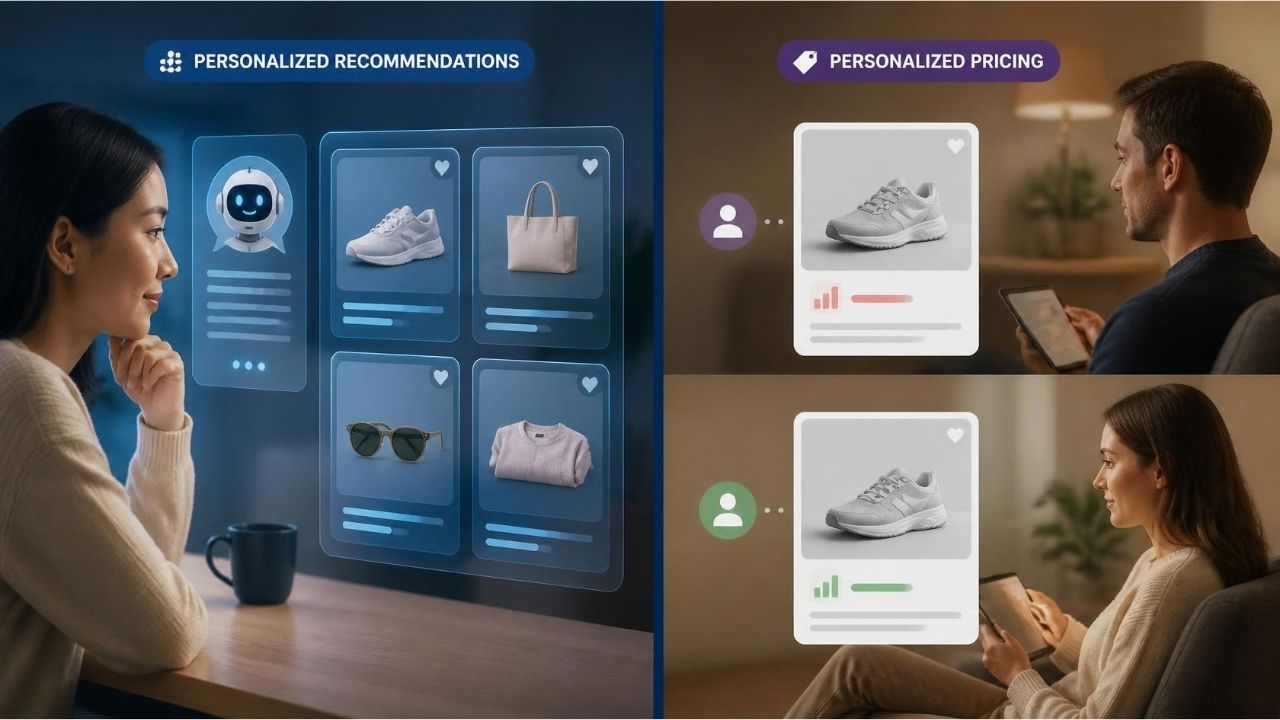
The Difference Between Personalized Recommendations and Personalized Pricing
AI-powered shopping systems can help users find products that suit their needs. For example, a shopping assistant can compare cheaper, higher-quality, or differently featured products based on a customer's request. However, the situation changes when pricing is involved. A system saying “You might like this product” is not the same as one operating on the basis of “This customer may be willing to pay more, so let's increase the price.”
Walmart specifically emphasizes this distinction in its statement, explaining that pricing decisions are not based on personal customer information. According to the company's official statement, prices may be determined by commercial factors such as costs, competition, inventory levels, geography, and seasonality. However, personal information is not used to set a different price for the same Walmart product specifically for an individual customer.

Will Walmart Use AI to Change Prices Based on Individual Customers?
The company says it uses technologies such as artificial intelligence and machine learning in its operations and to support its pricing processes. However, it states that these systems do not generate unique prices for individual customers.
Walmart CEO John Furner expressed a similar position in his statement. He explained that the company wants to use AI to improve the customer experience but will not set different prices based on customers' personal information.
This approach is particularly important in terms of AI's role in the retail industry. As AI systems become capable of analyzing increasingly large amounts of customer data, the debate over how personalized pricing can become is also gaining momentum.

Which Personal Data Is Not Used for Pricing?
In its statement published as part of Walmart's “Everyday Affordability” initiative, the company explicitly states that it does not apply different prices based on an individual's browsing history, purchase history, device information, location, or shopping behavior. This is significant because precisely these types of data are at the center of discussions about personalized pricing.
For example, using information such as which products a customer has previously purchased, which products they have viewed, which device they use, where they shop, or how they behave while shopping to change the price of a particular product specifically for that individual would not align with Walmart's stated pricing approach. However, this statement does not mean that Walmart collects no personal data whatsoever.
The company's current customer privacy notice states that various categories of personal data may be processed, including purchase history, contact information, location data, demographic information, and certain assessments derived from shopping behavior. Therefore, the important distinction here is between collecting personal data and using that data to determine individualized prices for the same product.

Do Digital Price Tags Change Prices Automatically?
According to Walmart's statement, digital price tags do not determine prices on their own. Known as Digital Shelf Labels (DSL), these systems serve as electronic alternatives to traditional paper price tags in stores. Walmart says prices are determined through a centralized system, while digital labels simply display the approved prices. Therefore, it would be inaccurate to establish a direct connection between the presence of digital price tags and dynamic personalized pricing.

Do Digital Price Tags Track Customers?
Walmart states that its digital price tags are not used to track customers. According to the company's statement, these labels operate on a closed system, contain no cameras or microphones, and cannot identify customers or track their shopping behavior.
Walmart also explains that digital labels do not independently change prices but display prices approved through the centralized pricing system. The primary purpose of the system is therefore to ensure that prices are displayed accurately on store shelves and match the prices shown at checkout.
Do Prices Change Throughout the Day Based on Demand?
Walmart's official statement says that digital price tags do not change prices based on demand, the time of day, or the customers present in a store. The company explains that price updates are centrally approved and that digital labels display those prices.
In its March 2026 statement, Walmart also noted that digital price tags do not change prices based on in-store demand, the time of day, or the individual making a purchase. It explained that price changes are managed through a centralized system and processes approved by employees.

Walmart's Approach to Its AI Shopping Assistant Sparky
Another important component of Walmart's AI strategy is its shopping assistant, Sparky. According to the company's CEO, Walmart wants to bring the personalized assistance employees provide to customers in physical stores into the online shopping experience as well. Sparky is positioned as part of this approach. The important point here is the distinction between personalization and pricing.
An AI shopping assistant can understand a customer's needs, compare products, or help them find suitable options. However, Walmart's announced policy makes it clear that this personalization approach is not intended to set customer-specific prices for the same product.

Can AI Promote More Expensive Products?
In AI-powered shopping systems, not only prices but also the ranking of recommendations can influence the consumer experience. For this reason, the debate is not limited to the question, “Is the customer paying more?” The question, “Which products are being shown to the customer?” is also becoming increasingly important.
Walmart's statements indicate that Sparky will be used to assist customers and that the company aims to provide a personalized shopping experience through AI. Its pricing statement, meanwhile, makes clear that personal information is not used to charge a particular customer a different price. Therefore, Sparky's product recommendations and its pricing mechanism need to be considered separately.

Why Is the AI Pricing Debate Important?
The growing adoption of AI in retail enables companies to analyze much larger amounts of data more quickly. While this can improve operational efficiency, it also raises new transparency questions for consumers.
For example, there is a significant difference between a system supporting pricing decisions by analyzing factors such as inventory, competition, and costs, and one predicting a customer's purchasing power to display the same product at a higher price.
If the second scenario occurs, it may also become more difficult for consumers to compare prices. Customers may not know whether someone else is seeing a lower price for the same product. This is why, when it comes to AI pricing, it is important to understand not only whether AI is being used but also which data is being used and for what purposes.
Why Is Transparency Critical?
In traditional retail stores, most customers can see the price of a product displayed on the same shelf. In digital shopping, however, prices and product recommendations can become part of a more personalized experience. This raises questions about how systems that may limit consumers' ability to compare prices are designed.
Walmart's current statement establishes a clear framework in this regard: the company says it does not apply different prices to the same product based on personal customer information and that its digital price tags do not track customers or change prices.
What Does Walmart's Announcement Mean for the Retail Industry?
Walmart's approach is part of a broader discussion showing that AI in the retail industry is more than just an automation tool. Artificial intelligence can be used across various processes, including product searches, customer service, inventory management, logistics, demand forecasting, and pricing. However, not all of these applications carry the same risks for consumers.
When it comes to pricing, the fundamental question becomes: Is AI determining prices based on product characteristics and commercial conditions, or based on who the customer is? In its official statements, Walmart rejects the second approach in relation to its own systems. The company says its pricing technologies serve efficiency and affordability goals and are not used for personalized pricing.
This approach can also be considered part of the company's broader AI strategy. Particularly at a time when customer data is being analyzed more extensively, clearly defining the boundary between personalization and pricing is important for consumer trust.

Why Is This Significant for Companies in Türkiye?
The use of AI alongside customer data is not just on the agenda of retail companies in the United States. Companies in Türkiye also need to pay attention to issues such as the processing of personal data, data security, and the AI tools used by employees when implementing AI systems.
The importance of evaluating which data companies process when using AI tools, where that data is transferred, and the data processing conditions of service providers is examined in detail. The underlying issue here goes beyond the Walmart example. Using AI is not inherently a problem for companies; what really matters is the purpose for which a system operates, the data it uses, and the boundaries within which it functions.
AI-powered shopping experiences are also becoming increasingly common in e-commerce and fintech in Türkiye. As these applications become more widespread, it is becoming increasingly important for consumers to understand the distinction between personalization and personalized pricing.
Which Factors Are Used in Walmart's Pricing Model?
While rejecting data-driven personalized pricing, Walmart is not claiming that its prices are entirely fixed or unaffected by external conditions. According to the company's official statement, commercial factors such as costs, competition, inventory levels, geography, and seasonality may be taken into account when making pricing decisions.
A product's price changing in response to different economic or operational conditions does not, by itself, constitute personalized pricing. At the heart of the personalized pricing debate is the practice of charging different prices for the same product under the same conditions based on a customer's personal characteristics or behavior. Walmart's statement makes clear that the company does not use this method in its own systems.

What Does the Future Hold for AI-Powered Personalized Pricing?
Walmart's announcement does not mean that the debate over AI-powered personalized pricing is over. On the contrary, this issue is likely to receive even more attention as AI becomes increasingly integrated into commerce. From the consumer's perspective, the most important concern is being able to understand how the systems being used actually work.
One company may use AI for product recommendations. Another may use machine learning to optimize inventory management. Yet another may use it for demand forecasting. Each represents a different application. However, using AI to determine the prices displayed to customers is a much more sensitive area because it directly affects consumers' financial interests.
Frequently Asked Questions
Does Walmart Use AI for Personalized Pricing?
According to Walmart's official statement, the company does not use personalized pricing models that offer different prices to different customers for the same Walmart product based on personal customer information.
Which Personal Data Does Walmart Not Use to Set Prices?
The company states that it does not set customer-specific prices based on browsing history, purchase history, device information, location, or shopping behavior.
Do Walmart's Digital Price Tags Track Customers?
Walmart states that its digital price tags are closed systems and do not contain cameras or microphones. The company says these labels do not identify customers or track their shopping behavior.
Do Digital Price Tags Change Prices Automatically?
No. According to Walmart, prices are determined through a centralized system, and digital price tags display approved prices. The labels do not independently determine or change prices.
What Does Walmart's AI Assistant Sparky Do?
Sparky is positioned as an AI shopping assistant developed by Walmart to help customers with their online shopping experience. The company says its goal with Sparky is to bring the personalized customer assistance available in physical stores into the online experience.
Are Personalized Shopping and Personalized Pricing the Same Thing?
No. Personalized shopping may involve adapting product recommendations, search results, or shopping assistance to individual users. Personalized pricing, on the other hand, means charging different prices for the same product based on a customer's personal information.
Why Is AI-Powered Personalized Pricing Being Debated?
Because AI systems can analyze large amounts of customer data. This raises concerns not only about personalized services but also about the possibility of setting prices based on customers' willingness to pay or their behavior. Walmart's current statement says that the company does not use this approach in its own pricing systems.
What Are Walmart's Digital Price Tags Used For?
According to Walmart, the primary purpose of digital price tags is to reduce the manual work involved in replacing paper labels, make price updates faster, and help ensure that the prices displayed on shelves match those at checkout.
WriterTürkiye'de Yapay Zeka Regülasyonu 2026


Claude Sonnet 5: Yapay Zeka Ekonomisinde Yeni Çağ


