
AI Is Tackling Decades-Old Open Problems in Mathematics
Automatically translated
 Writer
Some problems in mathematics can be stated in a single sentence, yet their answers take the efforts of several generations. The problems posed by Paul Erdős are among the best examples. One of the most prolific mathematicians of the 20th century, Erdős left behind not only thousands of papers but also a broad legacy of open problems that researchers still work on. In 2026, a new player joined the research table for some of these problems: artificial intelligence.

Recent mathematical work by OpenAI shows that large language models are moving beyond systems that only answer known questions and can produce new mathematical structures and results. In May, an OpenAI model found a new construction that disproves a conjecture about Erdős's unit distance problem, posed in 1946, which had been accepted for roughly 80 years. In August, OpenAI announced 10 new results in mathematics and theoretical computer science.
These developments start a more interesting discussion than the question "Can AI solve math problems?" The real issue is whether AI can be a research partner that generates new ideas in mathematical research.
How Is AI Entering Mathematical Research?
Using computers in mathematics is not new. Symbolic algebra systems, numerical computation, computer-assisted proofs and simulation tools have long been part of researchers' methods. What AI brings is not just faster calculation, but the ability to suggest which calculations or structures might be worth trying.

In a research problem, the hardest stage is often not doing the calculations, but asking the right question and noticing the right structure. A mathematician can look at a problem from dozens of angles, but does not know in advance which approach will work. Modern AI systems are becoming a strong tool for widening this search space.
At this point, AI's role in mathematics departs from the classic "question and answer" model. Instead of stating the result of a theorem, a model can try different constructions, search for counterexamples, or investigate under which conditions a conjecture fails.
Matematiksel keşif ve yapay zekanın değişen rolü focuses precisely on this transformation. The key point is that AI does not replace the mathematician; it helps the researcher search a broader space of ideas.
This difference matters especially for open problems. Finding the answer to a known math question is not the same as producing a result that does not yet appear in the literature.
Why Are Erdős Problems an Important Test for AI?
Paul Erdős's influence on mathematics cannot be explained by the number of his publications alone. Erdős is also known for posing problems that are easy to state but extremely hard to solve. Some of these problems have been studied for decades in fields ranging from number theory to combinatorics, graph theory and geometry.
This makes them an interesting testing ground for AI. When a model solves a standard math question, it may show how well it processes existing knowledge. But producing a new result on a problem that has been open for decades points to a very different ability.
It is worth stressing the phrase "new result" here. If an AI system reproduces a proof from an old paper, that is not a discovery. Likewise, restating a construction already in the literature in different words does not create new mathematical knowledge. What matters is whether it can present a previously unknown structure, counterexample or proof strategy.
The 80-Year-Old Unit Distance Problem
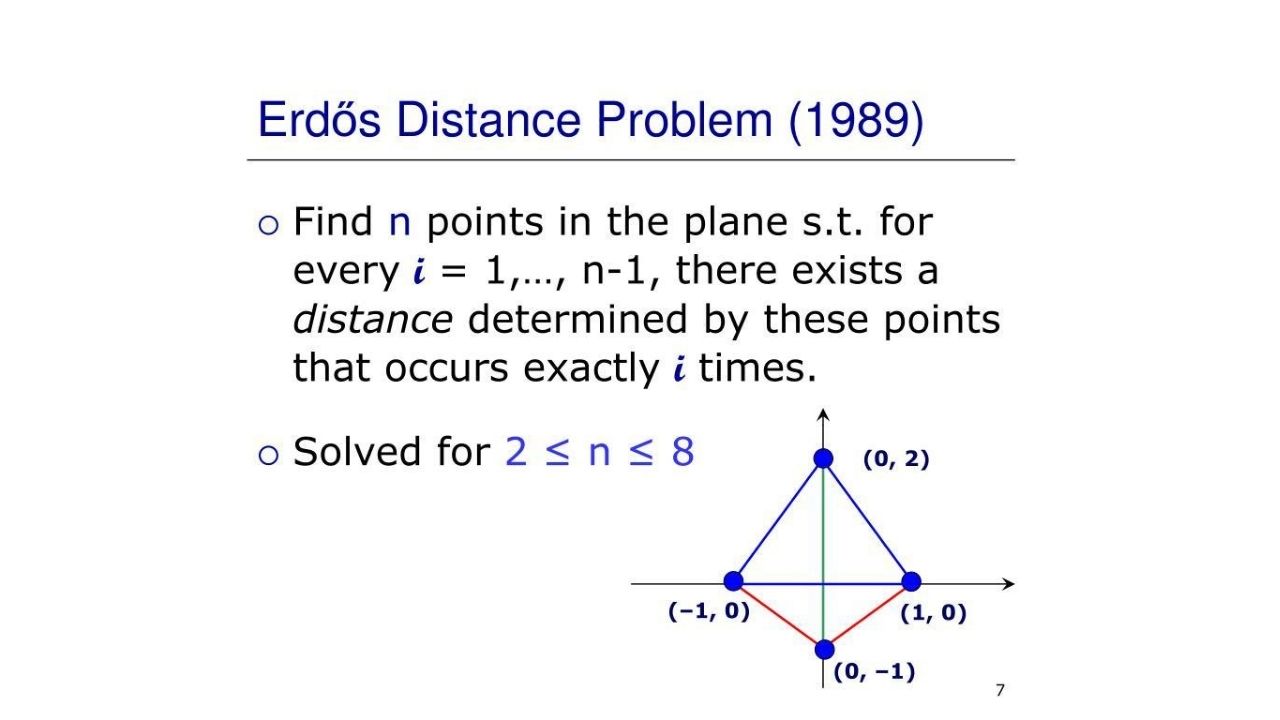
The central question of Erdős's unit distance problem, posed in 1946, concerns how many pairs of points can be exactly one unit apart when a given number of points is placed in the plane. This simple-looking geometric question becomes a complex combinatorial problem as the number of points grows.
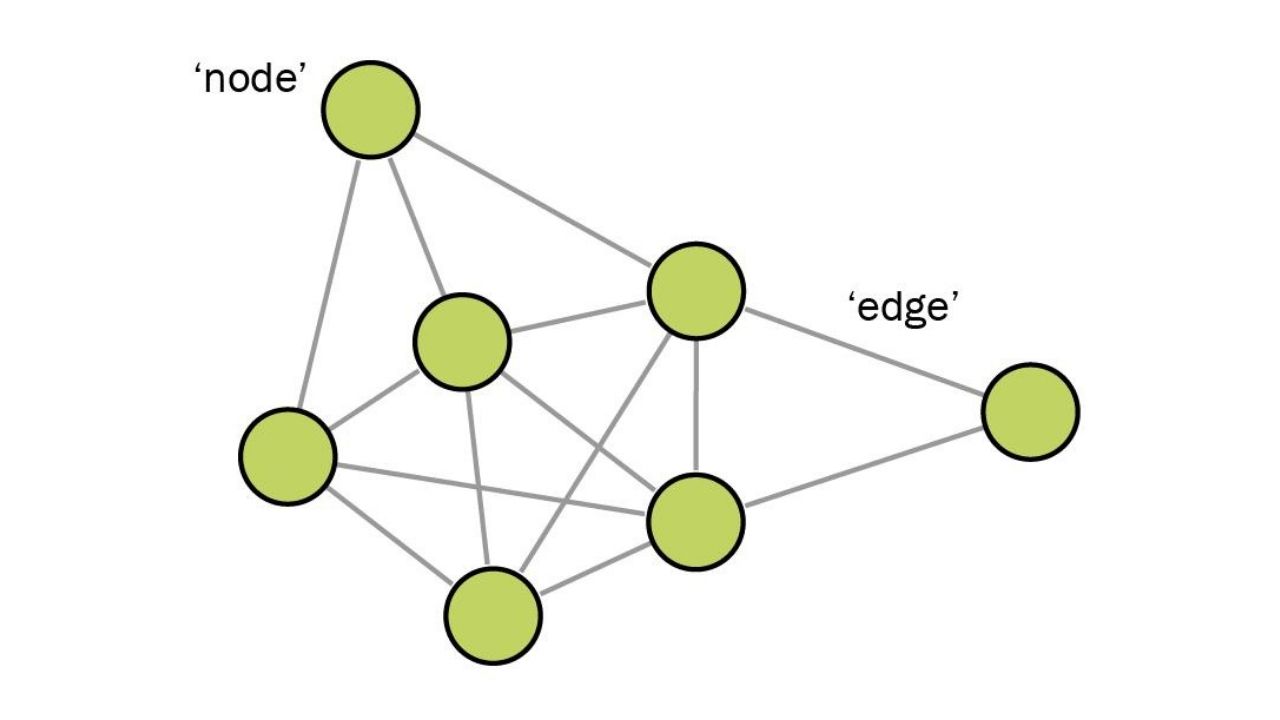
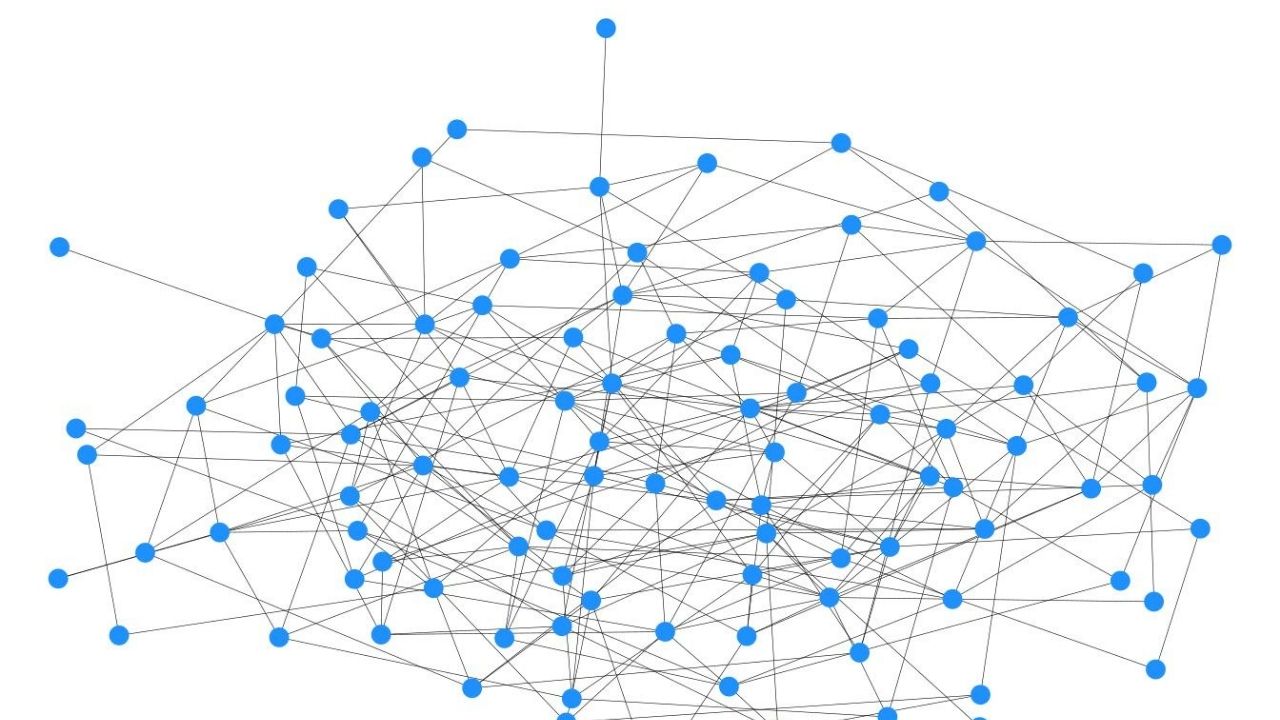
It is also possible to think about the problem through graph theory: each point is a vertex, and the unit distance relation between points is treated as an edge. Seen this way, the geometric problem becomes a question about how dense graphs with certain properties can be constructed.
For a long time, constructions based on square grids were considered an important approach. The regular structure made it easier to calculate unit distances and study their properties. However, the new construction found by the OpenAI model showed that this approach is not as powerful as was thought.
According to OpenAI's announcement, the model found a new infinite family of constructions that disproves the square grid conjecture and gives a better lower bound. Looking at OpenAI's research on the unit distance problem, the significance of the work is not limited to finding a new example: the result shows that the problem can be approached through a geometric structure different from what was previously considered.
Here, it is important to avoid a common mistake in news reporting. This result does not mean that "Erdős's 80-year-old problem has been completely solved." What was disproved is a long-accepted conjecture about one direction of the problem. The new construction improves known bounds. In mathematical research, such progress can be significant in itself, but equating it with a full solution of the problem would be incorrect.
What Do OpenAI's New Mathematical Results Mean?
The unit distance problem alone would have been noteworthy. However, the new work OpenAI announced on August 1, 2026 placed the topic in a broader context.
The company announced that a research system it calls Astra produced 10 new results in mathematics and theoretical computer science. The work spans different fields such as geometry, graph theory, combinatorics, coding theory, cryptography and computational complexity.
Here too, it is necessary to avoid the simplified framing of "10 problems solved." Some of the announced results offer solutions to open problems, while others make significant progress on existing results. OpenAI's own wording preserves this distinction.
Among the works are a solution to Erdős Problem 183 and new results on Erdős Problems 146 and 180. The value of these examples lies in the fact that AI does not behave like a special-purpose system trained in only one area of mathematics. Being able to conduct research on problems involving different mathematical structures broadens the potential range of use for such systems.
How Astra works is also important here. The model is not expected to simply give an answer to a question. The system can try different ideas over long research processes, evaluate candidate approaches, and then carry the resulting findings into formal verification.
This approach may matter more for the future of AI in mathematics. In research mathematics, the first idea is often not the right one. Dozens of failed approaches are a natural part of reaching the correct result. If AI can take on much of this search process, mathematicians can devote their time to higher-level evaluation.
Can AI Really Produce New Mathematical Knowledge?
The answer to this question is no longer purely theoretical. The examples from 2026 show that, at least on certain research problems, AI systems can go beyond existing results in the literature. But here the mathematical meaning of "new" must be preserved.
If a model reproduces a result found on the internet or in its training data, that is not a new discovery. Appearing to solve a problem correctly is not enough by itself either. For a mathematical result to be considered new, it must be compared with the existing literature, its argument verified, and shown to make a contribution that was previously unknown.
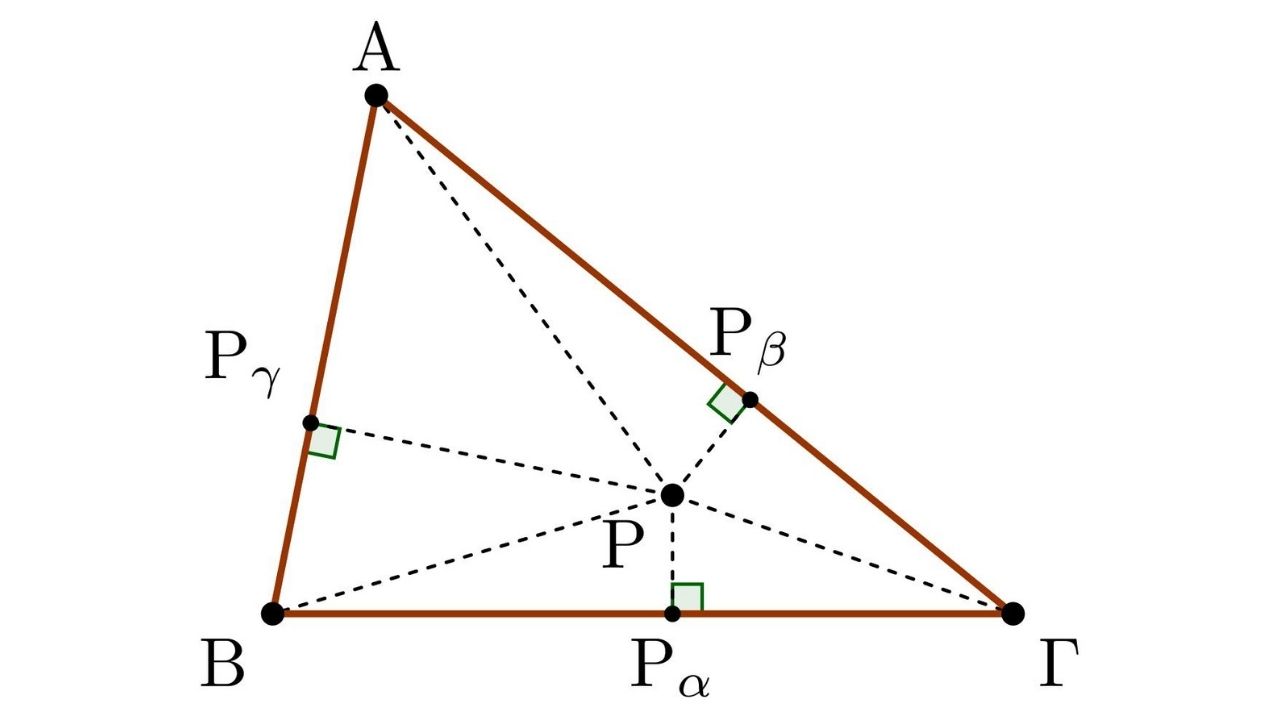
This is exactly the interesting stage in the Erdős example. The model produced a construction that goes beyond the structures used before. Mathematicians then examine what this structure really means, develop the proof, and place it within the literature.
This division of labor could move to the center of the AI-in-mathematics discussion. The model searches a broad space of candidates, while the human researcher evaluates their mathematical meaning.
Generating counterexamples is especially important here. If a conjecture is believed to hold in all cases, a single valid counterexample is enough to refute it. In complex combinatorial structures, however, finding such a counterexample can be extremely difficult.
AI's ability to scan many possibilities quickly can be an advantage precisely in this kind of research problem. The structure the model finds may not be the final answer, but it can reveal an aspect of the problem the mathematician had not considered.
The Division of Labor Between Mathematicians and AI Is Changing
This is also the most easily misread part of these developments. An AI system finding a new mathematical structure does not mean mathematicians are no longer needed. On the contrary, the researcher's role becomes more important in some respects.
Choosing which of the hundreds of ideas a model produces is truly new, understanding which existing theories a result connects to, and assessing whether the method can be applied to other problems still require expertise. The question a mathematician asks during research, "Why does this result matter?", is different from a model saying "This structure works."
The same holds in academic publishing. An AI system producing a mathematical argument that is correct does not by itself create an academically valuable work. The result's place in the literature, its novelty, generality and scientific contribution must still be evaluated.
So a more realistic future scenario is not "AI replaces the mathematician." It is human mathematicians, AI research systems and formal verification tools working together in the same research cycle.

Why Do Lean and Formal Proofs Matter?
One of the biggest obstacles to wider use of AI in mathematics is reliability. Language models can produce proofs that look highly convincing but contain a small logical error. In mathematics, a single faulty step can invalidate an entire result. That is why independent verification of AI-generated mathematical results is critical.
Formal proof assistant systems such as Lean come into play here. When a mathematical argument is formalized in a form Lean can understand, the system can check by computer whether the proof follows the defined rules.
OpenAI's August work also uses this method. The company says researchers turned AI-generated arguments into papers and that the results were formalized with Lean certificates. For academics who want to examine it, the published technical mathematics document is a direct source for studying the more detailed mathematical work behind the results.

The role Lean plays here prevents the assumption that everything AI produces is automatically correct. Formal verification does not make the human mathematician redundant, but it adds a strong safety layer to the research process.
What Does This Mean for Academics in Turkey?
The most practical aspect for academic researchers in Turkey is that AI is moving beyond summarizing papers or editing text.
A researcher working in mathematics, computer science or statistics can use AI systems at various stages, from literature review to hypothesis development, and from experimental research with Python to preparing formal proofs.
For example, a researcher studying the properties of a certain graph family can use AI to write code that generates small examples and tests different parameters. Patterns obtained this way can be used to form a mathematical hypothesis. But it should not be forgotten that a pattern observed experimentally is not a theorem; the final claim must still be proven mathematically.
Similarly, AI-supported academic research tools can help classify studies in the literature and map approaches that have already been tried. However, it is risky to accept bibliographic information provided by a model in academic sources at face value. Verification requires checking the original paper, the DOI or the publisher's record.
Where Is the Limit of AI in Mathematics?
The developments of 2026 are impressive, but it is too early to conclude from them that AI has taken over the whole of mathematical thinking.
A model finding a new construction does not prove that it understands mathematical concepts the same way a human researcher does. Likewise, a formal proof being correct does not show that the model grasps why the resulting theorem matters.
A significant part of research mathematics takes place outside formal proof. Deciding which problem is important, connecting two areas that seemed unrelated, recognizing why a result can be generalized, or designing a research program that will take years remain at the center of human expertise.
AI may be strongest in a different place: searching a large space of ideas. That is why, in mathematics, AI is best understood as a tool that expands the scope of the research process rather than a system that replaces the human mathematician.
It is also symbolic that problems Erdős asked decades ago are now being investigated again with AI. The mathematical question stays the same, but the tools used to study it change.
Perhaps one of the most important changes in mathematical research in the future will be AI moving from a "machine that gives answers" to a research partner that helps mathematicians look where they have not looked before.
Frequently Asked Questions
Can AI solve math problems?
Yes. In 2026, OpenAI models produced new results on some long-open math problems. However, it is important to distinguish that not every result amounts to a complete solution. Some works disprove conjectures, while others provide new bounds or constructions.
On which Erdős problems did OpenAI produce results?
Among the 10 results OpenAI announced in August 2026, there is a solution to Erdős Problem 183 and new results on Erdős Problems 146 and 180. A separate significant result on Erdős's unit distance problem had been announced in May.
Has Erdős's unit distance problem been completely solved?
No. The May 2026 result disproved a specific long-accepted conjecture and provided a new construction with a better lower bound. This is not the same as a final solution of the entire problem.
What is Lean used for in mathematics?
Lean is a proof assistant that allows mathematical statements and proofs to be formally defined and checked by a computer. It can play an important role in verifying mathematical arguments generated by AI.
Could AI replace mathematicians?
There is not enough evidence for that yet. Current examples mostly show that AI can offer mathematicians new constructions, counterexamples and research ideas. Evaluating the importance of a problem, interpreting results and taking academic responsibility remain the role of the human researcher.
Writer