



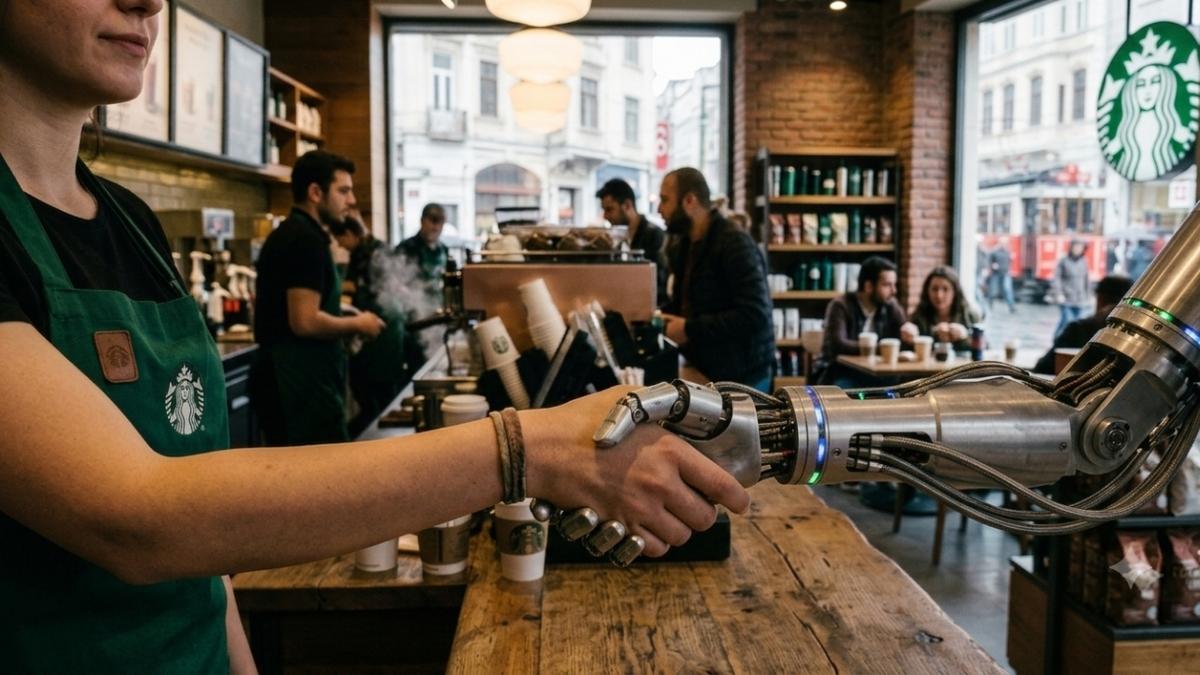
Why Human Collaboration Still Matters in AI
Automatically translated
 Writer
The technology world has long told a fascinating yet equally mechanical tale: AI will arrive, bury human error and labor in the dusty pages of history, and everything will flow along in flawless autonomous order. But when we step out of that smooth laboratory setting and collide with the chaotic reality of life, the street, and massive operations, this tale gives way to a harsh awakening.
The most vivid proof of this is the operational fiasco that the coffee giant Starbucks faced after entrusting its inventory management to AI. What is more, this harsh awakening is not confined to the field and practical applications; even Sam Altman, the OpenAI CEO who has been the standard-bearer of AI vision, is showing a sharp step back in his remarks. Today, beyond futuristic dreams of full automation, we need the flexibility and guidance of the human mind more than ever. Because the real power of the digital age lies not in replacing people, but in building a solid culture of AI and human collaboration.
Starbucks’ AI Crisis: Driving the Process Faster Into Disaster
It all began when Starbucks, which has a highly fragmented supply chain dependent on local suppliers and requiring real expertise to manage, wanted to digitize it. The company partnered with the AI startup NomadGo to scan store inventory through cameras, count it automatically, detect everything from milk cartons to coffee packs, and order shortages from the central warehouse. The goal seemed very innocent and logical at first glance: to reduce the warehouse counting burden on staff working intensely in stores and make the logistics process error-free. If the system had worked, employees would have been able to focus solely on making coffee and serving customers.
However, the result was a complete Starbucks AI failure. The AI system, which had successfully recognized objects in the laboratory, literally collapsed when it entered the daily chaos of a real store. It could not properly recognize people passing in front of the cameras or stacked boxes; it even got the most basic inventory counts wrong. When erroneous data and wrong orders generated by AI were added to a massive supply chain already balanced on a knife's edge and awaiting fresh products every morning, the process completely jammed. Missing cups, excess milk, or wrong products began to create crises in stores. Internal managers describing the situation as a "disaster faster" was, in fact, the clearest proof of how much large and inextricable operational crises AI can create when left unsupervised and uncontrolled, instead of making work easier.

AI's Three Big Walls: Infrastructure, Behavior, and Financial Illusion
Behind this failure at Starbucks lie three fundamental structural problems that every company considering AI integration should take to heart:
The Century-Old Infrastructure Contradiction:
Starbucks tried to integrate a shiny, modern AI layer into an old IBM infrastructure from the 1990s running in the background. Expecting full automation by simply adding AI on top, without updating the old data structure underneath, caused the system to collapse.
Lack of Behavioral Data:
Current AI models are very successful at analyzing what people say (language data). However, they have not yet grasped how people actually act, how they make flexible decisions in moments of crisis, or the workflows of the physical world. Because AI cannot perceive an obvious logistical error or object clutter that a human would notice in seconds, it makes chain-reaction mistakes.
The Stock Market Illusion and Financial Mirage:
Companies often see AI as a magic wand that will cut costs and send share prices soaring. Starbucks, too, had aimed with this AI move to look appealing to investors and keep its market value high. But choosing not to invest in the core infrastructure and instead cheaply patching an old system with an AI layer backfired. Far from delivering the expected gains on the stock market, this turned into a huge financial loss and logistical chaos for the company. In the end, this showed that cheap AI moves made without fixing the infrastructure do not reduce costs; on the contrary, they inflate the bill.

OpenAI CEO Sam Altman's Big Step Back
These harsh realities on the ground have deeply shaken not only coffee giants like Starbucks but also the summit of the AI world. OpenAI CEO Sam Altman was, until quite recently, drawing a very different vision. Altman had been at the forefront of futuristic scenarios claiming that future AI models would be fully autonomous and that almost no line of work would need humans. But as he ran into the operational walls of the real world, he had to take a sharp and radical step back from that bold rhetoric.
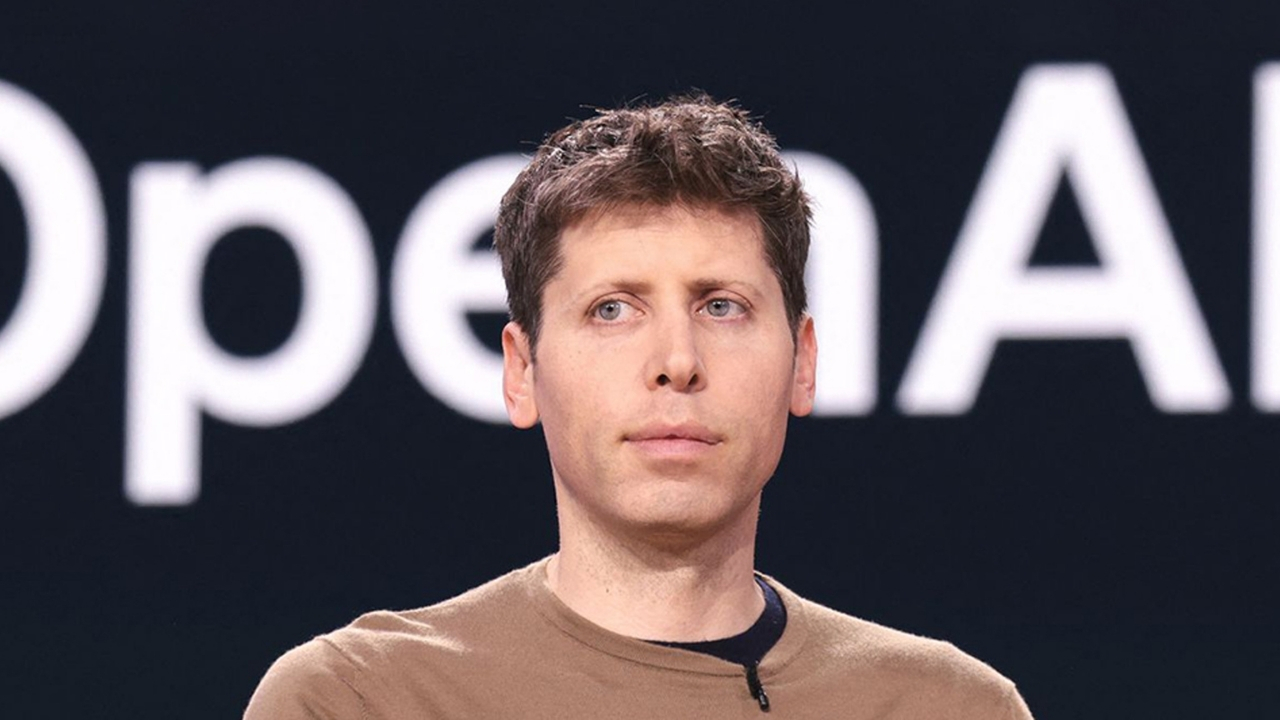
In his recent remarks on the future of AI technology, Sam Altman stated that he had completely changed his mind on this. He acknowledged that no matter how much the technology advances, it cannot be a magic force that solves everything on its own. He now describes AI applications not as autonomous systems that will take people's jobs, but as powerful "assistants" that always need human oversight and only amplify human abilities. Indeed, in his recent OpenAI sessions, he emphasizes that in the future, it will be purely human abilities such as idea generation, flexibility, high adaptability, and crisis management, rather than technical coding skills, that will shape professions.
The fact that even the leaders steering the AI world step back so quickly from the dream of full automation says a lot. Regardless of how flawless technology may appear, this clearly proves that to solve the complexity of the real world, the "human hand and mind" remains firm and irreplaceable in the business world.
The Future Lies in "Partnership"
Ultimately, this "rapid disaster" Starbucks experienced is a stylish lesson for all of us about the limits of technology and the value of people. The clearest and most concrete answer, given right on the ground, to the famous fear of "Will AI take our jobs?", which has headlined for years and gnaws at all of us with every new AI update, is exactly this. We see that career planning and the jobs of the future in the age of AI are being shaped entirely by this reality, that is, by forming partnerships with people rather than excluding them. Trying to make AI the sole master of work and removing humans from the equation entirely does not bring visionary efficiency; it only creates an impossible-to-manage, perfect chaos. The enthusiasm for building human-free systems shatters against the wall of practical life.
No matter how advanced algorithms become, a system stripped of the human spirit, intuition, empathy, and the flexible judgment needed in moments of crisis cannot survive on its own in the real world. Because life is not made up only of computer code or mathematical data that can be predicted in advance; every process involving humans requires a flexibility that can change at any moment. The future will not belong to robotic cafes, dark factories where only machines work, or cold, soulless automations that exclude people. The future will belong to those who succeed in blending human aesthetic perception, emotional intelligence, and problem-solving ability with the massive data processing power of AI.

A human will always sit at the wheel; AI will remain a powerful map that shortens our route and points the way, or our right arm. Contrary to what is feared, AI will not dethrone humans; on the contrary, it will bring their creative and supervisory power even further to the fore. In this new era of the digital age, the future will be designed not by those who set technology free alone, but by the strong architects of AI and human collaboration who walk human intelligence and algorithmic power side by side.
WriterAI Tembellik Tartışması Teknoloji Dünyasını Karıştırdı


AI Destekli Siber Saldırı Dalgasında Yeni Tehdit GreyVibe


