




Claude Opus 4.6 Features: A Next-Generation LLM
Automatically translated
 Writer
As competition in artificial intelligence continues at full speed, Claud Opus 4.6, developed by Anthropic, has been updated with notable improvements. The model offers high accuracy, more controlled output generation, and large context structures, making it a strong option for both individual and enterprise users.
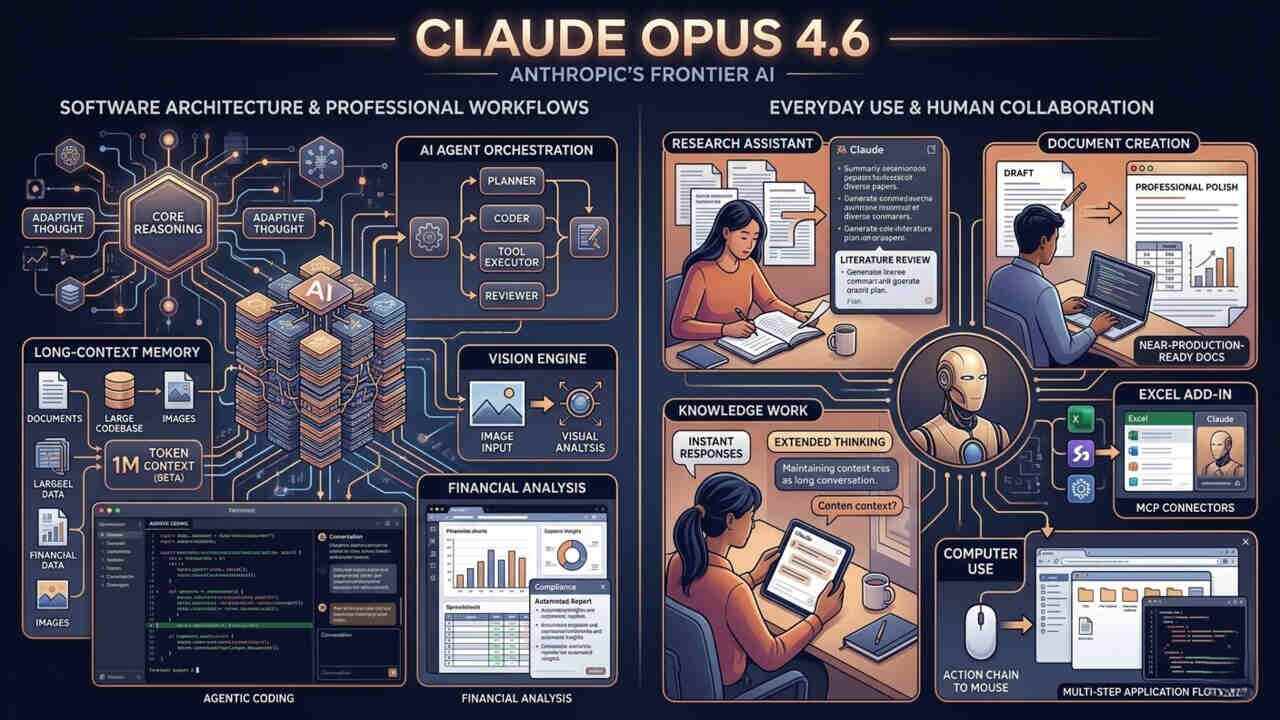
Compared with previous versions, this release stands out for consistent text generation, stronger reasoning capabilities, and safety filters that reduce incorrect responses. Claude Opus 4.6 improves performance especially on tasks such as long text analysis and multi-step problem solving.
Claude Opus 4.6 Features
The model shows improvements in the following core areas:
- Advanced Reasoning: It produces more consistent and accurate results on multi-step logic problems.
- Long Context Support: Thanks to a larger context window, it can analyze long texts at the same time.
- Reduced Hallucination: The rate of misleading and fabricated content has been lowered compared with previous versions.
- Safety Filters: It systematically blocks the generation of risky or inappropriate content.
- Multi-Task Performance: It achieves high success across different tasks such as code generation, text summarization, question answering, and data analysis.
With these features, Claude Opus stands out as a strong option among LLM solutions.

Anthropic Claude Opus 4.6 Usage Guide
You do not need a special coding program to use Claude Opus 4.6. The model is usually available through an API, and the setup process is practical.
- Account Creation and API Key: First, sign up on the platform from the official Anthropic website and create your API key. This allows you to interact with Claude Opus 4.6.
- Writing a Simple Prompt: Create a prompt to use the model. For example: “Summarize this text in 500 words and highlight the key terms.”
- Sending a Query via the API: Send the prompt you entered to the model with an API call. Claude Opus will return the response in JSON format.
- Processing the Response: You can integrate the output into your application. You can also show this response directly to users or use it in data analysis processes.
Because Claude Opus 4.6 works with API standards, it can easily be used with Python, Java, or other backend languages.
Free Claude 4.6 Trial
As with many AI services, Claude Opus 4.6 also offers a free trial option. Anthropic provides a limited usage quota so new users can test the model. To get free trial access:
- Sign up on the Anthropic platform
- Once the free trial credit is added to your account, run your first test with your API key
- Evaluate the model's productivity, safety, and accuracy performance.
How Claude Opus 4.6 Differs From Previous Versions
Claude Opus 4.6 offers a significant performance difference over earlier versions. Below are the general differences compared with previous versions:
- Accuracy: The 4.6 version lowers the hallucination rate, allowing it to give more realistic answers.
- Context Management: Larger context windows help you achieve more consistent results on long texts.
- Multi-Task Performance: It is much stronger than previous versions in data analysis, summarization, and code generation.
- Safety: It more effectively blocks inappropriate and risky content generation
With this release, Claude Opus 4.6 comes forward with a broader range of output and a focus on safety and practicality.

Claude Opus 4.6 vs GPT-5: Accuracy and Context Differences
GPT-5 currently stands out as one of the most powerful LLMs in the AI market. Comparisons with Claude Opus 4.6 help us see the differences between the two models more clearly.
| Criteria | Claude Opus 4.6 | GPT-5 |
|---|---|---|
| Context Window | Large | Very large |
| Hallucination Rate | Low | Low–Medium |
| Code Generation | High performance | Very high performance |
| Data Analysis | Strong | Top level |
| Safety Filters | Default and strict | Advanced but wide flexibility |
| API Access | Easy | Broad ecosystem |
| Turkish Performance | Advanced | Strong |
This table shows that GPT-5 generally operates at a higher level in terms of capacity. The main reason is that GPT-5 is an older model that has been worked on more extensively. However, it is fair to say that Claude Opus 4.6 delivers a balanced performance in terms of safety and consistency. It stands out as a strong alternative, especially for enterprise applications that require reasoning and control.
Claude Opus 4.6 vs Gemini Series
Models developed by Google, namely the Gemini series, stand out with large contexts and multi-modal capabilities. The differences in the comparison are;
- Context Management: Gemini offers very large context support.
- Multi-Model Support: It processes multiple outputs such as images, text, and audio.
- Safety Policy: Gemini's safety filters are aimed at a wide range of application areas.
- Claude Opus 4.6: It offers a more controlled, enterprise-focused safety approach.
Looking at both models, each responds to different needs. Gemini offers a broader range of applications, while Claude Opus 4.6 takes a more controlled approach focused on enterprise use.
A Balanced and Controlled LLM Solution
Claude Opus 4.6 offers a much stronger, safer, and more consistent LLM experience than previous versions. Comparing it with rivals such as GPT-5 or the Gemini series also reveals the model's focus on safety and control. In the coming period, LLM competition will increasingly be integrated into everyday life with the features we have discussed.
WriterRoboCup 2025 İnsansı Robot Oyunları


Relevance Engineering: 2026'da Alaka ve Bilgi İhtiyacı


