
Claude Sonnet 5 New Model Up to Opus 4.8
Automatically translated
 Admin
Admin69.2% against 63.2% in agent-oriented coding test. The difference between several points, but the price difference is much greater. Anthropic announced Claude Sonnet 5 on 30 June 2026 and presented the model with a price starting from 2 dollars per million tokens while Opus reaches the performance of 4.8. In this article, Sonnet 5’s agent capabilities, price fiction, security profile and place in public supply race.

Claude Sonnet 5 How A Model?
Anthropic according to the official announcement Claude Sonnet 5 is positioned as the most agent-oriented Sonnet model ever. Model 30 June 2026 was released on Tuesday and became the default model in Pro plans with Free on the same day. Max, Team and Enterprise users can also access the model.
Access is not limited only with chat interface. Sonnet 5 is open to developers via Claude Code and Claude Platform; it calls with claude-sonnet-5 string in API. According to the announcement shared on AWS Machine Learning blog The model was also available on Amazon Bedrock, which makes it possible to work with regional data storage in existing AWS environments.
History of the sonnet series Anthropic’s agent moves. The path starting with Claude Sonnet 4 continued with Sonnet 4.6 released in February 2026; Sonnet 5 last ring of this line. According to Anthropic, the new model of reasoning, tool use, coding and information work shows obvious progress based on the fundamental components of agent performance.
What Changed in Agent Talents?
Sonnet 5’s main claim is collected in agent tasks. The model is able to plan, you can use tools such as scanner and terminal and run things that require larger models a few months ago. The most prominent difference according to Anthropic is to carry the model’s tasks to the end without leaving.
Observations of early access testers are also in this direction. According to the news published in VentureBeat Cursor co-founder Sualeh Asif summarizes the effect of Sonnet 5 in agent workflows as follows:
"Claude Sonnet is loyal to agents plan with 5, fits our rules and completed very step changes efficiently." (Sualeh Asif, Cursor co-founder)
In an example shared in the announcement of Anthropic, Zapier team released a two-stage task model: updating salesforce account layers and sending announcements to corporate connections. Sonnet finished 5 jobs from beginning. Previous models left these types of tasks in half. There is a new audit on the user side: the effort (effort) level. Sonnet 5 with Opus 4.8 is set this level and installed performance balance with cost. Anthropic also upgraded speed limits on Chat, Cowork and Claude Code to meet the token usage of higher effort levels.

Difference Between Sonnet 5 and Opus 4.8
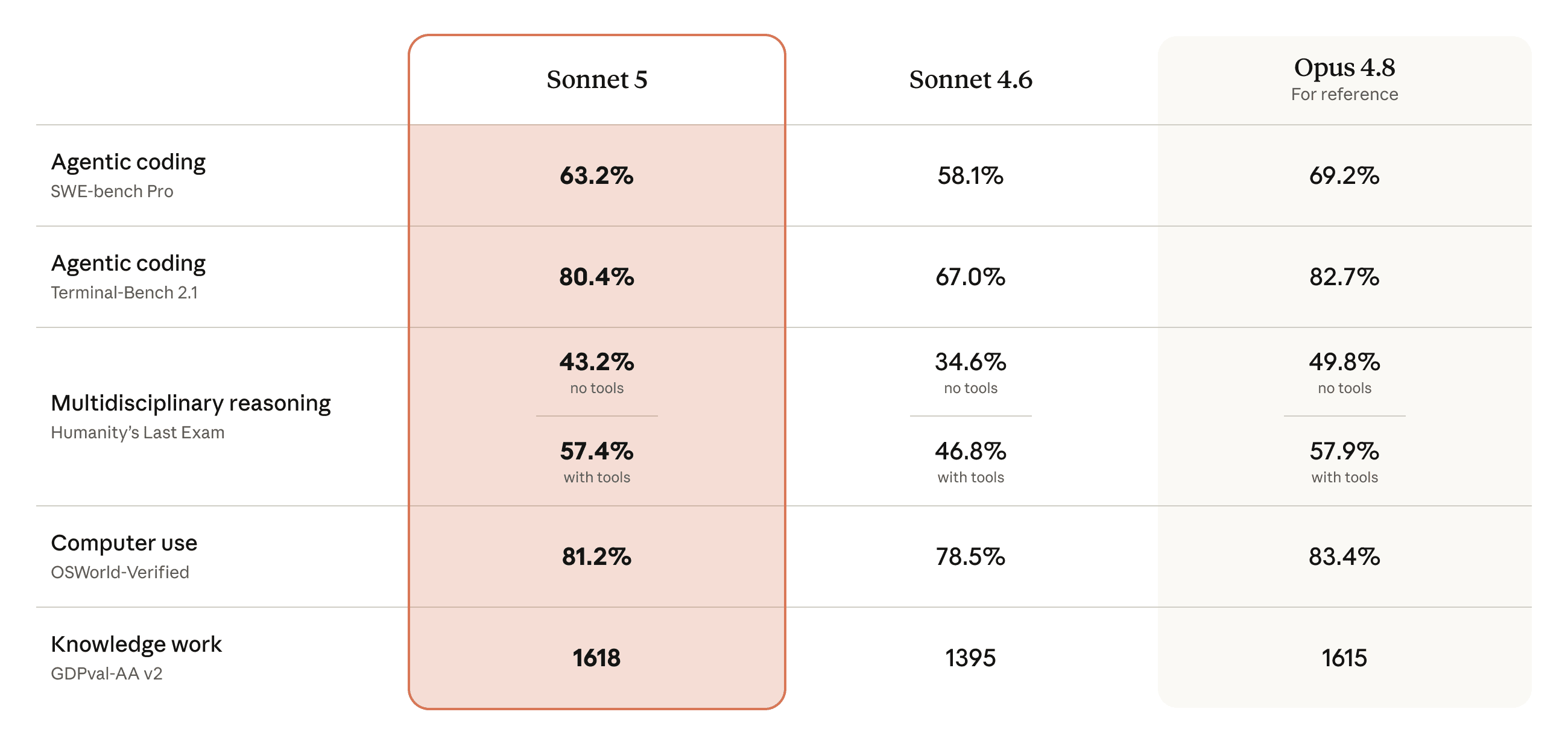
Benchmark table shows where two models are separated. Sonnet 5, according to the results shared by Anthropic, the agent-oriented coding test scored 63.2% in the same test; Opus 4.8 was 58.1% in the same test.
Home | Agent-oriented Coding |
|---|---|
Claude Opus 4. 8 | %69,2 |
Claude Sonnet 5 | %63,2 |
Claude Sonnet 4. 6 | %58,1 |
The table changes on the information work (knowledge work). Sonnet 5 according to the data of Anthropic, in this test, Opus 4.8 takes a little difference; even in the tasks requiring deep research and demanding reason, Sonnet can take 5 out. According to the analysis published in The New Stack Sonnet 5 has not passed the latest Opus version for this time, but the difference between turned off until Opus will offer an affordable alternative to 4.8. At the highest level of reasoning (Extra High) Sonnet 5, OSWorld-Verified and BrowseComp tests, Opus 4.8 results close to the middle-high adjustment. However, Opus is still preferred in some tasks since this level works more expensive than 4.8.
How to Install Pricing?
The price is the most visible cozu of Sonnet 5. The model was released with 2 dollars input per million tokens and 10 dollars output promotional price. This tariff applies to 31 August 2026; then the price rises to 3 dollars per million tokens and 15 dollars output.
Home | Entry Tariff | Standard Tariff |
|---|---|---|
Claude Sonnet 5 | 2 $ / 10 $ | 3 $ / 15 $ |
Claude Opus 4. 8 | No | 5 $ / 25 $ |
(Prices are input/out values per million tokens. )
When comparison is done, the Sonnet 5 is 5$ per million tokens, and the output price of $25 is under the apparently below Opus 4.8. According to the news published in TechCrunch Model, OpenAI GPT-5.5 and Google Gemini 3.1 Pro versions also cost cheap; against this Gemini 3.5 Flash is still lower than Sonnet 5. Opus 4.8 will continue to be preferred in jobs requiring high accuracy according to Anthropic, but Sonnet 5 offers a price-quality balance that is not possible before. Claude layers in product family pricing logic installed on this speed, cost and ability balance.

What is the Status on Security Side?
Sonnet 5, according to Anthropic’s security assessments, the selefi Sonnet is lower than unwanted behavior compared to 4.6 and is considered safer in agent contexts. The model is even more successful in rejecting malicious requests and prosecuting prompt injection attacks. Halusination and dalkavukluk (sycophancy) rates under Sonnet 4.6.
Cybersecurity side is a separate header. Sonnet 5, cyber measures are published in the default open state, but these measures Fable 5 to close access not as tight as solid restrictions leading. According to the transfer of VentureBeat, the Firefox 147 open development test conducted with Mozilla was not produced a exploit running at two Sonnet models and remained at 0.1% points. With partial success rate, Sonnet 5, 13.9% and Sonnet 4.6 out at least 8,8%. In the same test, Opus 4.8 68,8, Mythos 5 had reached 88.4% of exploitation. According to Anthropic, Sonnet was not particularly trained for 5 cyber tasks, and its performance in this field is the apparent back of Opus models.

Sonnet 5 in Ring Arz Race
Sonnet 5's timing coincides with the financial calendar of Anthropic. Based on Yahoo Finance The company made a secret application for public supply on June 1, and the launch came in a period that goes forward to worthing about 1 trillion dollars. Providing a cheaper flagship alternative, cost-oriented enterprise developers are reading as part of withdrawal strategy.
Price printing is not only specific to Anthropic. Sonnet 5, OpenAI and Google are located in an advantageous position in price against top segment models. Anthropic’s flagship line with Claude Opus 4.5 dates back to Opus 4.8. Sonnet 5 unlike previous launches of sonnet models, the latest version of Opus was not passed. This situation in the analysis of The New Stack was interpreted as a sign that Opus 5 is not far.

What does the community think?
Supporters
The point that stands out on the developer side can be used at lower cost, close to the Opus level. The Lovable co-founder Fabian Hedin noted that the model refuses unsafe requests in clean and consistent manner. Feedback on the Zapier side is that the model is preferred for daily automation. To complete tasks without leaving the semi-definition, the gain brought to the most language for teams that build up agent workflows.
News
The most up-to-date Opus of the criticized model is collected, some users see it as a gradual progress, not a big leap. The increase in cyber tasks based on the selefine of partial capabilities brings the question caused by default security measures. The entry price ends on 31 August also gives questions about whether the cost advantage is permanent. A part of the open source community protects the overall distance for closed models.

Frequently Asked Questions
Claude Sonnet 5 when output? Claude Sonnet 5, 30 June 2026 Tuesday. The same day was the default model in Free and Pro plans; Max, Team, Enterprise, Claude Code and Claude Platform has also opened access. Model is also available on Amazon Bedrock.
How much is Claude Sonnet 5 price? Sonnet 5 started with 2 dollar entries per million tokens and 10 dollars output promotional price. This tariff is valid until 31 August 2026, then 3 dollar entries per million tokens and load to 15 dollars output. Opus is located under the entry of $4.8 and the output price of $25.
Claude Sonnet 5 is better than Opus 4.8? Not in most tests. Opus 4.8 (69,2) is still ahead in the agent-oriented coding test, while Sonnet 5 is 63.2 points. In this regard, Sonnet 5 Opus 4.8 takes less difference and the price is significantly lower.
Claude Sonnet 5 Is it accessible in Turkey? Accessibility. Claude, before Free access was opened in Turkey and Sonnet 5 is the default model in the Free plan, users in Turkey can also reach the model. Developers can call model with claude-sonnet-5 string via API.
Claude How much is the context window of Sonnet 5? The official announcement and system card did not share a clear context window figure. In social media 1 million token context and January 2026 datacut information collected, but Anthropic did not verify these details. This information is currently at the speculation level.
Claude Sonnet is secure for 5 cyber security? Anthropic released the model with default cyber security measures. Firefox 147 did not produce a exploit running model in open test and scored 0.1%. Since performance in cyber tasks is behind Opus models, the measures were kept up to 5 times.
It is expected to test the Sonnet 5 of developers up to 31 August 2026 that the entry price will end. The balance between Modelin Opus 4.8 and the users will clarify on the next months how to install in what tasks. Opus 5 is an open question when the future comes.
AdminClaude Code Kullanımı İçin Beklenmedik Verimlilik Dersi


Claude Fable 5 ve Mythos 5 Erişimi Yeniden Açılıyor