



What is Generative AI? Working Principle and Model Types
Automatically translated
 Creator
Generative AIIt is a kind of artificial intelligence that produces new content (text, visual, audio, video or code) that resembles molds that learn from large data sets. Classic artificial intelligence often classifies or predicts a value; productive artificial intelligence creates a new output. Today, the most used types are large language models (LLM), diffusion models, GANs and VAEs.
Last update: 18.10.2026
Short date: ELIZA was published in 1966 from the first chat programs, but it was working with ready rules; it was not a productive model today. Asıl leap VAE (2013), GAN (2014), came with transformer architecture (2017) and diffusion models. The idea of diffusion was recommended in 2015, widespread with DDPM work in 2020. This technology is used in many works from dublajdan educational content; the risks such as deepfake, copyright, bias and model fitting (halüsination) are still on the agenda.
So what exactly is this Generative AI? How does it work and what are the models? Here, details:
What is Generative AI?
Generative Artificial Intelligence is an AI field that focuses on creating algorithms and models that can produce new and realistic data that resembles patterns in the educational data set. Simply express, generative AI refers to a class of AI systems that produce completely new data. These systems or models are trained to learn from large data sets and create something completely new based on this information. So, the term “generative” (produced) is used.
Generative AI has many applications in art, image synthesis, natural language production, music composition, coding and many more areas. Most of the traditional types of artificial intelligence are designed to classify existing data or categorize, the purpose of generative AI models is to produce completely original works that have never been seen before.
Discriminative AI (Permanent Artificial Intelligence) and Generative AI Differences
Understanding the differences between Discriminative AI (Permanent Artificial Intelligence) and Generative AI (Manufacturer Artificial Intelligence) helps us better grasp different applications of artificial intelligence.
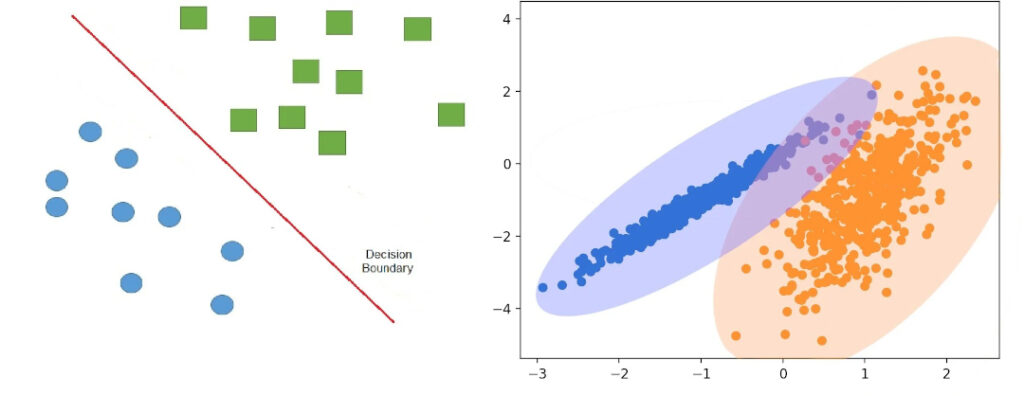
Discriminative AI model HomeThey are trained to recognize patterns in data sets and predict or classify new examples using these patterns. For example, a discriminator AI model trained on a data set containing cat or dog pictures can classify new pictures as cat or dog based on patterns that they learn from input data. Such models are often trained using surveillance learning techniques and are highly effective for specific tasks. They are mainly used to solve specific problems such as classification or prediction.
Generative AI If it is designed to learn the underlying patterns in the data sets and produce those information similar to the original data set but not entirely the same new examples. For example, a manufacturer trained on cat pictures AI algorithm can produce new cat pictures, which looks similar to the original data set but without full copies. When producing models largely learn from unlabeled data, self-controlled (self-supervised) methods; for example, a language model is trained by predicting the next piece in the text. Chat assistants take fine adjustment with human feedback on it. This makes the manufacturer AI particularly useful in applications where configured or regulated data is difficult to scare or obtain.
Surveillance machine learning algorithms used when labeled data is not available. Instead, the algorithm is given with a number of unstructured data sets. Algorithm looks at unstructured data and tries to identify patterns and structures independently without any instructions or prior knowledge. Clustering and anomaly detection are examples of unsupervised learning techniques.
Semi-reviewed machine learning algorithms When there is some labeled data available for training, but it is used when it is not enough to train a full model. Algorithm defines patterns and structures within the data, using labeled data with unlabeled data. Half surveillance learning can be considered as a hybrid approach between surveillance and unsupervised learning techniques.
Generally, the immissive AI develops the ability to produce more broad understanding and new data samples while learning to solve a specific problem. Understanding these two types of AI helps us identify what situations and how they can be used effectively.
Basic Difference Between Artificial Intelligence and Classic Artificial Intelligence
The basic difference is out: the classic model (sector) gives you a tag, score or prediction; the productive model produces a new content. The table below summarizes the difference.
Feature | Classic (also) artificial intelligence | Artificial intelligence (Generative AI) |
|---|---|---|
What does it? | It classifies data, scores, estimates | Produces new content that resembles data |
Output | Tag, probability, number (e.g. "spam" or "spam") | Text, visual, audio, video, code |
Sample tasks | Spam filter, credit risk score, product proposal, fault prediction Home | Chat, text writing, visual and video generation, code writing |
Sample systems | Email filters, recommendation engines, classifiers | ChatGPT, Gemini, Claude, Midjourney, Stable Diffusion |
In short, when you say "generative AI non-human intelligence", you can think the systems that decide or predict but do not produce new content.
Generative AI Working Principle
Generative AI can be considered as an AI version that mimics the creative processes of the human brain. In this field, using various techniques, such as nerve networks and deep learning algorithms, it is possible to identify certain patterns and produce new results based on them.
The training process of Generative AI usually starts with a large set of data. This data set may contain examples such as images, text, audio or videos. The model tries to figure out the basic rules that the content is managed by by analyzing patterns and relationships in input data. Next, we produce new data by pulling examples from the distribution of the possibilities you learn. It constantly tries to maximize the potential to produce the correct output by adjusting its parameters.
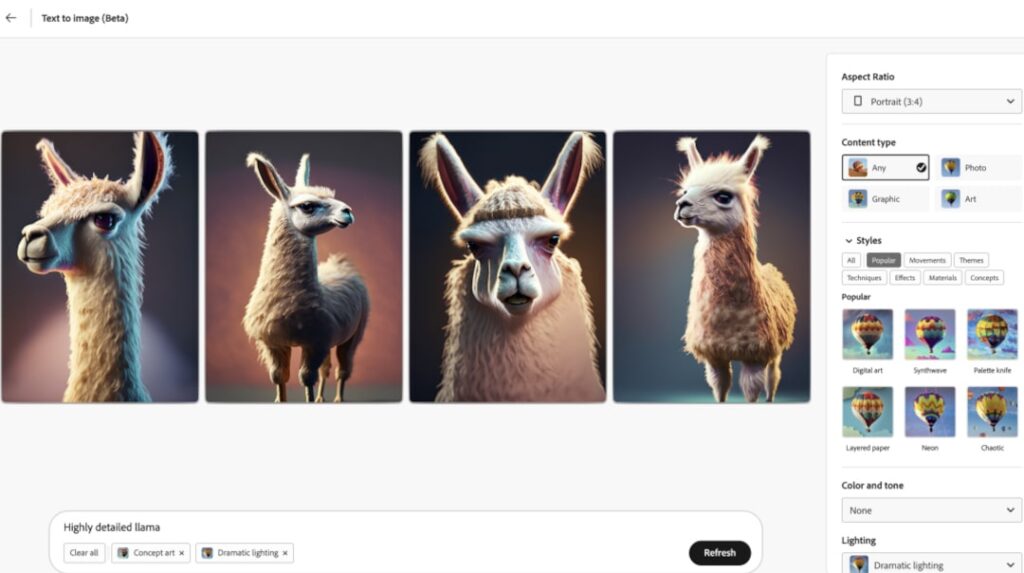
For example, a generative model trained on a data set consisting of lama images can create new lama images by highlighting examples from the learned distribution and then refining the output with a process called "paper". During removal, adjusts the model output better to the desired output or to fix any error. This ensures that the output generated is more realistic and better fit with what the user wants to see.
Generative AI has the potential to revolutionize creative content production. Using art, music, literature and even scientific discoveries, it can open the door of undistable innovations before. The work done in this field allows AI to turn into a technology that can only be a analytical tool, mimic human creativity, or even support.
What Are Generative AI Models?
Generative AI models are not the only type. Today, this type of artificial intelligence has been launched as different models by different artificial intelligence companies. Here are the most known of this type:
Model Type | How does it work? | Strong | Known examples |
|---|---|---|---|
GAN (2014) | The separator with the generator is trained against each other | Fast and sharp visual production in one step Home | StyleGAN, CycleGAN |
AaUppercase | Compresses data from hidden space, regenerates from there | Controlled variation, compression | Image encoder-breaker on Stable Diffusion |
Fusion (2015, 2020) | It creates visuals by cleaning the noise step by step | High visual quality, text guiding | DALL·E 2, Stable Diffusion |
Transformer based LLM (2017) | It produces text by predicting the next piece (token) | Text, code, chat, multilingual use m | GPT, Gemini, Llama |
Flow-based (Glow, 2018) | It uses reversed conversions | Full calculation of potential | Glow; Stable Diffusion 3 with flow matching |
Generative Adversarial Networks (GANs)
Generative Adversarial Networks (GANs) is an artificial intelligence model composed of two nerve networks: a generator and a separator. For example when you are asked to create cat pictures, the generator produces new cat picture using a random input vector.
These pictures may be simple initially, but it becomes realistic over time. The separator works to classify real or fake by taking both real cat pictures and fake pictures produced.
Both networks develop continuously by competing with each other: make the separator better classification, the generator learns to create more inconductive pictures. This competitive structure has caused the use of "adversarial" expression called the model.
Training Process of GANs
Training process of GANs (Generative Adversarial Networks-produced Traction Networks) is a rather interesting and innovative approach. This process consists of the following steps:
Start Tags: Generator (generator) and distinguishing (discriminator) are launched with random weights. The main idea here is that two networks compete with each other.
Training Cycle: The generator is trained on the combination of distinctive real and fake data when creating fake data communities. The cradle gives a possibility score between 0 and 1, stating whether the input data is real or fake.
Back Spread (Home): The error signal from the shutter spreads back to update the weight of the network. Then, the generator is also trained using the fault signal from the distinguishing and updated its weight.
Sampling: After the model is trained, the generator can produce new data samples from the learned distribution.
GANs have been used for various applications such as producing realistic images, videos and conversations. One of the advantages of GAN is that they can produce high quality and various examples thanks to their ability to learn complex and multi-mode distributions.
However, training of GANs can be difficult and they may suffer from problems such as mod collapse (mode crash), here the generator produces limited and repetitive examples. Various modifications and improvements were recommended to address these problems, such as Wasserstein GANs and StyleGANs.
Application Areas of GAN
GAN’s (Generative Adversarial Networks) is an artificial intelligence technology composed of two networks, allowing innovative applications in various fields. These:
Image and Video Production/Manipulation: Displays and deep fakes (deep fakes).
Style Transfer and Video from Image translation: Convert images by applying different styles.
Data Recovery and Syntheticization: Used to improve the performance of controlled learning models.
Synthesis and Image Subtitle from Text: Visualize written text or add subtitles to images.
3D Object Production and Design: Creating realistic avatars and virtual environments.
Sound Transformation and Sound Synthesis: Sound and music production.
Game Development and Design: Create new levels and characters.
Creative Applications: Art, music, literature production.
Security & Privacy: Fake data generation and deep counterfeiting detection.
Scientific Research and Simulation: simulate complex systems and make scientific predictions.
CycleGAN is a GAN example used for translation from image to image and can convert images without unmatched training data. The effectiveness of GAN depends on the quality of educational data, complexity of the underlying distribution and factors such as the architecture of the model.
Variable Automatic Encoders (VAEs)
Variable Automatic Encoders (VAEs) are regenerative models used in the field of artificial intelligence. These models can produce new outputs that are similar to data sets, especially they are effective in exploring the correct variations of certain directions within the data. VAEs work through two network of nerves, which include a encoder and solvent to take a image.
The coder converts the image into a low-sized representation called 'hid space' and produces a new image similar to the original using this representation of the solvent. The distinctive feature of VAE is that it uses exceptional models to learn the distribution underlying under educational data. In this way, they can better capture uncertainty and variable in data. VAEs carries great potential for innovative applications in areas such as visual arts and data simulation.
Training Process of VAEs
Variable Automatic Encoders (VAEs) is a widely used method in machine learning and is especially effective in applications such as data generation, compression, noise removal and property extraction. The training process of VAEs consists of the following steps:
Coding (Encoding): Input data is fed to the encoder network (encoder). This network compresses data to a lower-sized "latent" space. This hidden space is based on Gaussian distribution assumption.
Sampling (Sampling): A random spot in the hidden space from the Gaussian distribution learned.
Code Solving (Decoding): Code solvent network (decoder), takes the sampled point and converts it to a new point of data. Code solvent is trained to reconfigurate the original input data using hidden space representation.
Lost Calculator (Loss Calculation): The loss function for VAEs consists of restructuring loss and loss of KL-divergence (Headback-Leibler deviation). Restructuring loss measures how well the code solvent can restructure the original input data. On the other hand, KL-divergence loss measures the difference between the distribution of the learned secret space.
Back Spread (Backpropagation): The error signal from the lost function, spreads back across the network to update the weights of both encoder and decoder.
After the training is completed, VAE can produce new data by sampling from the distribution of the secret space learned. VAEs can also be used in other applications such as data compression, noise removal and property removal. For example, image noise removal application can be made with automatic encoders.
Application Areas of VAE
Variable Automatic Encoders (VAEs) is an artificial nervous networks-based technology that has an important place in the field of artificial intelligence and machine learning. This technology is used in many areas, especially as data generation and manipulation. Here are some of the areas of application of VAEs:
Image Production and Manipulation: VAEs can produce new and realistic images or change existing images. This offers new creativity in the field of art and design.
Video Production and Forecast: VAEs can be used to create video contents and predict future squares.
Data Compression and Noise Removal: VAEs are quite effective in reducing data from compression and noise, thus require less storage space and increases data quality.
Abnormality Detection and Excavation Value: VAEs can be used in detecting abnormal or illegal items in datasets and removing them.
Recommendation Systems and Personalization: Uses VAEs to provide customized content and product recommendations according to personal preferences.
Feature Extraction and Representation: VAEs are used to learn more meaningful and useful representations of data.
Producing realistic 3D Models and Environments: VAEs can be used to create 3D models and virtual environments that resemble the real world.
Natural Language Processing: VAEs have an important role in natural language processing, including text production and machine translation.
Biomedical Data Analysis and Drug Discovery: VAEs are used in the analysis of biomedical data and discovery of new pharmaceutical candidates.
Simulation and Forecast in Physics and Other Sciences: VAEs are used to simulation and forecast in various science branches.
Diffusion Models
Diffusion models come to us as an innovative step in the field of artificial intelligence. These models add noise to the basic data to produce high quality synthetic data and learn by removing this noise. Thanks to the noise extraction process, diffusion models make data patterns and structures better understand.
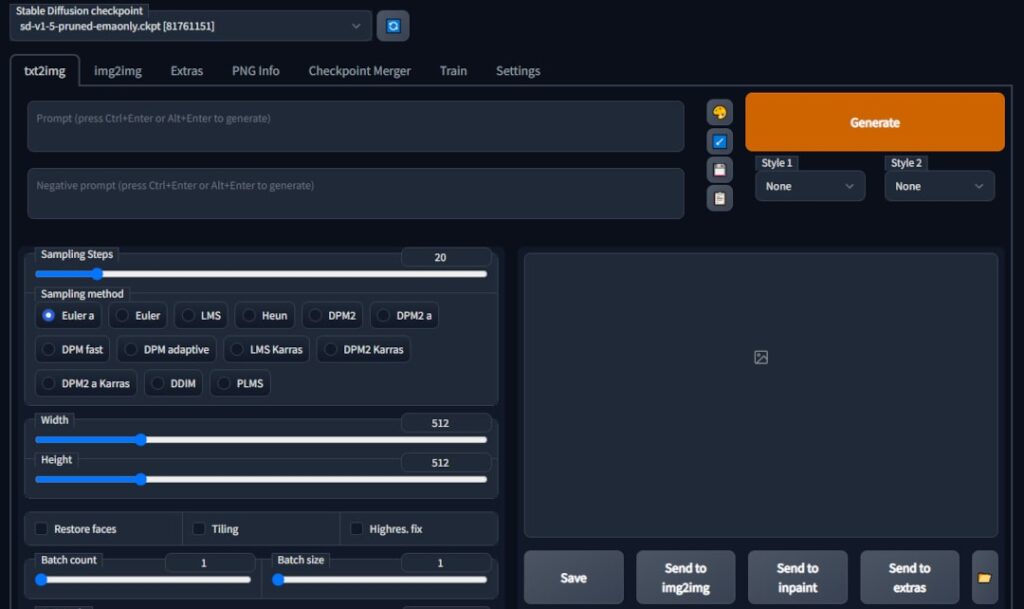
These models are particularly successful in creating images. The model in the training learns to predict the noise added to the data, this simple goal makes training more stable than two network competition in GAN. Bedeli is slower operation due to the production is very stepped. OpenAI's DALL·E 2 model (2022) and Stable Diffusion (latent diffusion) that works in a compressed hidden space before the image is an example of diffusion models that produce visual from text. The first DALL·E (2021) was not diffusion, but an autoregresific transformer model.
Other Generative AI Models
We have seen Generative AIs mainly divided into 3 different models. But more innovative and experimental Generative AI models are also available. These models are listed in detail below.
Autoregresific Models
Autoregresif models are the possibilities of predictive models based on the previous elements, each element by producing a data array in turn. In the field of natural language processing (NLP), they are often used in tasks such as text production and language translation. These models predict the next value by looking at previous values in a number. For example, the price of the next day based on the prices of the previous days in the time series analysis of stock prices can be predicted.
Large Language Models (LLMs), using such autoregresific models, they produce human-like responses to commands. They are trained on large text data sets such as books, articles and websites, and they are designed to produce new texts in style and content similar to actual data. LLMs have obtained successful results in many languages such as language modeling, machine translation, question-taking and text abstracting.
It is also important in creative works such as high quality text generation capabilities, chat assistants, code typing, abstracting and social media posts. How to train LLMs Home What is the Big Language Model (LLM), How To Be Educated? In our article we explained in detail.
Transformer Based Models
Transformer architecture was introduced in 2017 with the article "Attention Is All You Need" of Google researchers; today large language models such as GPT, Gemini and Llama are installed on this architecture. Transformer is a kind of nervous network architecture based on its own attention mechanism. When an input is given, the mechanism allows the model to assign weights in parallel to different parts of the input array.
Then, the model determines the relationship between these sections and produces the corresponding output to the special input. Transformers are popularly used for NLP tasks such as language translation, production and question-taking. However, unless they are specially trained to create new content, they can not only be considered as generative models.
Flow Based Models
Flow-based models are a kind of generative AI models and focus on learning the organization of data in a data set. These models work by understanding the possibilities of values/events in the data set and identifying what often occurs. When producing new data points, they protect the statistical properties and characteristic of existing data. The feature of these models is that they apply existing data can be easily reversed or reversed by a “simple reversal conversion”.
Because the conversion is reversed, these models can fully calculate the possibility of a data and can produce the sample from a simple starting distribution (e.g. random noise). Glow released in 2018 is the known examples of this approach. Disadvantage is the restraint of the architecture of the requirement of each layer to be reversed.
The idea of flow is back in different ways today: Stable Diffusion 3 was introduced in 2024 as a transformer model trained by the flow matching method called "rectified flow". So, diffusion and flow approaches in up-to-date visual models are imported. For Details Stable Diffusion 3 See our article.
If you want to try artificial intelligence tools while producing Artificial Intelligence Visual Building Guide with MidjourneyTags How to Use DALL·E 2 Artificial Intelligence Image Creation Tool? and Creating Visual and Video with Artificial Intelligence You can browse our articles. For general definition of artificial intelligence What is Artificial Intelligence? Our article is a good start.
Frequently Asked Questions
What does Generative AI mean?
Generative AI means "natural intelligence" in English. It tells about new text, visual, audio, video or code-generating artificial intelligence systems that resemble data they learn.
What is the main difference between classic artificial intelligence with Generative AI?
Classic classifies or predicts the data that has artificial intelligence; generative AI produces new content. For example, spam filter "spam" tags, a language model, writes you a new email.
What are examples of artificial intelligence without Generative AI?
Systems such as spam filters, credit risk score, product recommendation systems, fault prediction and object detection in image are examples of non-professional artificial intelligence. These decide or predict, do not produce new content.
What is Generative Adversarial Networks (GAN)?
GAN is a productive model, introduced in 2014, and trained against two nerve networks. The generator produces fake examples, the separator tries to separate them from their truths, making this competition more realistic outputs.
ChatGPT is a generative AI?
Yes. ChatGPT is a productive artificial intelligence application that works with large language models based on transformer architecture; it produces new text by predicting the next word parts according to the command you give.
CreatorMeta’nın Çığır Açan Yeni AI Uygulaması: Duygusal Anlamda İletişim!

GenAI: Çok Yönlü Yapay Zeka Platformunuz