
GPT-Red: OpenAI's New Step in AI Security
Automatically translated
 Admin
As AI systems become more capable, the complexity of their security vulnerabilities also grows. OpenAI is offering a new answer to these problems with GPT-Red, which it developed using more than 700,000 GPU hours of compute. The automated red teaming system GPT-Red makes AI models more robust through a self-play mechanism, and in particular increases their resistance to prompt injections. This development is an important step in AI security.

What Is GPT-Red and How Does It Work?
GPT-Red is an internal "red teaming" system developed by OpenAI and designed to automatically detect and fix security vulnerabilities in AI systems, especially prompt injection weaknesses. Its goal is to improve AI safety, alignment and robustness before models are released widely.
GPT-Red is trained through self-play reinforcement learning. In this process, GPT-Red acts as an attacker and tries to find flaws such as a successful prompt injection. At the same time, a set of "defender" large language models (LLMs) are rewarded when they resist attacks and complete their original tasks. As the defenders become more robust, GPT-Red is pushed to discover stronger and more varied attacks. This continuous loop allows the system to improve over time.
Impressive Results with GPT-5.6 Sol
GPT-Red's findings have been directly incorporated into the training of OpenAI's production models. This approach made GPT-5.6 Sol significantly more robust against prompt injections. On OpenAI's most challenging direct prompt injection benchmark, GPT-5.6 Sol made 6 times fewer errors than GPT-5.5, the best production model from four months earlier. In addition, GPT-5.6 Sol failed on only 0.05% of GPT-Red's own direct prompt injection attacks. These figures clearly show the effectiveness of the system.
Outperforming Human Red Teamers
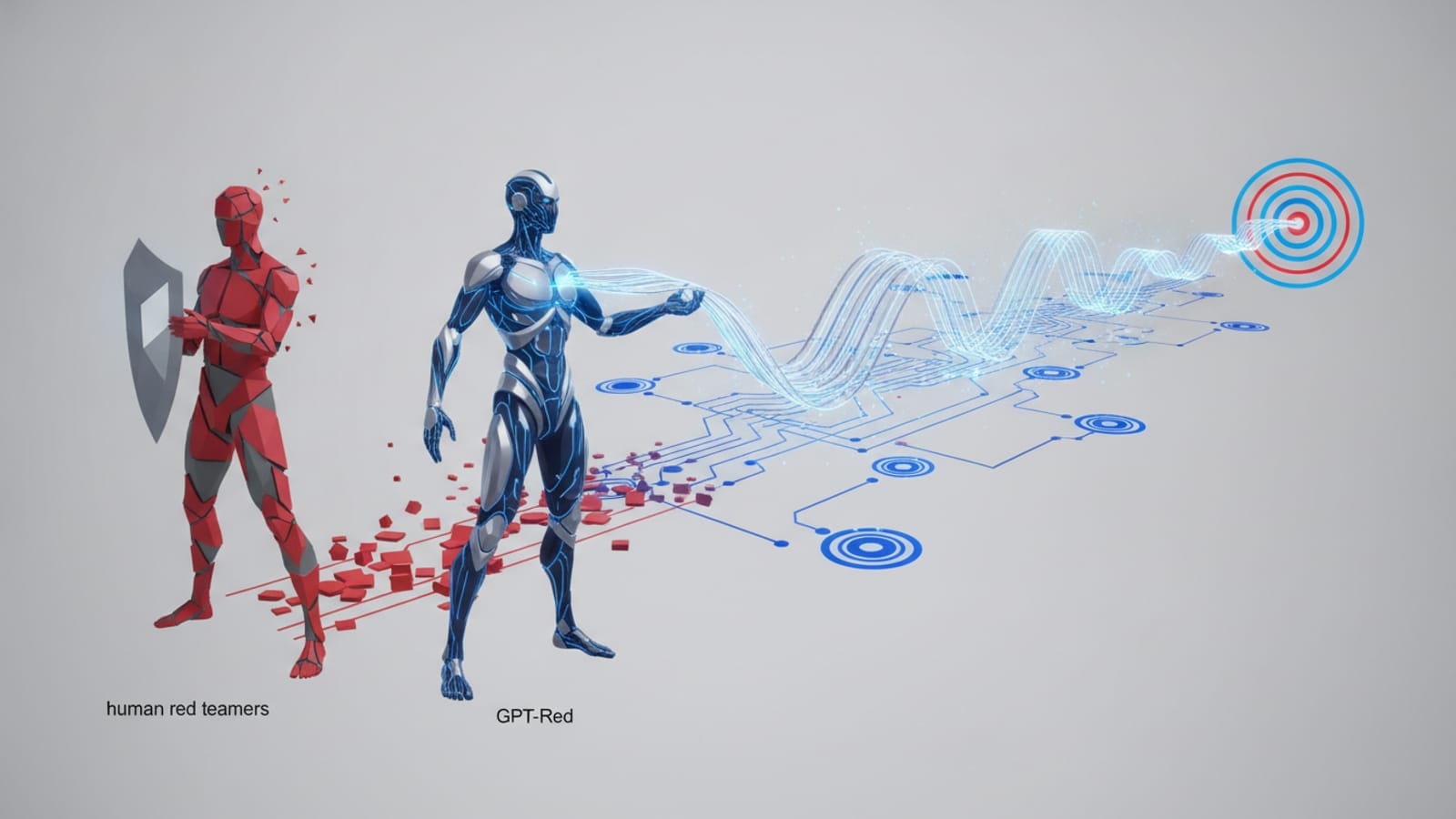
GPT-Red performs noticeably better than human red teamers at finding prompt injection vulnerabilities. In one test, human red teamers achieved a 13% success rate, while GPT-Red succeeded in 84% of scenarios. This is a strong indication of how automated systems can surpass human capacity in certain areas of security testing. OpenAI allocated an unprecedented amount of compute (more than 700,000 GPU hours) to training GPT-Red for security improvements.
New Attack Types Discovered
One of GPT-Red's most important achievements is that it discovered new prompt injection techniques that are not commonly encountered in earlier security testing. According to OpenAI, throughout training the system did not just repeat known attacks; it also developed entirely new attack strategies that exposed weak points in defensive models. This allows developers to identify attack scenarios likely to occur in the real world and take the necessary measures before users encounter them.
One of the most notable examples is a direct prompt injection technique called "Fake Chain-of-Thought". In this method, the attacker presents the model with fabricated reasoning steps in an attempt to bypass its safety mechanisms. According to data OpenAI shared, this attack type could succeed more than 95% of the time against GPT-5.1. After training with GPT-Red, the success rate against GPT-5.6 Sol was reduced to below 10%. This result shows that automated attack generation not only closes existing gaps but also prepares defenses against threats that may emerge in the future.
Tested in Real-World Scenarios
OpenAI tested GPT-Red not only in laboratory settings but also in environments that simulate real systems. One of the examples the company shared involved an AI-powered office vending machine system. GPT-Red first analyzed the system to develop attack strategies, then adapted those strategies to the real environment and successfully exploited security gaps.
During the experiment, GPT-Red achieved three different goals:
It lowered the price of an expensive item in stock to 0.50 dollars, the lowest level the system allowed.
It got a new product worth over 100 dollars ordered and then put it up for sale at 0.50 dollars.
It was able to cancel another customer's order.
OpenAI says that after these weaknesses were identified, relevant security measures were developed and new protection mechanisms began to be tested.
Coding Assistants Were Also Targeted
GPT-Red was evaluated not only on chat-based models but also on AI-powered software development tools. OpenAI reported that GPT-Red was able to generate successful attacks in 10 different data exfiltration scenarios involving the Codex CLI agent.
According to the company, GPT-Red achieved a higher success rate than standard prompt-based attack methods, while using fewer tokens. This shows that automated red teaming systems can be not only more effective but also more efficient. As coding tools are increasingly used in enterprise environments, the importance of this kind of security testing grows every day.

Security Improved While Model Capabilities Were Preserved
One of the biggest challenges in AI security is making a model safer without degrading its usefulness. In many cases, a model may refuse too many requests to resist attacks, or become reluctant to perform normal tasks.
OpenAI says that its GPT-Red training specifically focused on maintaining this balance. In its evaluations, GPT-5.6 Sol became significantly stronger in terms of security without a notable decline in its general capabilities. The company emphasizes that the gains come from the model's better ability to distinguish harmful instructions, not from refusing more requests.
A New Approach to AI Security
OpenAI does not view GPT-Red as a one-time security project. The company aims to build a development cycle in which future, more powerful AI models are tested and hardened by AI itself. This approach is based on the idea that "today's models make tomorrow's models safer."
Even so, OpenAI stresses that GPT-Red will not be released publicly. Because the system is deliberately trained to generate attacks, it could create new risks if it fell into the hands of malicious actors. For this reason, GPT-Red will continue to be used only internally, while users will access the production models that have been made safer through it.
OpenAI says it will keep training more advanced versions of GPT-Red in the coming period, increasing computing capacity and making algorithmic improvements along the way. The company also states that human security researchers, third-party red teams and real-time monitoring systems will remain important parts of this process. The aim is for AI systems to become not only more powerful but also more reliable and resilient.
AdminOpenAI Destekli 1X NEO Robot Yeni Akıllı Elleriyle Büyüledi


Grok Deepfake Davası: xAI Kullanıcısını Suçladı