Higgsfield Virality Predictor Guide: What Is Hook Score?
Automatically translated
 Writer
Sometimes, something really strange happens on TikTok. A video that looks technically poor can get millions of views, while another, professionally shot video struggles to get past 800 views. At some point, you realize something: it's not just about visual quality. It's about whether people stay on the video during the first 1-2 seconds.
The short-form video landscape has changed completely over the past few years. Content creators used to focus on finding a “good idea.” Now, they're fighting for attention from the very first second. That's because user behavior on TikTok, Reels, and Shorts has become incredibly aggressive. People don't give videos a chance anymore. If you can't spark curiosity in the first second, they're already scrolling.
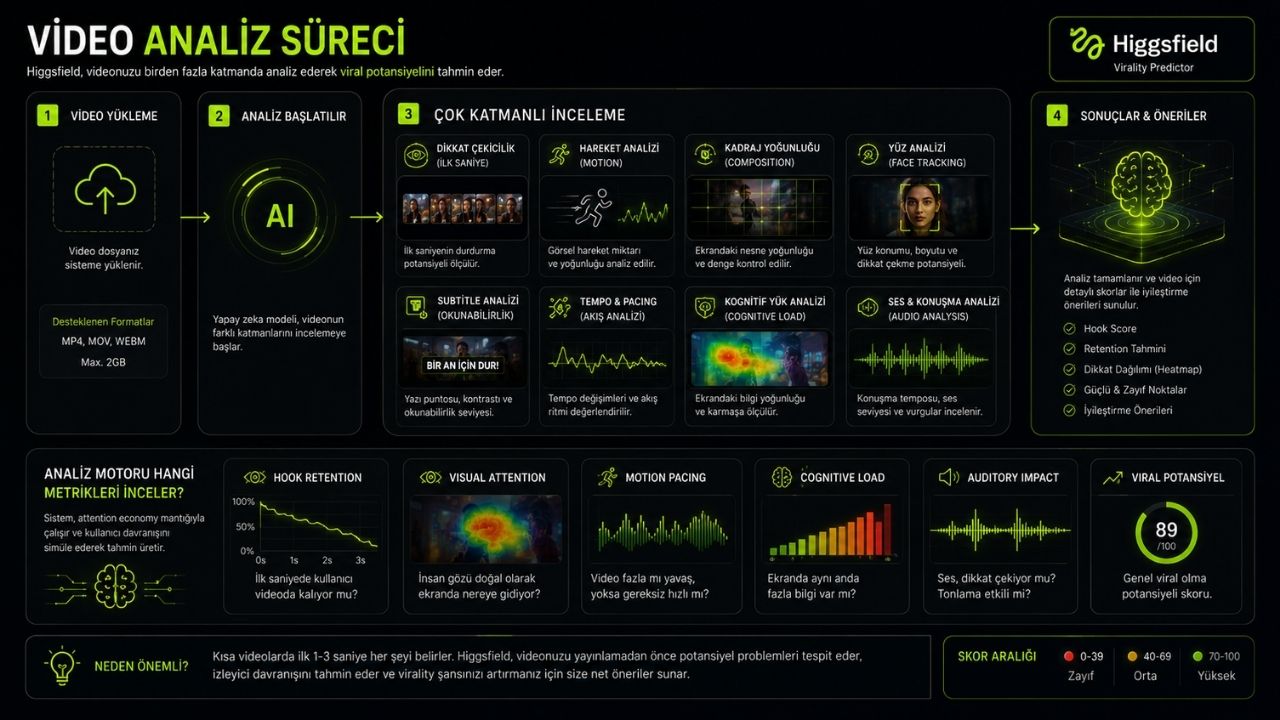
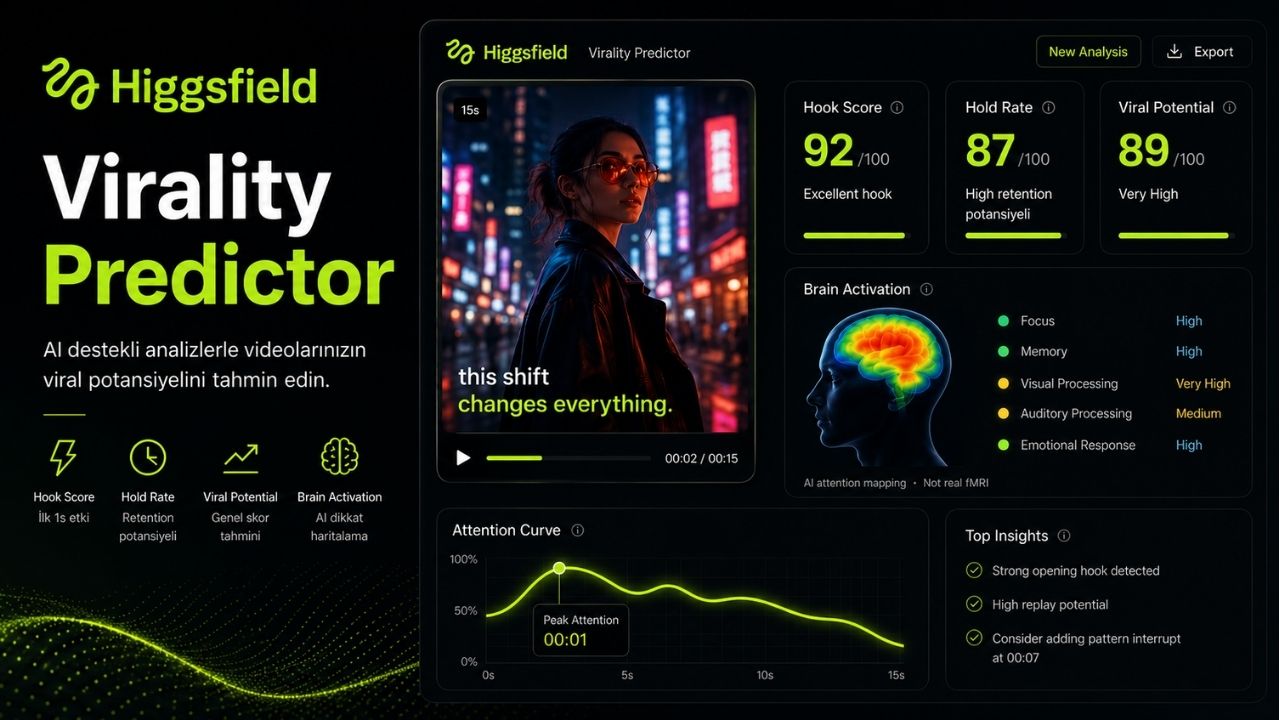
Higgsfield's Virality Predictor tool focuses precisely on this problem. It focuses precisely on this problem. When you upload a video, it doesn't simply tell you that it “looks good.” It attempts to analyze things like whether attention drops during the first few seconds, which areas of the screen attract viewers' eyes, whether the hook is strong enough, and where retention starts to decline.
What's actually interesting is that most AI tools have focused on the production side until now. Generate videos, create avatars, automate editing, clone voices... What makes Higgsfield different is that it goes directly into the analysis side of things. This is particularly critical for content teams producing short-form videos because the creator economy now revolves entirely around retention and attention.
What Exactly Does Higgsfield Virality Predictor Do?
At its core, the tool attempts to analyze the viral potential of short-form videos. But we're not talking about fake “viral score” systems designed around clickbait. The real focus is behavioral prediction.
After users upload a video to the system, the model analyzes its different layers. It evaluates multiple signals together, including first-second engagement, frame density, amount of movement, face positioning, subtitle readability, pacing, and attention distribution. In other words, it works a little differently from traditional analytics tools. YouTube Analytics gives you data after the results are in. Higgsfield, on the other hand, attempts to generate predictions before a video is published.
The tool appears to be specifically optimized for short-form content. The fact that the system currently supports videos of up to 15 seconds makes this clear. That's because on TikTok, the battle is often won or lost within the first few seconds. Especially recently, the TikTok algorithm has started placing significantly more emphasis on the opening seconds of short videos.
In today's short-form video landscape, people aren't consuming content; they're scanning it. That's why the system attempts to analyze behavioral signals such as hook retention, visual attention, motion pacing, and cognitive load together. This is particularly important for teams working in video content marketing because sometimes the reason behind poor performance isn't the idea itself, but simply a lack of focused attention.
Why Is Hook Score So Important?
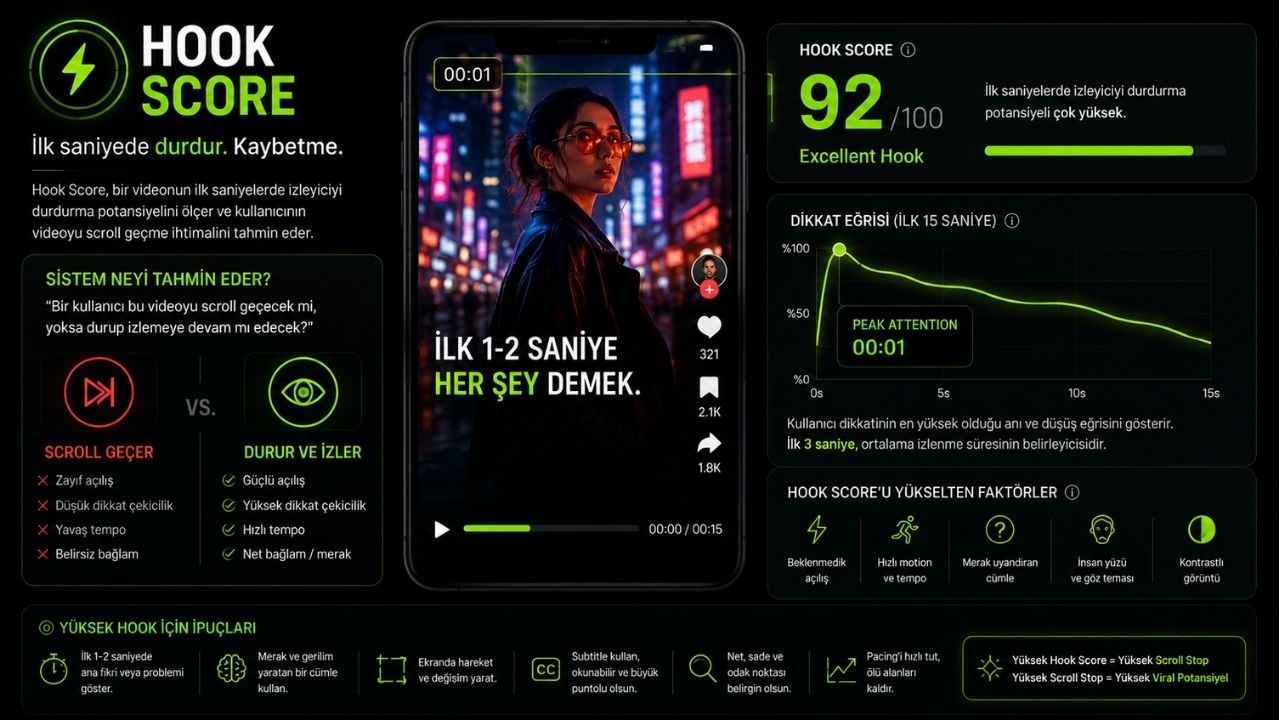
The biggest battle in the short-form video world is now the battle for attention. People don't want to simply see content; they want a reason to stop scrolling. Hook Score attempts to measure exactly that. In short, the system is looking for an answer to this question: “Will a user scroll past this video, or stop and keep watching?”
One of the most important signals in the TikTok algorithm is scroll-stop behavior. In other words, does the user actually stop on the video? If you can't create curiosity within the first second, the algorithm often won't push your video, no matter how high its production quality is. That's why creators are no longer designing videos like traditional stories. Instead, they're building attention-triggering structures. Unexpected openings, fast motion, high-contrast visuals, human faces, sudden audio changes, and curiosity-inducing statements can all generate higher Hook Scores. But there's an interesting detail here: some cinematic videos can receive low Hook Scores despite looking technically perfect. That's because the algorithm doesn't seem to favor slow openings anymore.
x.com/higgsfield/status/2053139109074657482
Still, there's an important mistake people are making here. Many have started treating AI scores as “guaranteed success.” But a video with a low Hook Score can still go viral. Likewise, a video with a high score can fail completely. That's because cultural context still matters enormously. Humor formats that work particularly well in Türkiye, for example, can sometimes produce behaviors that have no equivalent in global datasets.
Why Is Brain Heatmap Getting So Much Attention?
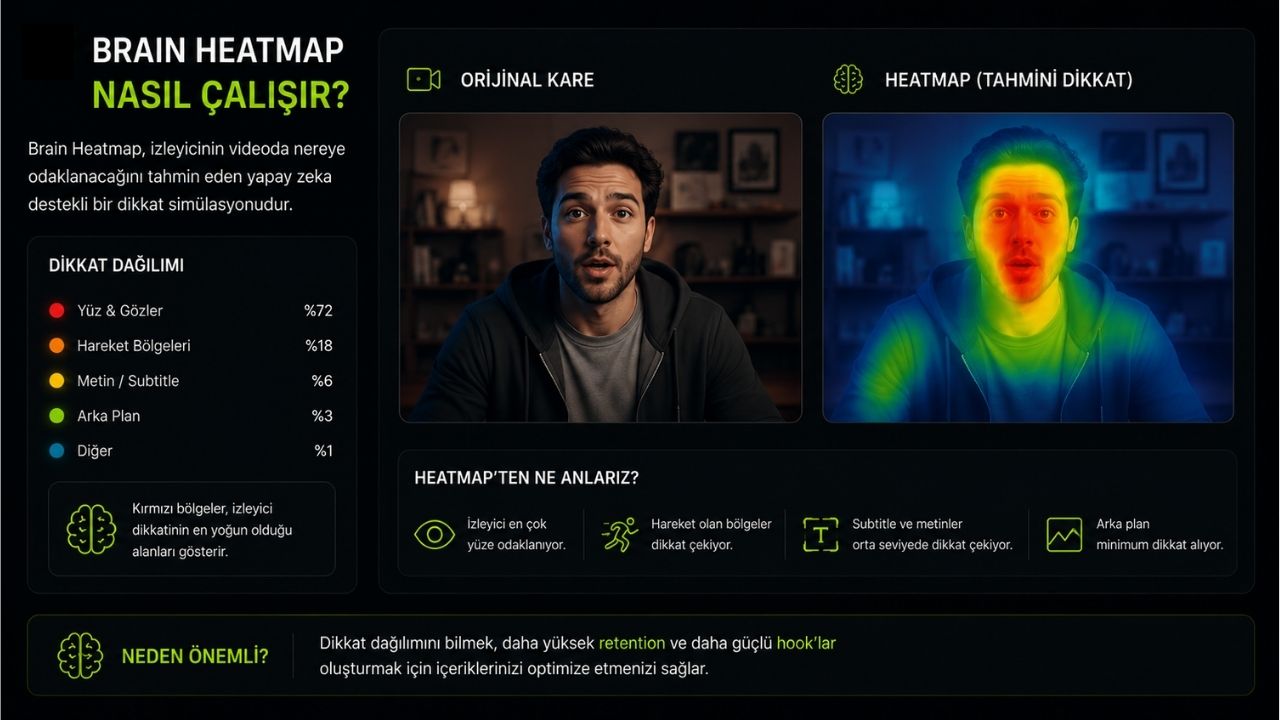
Probably the most impressive part of the tool is its Brain Heatmap system. That's because this feature doesn't simply generate a superficial score like “good video / bad video.” It attempts to model where people actually look while watching a video.
The system predicts which areas of a video will attract the most attention. At first glance, it looks like an eye-tracking simulation, but there's a little more to it. According to the technical details shared by Higgsfield, the system attempts to evaluate different cognitive signals together, including attention, memory, auditory response, and emotional response.
This could be incredibly valuable, especially for advertising creatives. That's because the problem with many ads isn't actually the idea itself; it's not knowing where viewers will focus their attention. While the CTA is positioned on the left, people's eyes might be drawn to the movement in the background. Or the scene might change before the subtitles can even be read. The Heatmap attempts to show the flow of attention directly.
The fact that human faces remain one of the internet's strongest attention triggers is also important here. The system seems to place considerable emphasis on factors such as face positioning, eye contact, close-up shots, and motion intensity.
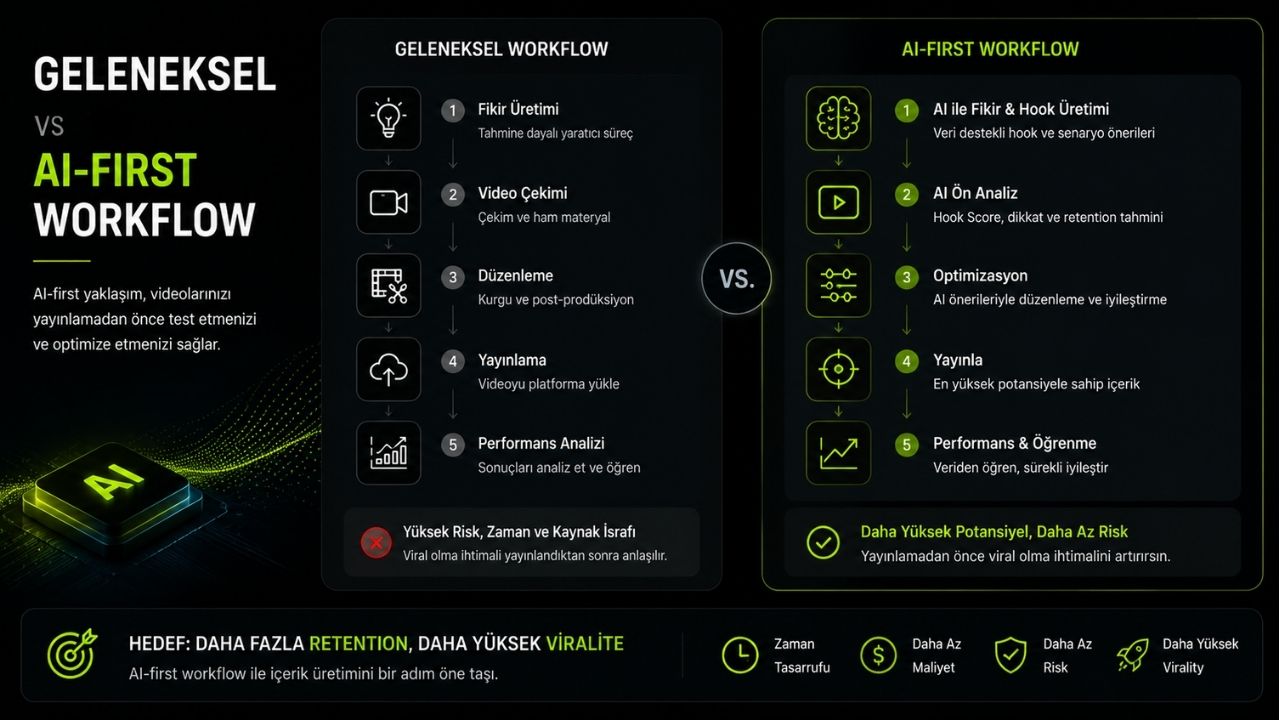
Meanwhile, the growth of AI-powered video creation tools has made these kinds of analysis systems even more important. That's because the goal is no longer just to produce content; it's to optimize the performance of that content before publishing it.
How Is AI Video Analysis Changing Content Creation?
I think this is where things really get interesting. Because the entire creator workflow is changing. The process used to look like this: publish the video, wait for analytics, examine retention drops, and create a new version. Now, you can identify certain problems before the video even goes live. Is the intro too long? Are the subtitles readable? Are there too many objects on the screen at once? Is the pacing boring? Does viewer attention drop at specific moments?
This could be particularly critical for creators working in UGC because brands no longer just want a “good-looking video.” They want retention. Many creator briefs now include requirements like these:
The product must appear within the first 2 seconds
Fast cuts must be used
Subtitles are mandatory
The problem must be stated in the opening sentence
Video content marketing is becoming entirely data-driven. For performance marketing teams in particular, a poor creative directly translates into wasted advertising budget. If underperforming videos can be filtered out in advance, this could provide a significant cost advantage. But there's also a somewhat unsettling side to this. When everyone starts applying the same optimizations, content begins to look increasingly similar. A serious homogenization problem is emerging in the short-form video world right now. The same hooks, the same pacing, the same jump cuts, the same subtitle styles...
Can Viral Content Really Be Predicted?
This is where things get controversial because virality isn't entirely mathematical. Sometimes, a terribly shot video gets millions of views, while a perfectly optimized video goes nowhere.
Still, certain patterns repeatedly appear in viral short-form videos. Movement in the first second, rapid context-setting, early tension, constant visual changes, and unexpected transitions are among the most common. AI systems are attempting to learn precisely these patterns. But cultural timing is still incredibly important. Meme culture in Türkiye, in particular, changes at an astonishing pace. Some content takes off simply because it captures “the spirit of the internet at that particular moment.” AI can't always understand that. That's why it's a mistake to treat tools like Virality Predictor as a “guarantee of success.” A more accurate way to look at it might be this: AI can show you your blind spots, but it can't replace your creativity.
Where Are AI Analysis Tools Heading?
I think we're still at the very beginning. It looks like the content creation process will soon become entirely AI-powered. You'll simply provide the idea. The system will generate a hook, create a thumbnail, suggest pacing, and produce a retention prediction for you. The fact that Higgsfield already offers MCP and CLI support also shows that creator workflows could be automated. In theory, we could see pipelines like this in the future:
Video generation → AI analysis → automatically replacing the hook with a low score → testing again.
This sounds a little like Black Mirror, but it's technically possible now.
Solo creators are now operating like small media companies. That's why analysis tools are likely to become even more important.
WriterGoogle Devri Kapandı mı? Reklamın Yeni Patronu: Advantage+


Otonom Yapay Zeka Savaşları: Intel mi, AMD mi?