



Nvidia Nemotron-3: New Open-Source AI Model for Multi-Agent Systems
Automatically translated
 Writer
Large language models (LLMs) have moved beyond tools that only generate text or images and have become one of the core building blocks of complex AI systems. As multi-agent systems become more widespread, the need for models optimized specifically for this area keeps growing. Nvidia Nemotron-3 is an open-source, agent-focused large language model family developed to meet exactly this need.
Nvidia Nemotron-3, is an open-source LLM model family introduced by Nvidia and optimized specifically for multi-agent architectures. Nemotron-3 is not a single model but a structure made up of several models, each customized for a different task. Standing out as an infrastructure-focused model family rather than a general-purpose LLM, Nemotron-3’s main goal goes beyond the classic chatbot concept and covers:
- A system in which multiple AI agents work together
- Autonomous agents that share tasks
- Enterprise and industrial workflows
- Reliable infrastructure for simulation and decision support environments
Why Was Nemotron-3 Developed?
Large language models are generally designed as structures that interact with a single user. However, modern AI applications increasingly face the following needs:
- The need to run multiple tasks at the same time
- The need for coordination between agents
- The ability to evaluate decisions in relation to one another
- The need for a modular and scalable AI system
Nvidia Nemotron-3 was developed precisely to meet these needs, with a multi-agent systems approach at its core. The goal is for agents, each specializing in a particular task, to work on a shared language model infrastructure.
What Are Multi-Agent Systems?
Multi-agent systems are systems in which many autonomous AI agents work together toward a common goal or on independent tasks. In these systems, each agent can take on a different role, agents are affected by each other’s outputs, and they can share tasks.
Nemotron-3’s Contribution to Multi-Agent Systems
For multi-agent architectures that make agent-based automation and decision support systems more capable, Nvidia Nemotron-3 offers the following advantages:
- Easy integration between agents thanks to being open source
- Optimization of task-based response generation
- Adaptability to enterprise workflows
- Suitability for modular AI designs
Why Is Nvidia’s Open Source LLM Important?
Nvidia Nemotron-3 is an important example of Nvidia’s open source LLM approach. With this model family, Nvidia aims to offer a more transparent and developer-friendly alternative to closed and license-restricted systems. Making the system available as open source also brings many advantages, which can be listed as follows:
- Model architecture can be inspected by developers
- Can be adapted to specific needs through settings such as fine-tuning
- Can be used in enterprise projects without license barriers
- Suitable for academic research
This way, Nemotron-3 provides an open-source infrastructure that can be used confidently in both research and production environments.
Synthetic Data Generation in Nemotron-3
Although Nemotron-3 is not a system centered on synthetic data generation, it has a foundation that supports this area. Because the model is trained for task-based and agent-focused scenarios, it can work smoothly with different types of data. Nemotron-3 provides infrastructure for models that generate synthetic data, the outputs produced by agents can be reused as synthetic data, and most importantly, it becomes possible to increase data diversity in test and simulation environments. In this respect, Nemotron-3 makes a noticeable, if indirect, contribution to synthetic data generation processes.

Nemotron-3 Technical Details and Model Family
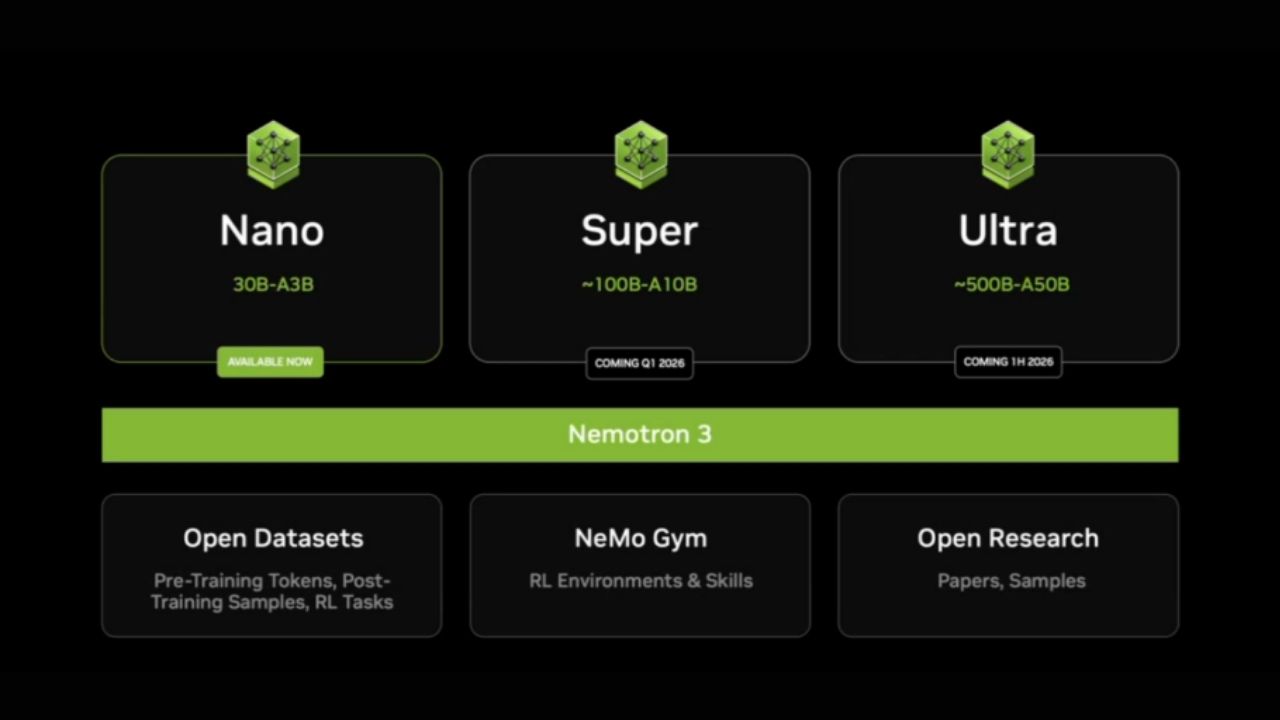
Nvidia Nemotron-3 is a model family that can be configured for different usage scenarios. Nemotron 3 Nano, Nemotron 3 Super and Nemotron 3 Ultra make up Nemotron-3, which consists of 3 models. Technically, it has the following key features:
- Task-focused model variants
- Scalable architecture
- Agent-based usage scenarios
- Integration with the Nvidia AI ecosystem
Nemotron-3 Nano
Nemotron-3 Nano is the lightest member of the Nemotron-3 family. Optimized for low latency and limited hardware environments, this model is designed especially for edge computing scenarios and lightweight agent tasks. Nemotron-3 Nano is used for basic agent communication, simple decision-making processes and low-complexity tasks. In multi-agent systems, it takes on a supporting or auxiliary agent role. In this respect, Nemotron-3 Nano is ideal for moments when high performance is not required but fast response time is critical.
Nemotron-3 Super
Nemotron-3 Super offers a balance between performance and resource consumption. It is designed for enterprise applications and medium-scale multi-agent systems. Nemotron-3 Super can be used effectively for task sharing, coordination between agents and complex decision-making processes. Preferred as the primary agent model that carries out the main tasks, Nemotron-3 Super is the most suitable Nemotron-3 model for developers seeking both flexibility and scalability.
Nemotron-3 Ultra
Nemotron-3 Ultra is the most powerful member of the Nemotron-3 model family. Designed for scenarios that require high computing capacity, Nemotron-3 Ultra is used in complex multi-agent systems and in advanced planning and evaluation tasks. It is well suited to large-scale simulations and decision support systems. Nemotron-3 Ultra is generally used as the core control agent of the system. In this way, it analyzes the outputs coming from other agents and feeds top-level decision mechanisms.
Requirements for Setting Up Nvidia Nemotron-3
For developers who want to use Nemotron-3, the process is similar to that of Nvidia’s other open models.
System Requirements
- CUDA-enabled GPU
- PyTorch-based working environment
- High memory capacity
Model Access
- Nvidia Developer platform
- Open-source model repositories (e.g. Hugging Face)
Use Cases
- Core model in multi-agent systems
- Task-based agent infrastructure
- Enterprise automation solutions
- Both research and commercial projects
Who Is Nvidia Nemotron-3 Suitable For?
- Developers working on Multi-agent systems
- Organizations looking for open-source LLM infrastructure
- Teams developing agent-based automation projects
- Academic and AI researchers
Nvidia Nemotron-3 is an open-source, infrastructure-focused large language model family centered on multi-agent systems. As an important part of Nvidia’s open source LLM strategy, Nemotron-3 offers a very useful option for teams that want to improve task sharing and agent coordination.
WriterNVIDIA PersonaPlex-7B: Gerçek Zamanlı ve Ücretsiz Sesli AI!
Bixby Live Nedir? Samsung’un Gören AI Asistanı


