



NVIDIA PersonaPlex-7B: Free, Real-Time Voice AI!
Automatically translated
 Admin
Whenever artificial intelligence comes up, the first thing that usually comes to mind is a digital assistant where we type text into a box and wait for a reply. However, NVIDIA’s latest move, PersonaPlex-7B, fundamentally changes this familiar picture, turning AI from "software that exchanges messages" into "a living character." As the first open-source, real-time speech-to-speech model in the world, this technology puts conversation, the most natural form of human interaction, at its center. Robotic pauses and cold text are giving way to digital entities that can talk and listen to you at the same time, react instantly when you interrupt them, and reflect the emotional tone of the character they play in their voice. Opening the door to the future of voice-based interaction, PersonaPlex-7B elevates technology from just a tool to a counterpart with which we can build a mutual connection.
What Is PersonaPlex-7B?
PersonaPlex-7B, occupies a very different position from the "all-knowing assistant" profile we are used to in AI. While models like ChatGPT or Gemini act like a general encyclopedia and focus on presenting information to you, PersonaPlex is more like an actor. What sets it apart from the others is that it plays the role you give it in a much more realistic, consistent, and emotionally deep way.
The "7B" in its name refers to the 7 billion different data connections in the model's mind. This figure makes the model both "small and agile" and "suitable for home use." Thanks to this structure, which is much lighter than massive models, you can run PersonaPlex on your own computer if you have adequate hardware. This lets you chat with your own digital character without staying connected to the internet, with your data kept entirely private and confidential.
What Are Its Standout Features?
- Staying in Character: Many AI models, after you tell them "You are a pirate," return to their real identity a few sentences later by saying "I am an AI." PersonaPlex, however, never drops the mask of the character you give it. If it is playing a knight, it keeps speaking like a knight until the story ends.
- Emotional Memory and Intonation: It doesn't just string words together; it also understands the emotion behind those words. It knows whether the character should be sad, angry, or excited, and adjusts its sentence structure accordingly.
- Uncensored and Flexible Structure: General-purpose AI models can often restrict creative writing because of strict rules. PersonaPlex moves more freely, especially in fictional stories, opening up room for your creativity.
- Low Resource Consumption: Because it is "7B," it doesn't need massive servers. You can give your character a "soul" even on your own computer.
What Is Its Importance and How Is It Different?
Most existing systems (Siri, the older Google Assistant, etc.) work "sequentially": first you speak, the system converts your speech to text (ASR), processes the text (LLM), and then gives you a spoken reply. This is what causes the robotic pauses we all know. Normally, you communicate with AI by writing. When the Speech-to-Speech feature kicks in, however, the process is built around "conversation." We can see this in three simple steps:
- Understanding Speech: You say something to the computer or microphone, and the model hears your voice and instantly turns what you said into text.
- Thinking in Character: PersonaPlex-7B takes the message coming from your voice and prepares a response according to its character (for example, a wise sage or a game character).
- Replying by Voice: It doesn't leave this response as text alone; it speaks it back to you out loud in a voice tone you have chosen.
Speech-to-Speech technology removes the biggest barrier between us and AI, the requirement of a keyboard and screen, and moves communication into speech, the most natural human method. By breaking the distant and cold nature of writing, it gives users the feeling of communicating with a real personality rather than a robot, thanks to the emphasis, pauses, and emotional intonation in the character's voice. This not only makes digital characters more realistic, but also provides a fast, uninterrupted flow of information in which thoughts are conveyed instantly.
At the same time, this technology is vitally important for accessibility. For visually impaired people or older adults who have difficulty using technology, it turns AI into a fully accessible assistant. For language learners, rather than reading text on a screen, it offers the chance to practice as if a live "character" were in front of them, making the learning process far more efficient and natural. In short, speech-to-speech technology raises AI from a piece of software to a living entity integrated into our daily lives.
How to Use It?
You don't need a massive system to run PersonaPlex-7B on your own computer; a mid-range device is enough. However, for a smooth experience, you should pay attention to three points:
First, for the model to "think" comfortably, it needs at least 8 GB (preferably 16 GB) of memory. Your graphics card determines the speed: if you have a powerful graphics card, the AI will talk to you very quickly; otherwise, since it runs on the processor, its replies may be a bit slower. Finally, to save this digital intelligence on your computer, setting aside about 5–8 GB of free space, roughly the size of an average movie, is enough for installation.
Step 1: Choose an "Interface"
There are free programs that let you use the model without writing code, just like WhatsApp. The most popular ones are:
- LM Studio (Easiest): It is very simple visually. You can search for the model within the app and download it with a single click.
- Ollama: It runs quietly in the background and consumes very few computer resources.
- KoboldCPP: A tool that offers more detailed settings and is especially favored by role-play enthusiasts.
Step 2: Download the Model
Type "PersonaPlex-7B" into the search field of the program you chose. Options in different sizes may appear. You will usually see terms like "Q4_K_M" or "Q5"; these determine the model's quality and how much space it will take up on your computer. Simply press the "Download" button.
Step 3: Create Your Character
After downloading the model, you give it a "System Instruction." Example: "You are an Ottoman gentleman living in the 19th century. Let your words be gentle and your demeanor dignified." After this instruction, the model takes on that personality.
How Does It Work?
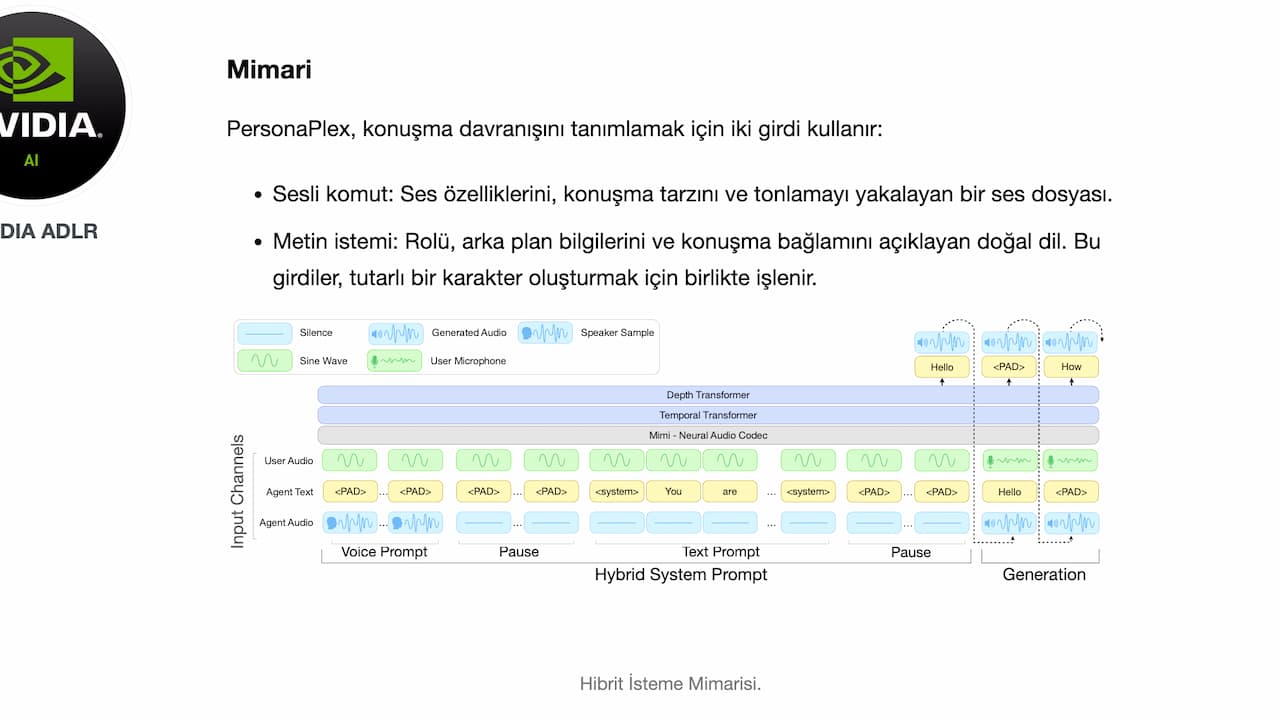
PersonaPlex, developed by Kyutai, is built on the Moshi architecture and uses the Helium language model infrastructure. It is an artificial neural network fine-tuned for characters on a strong foundation and mathematically streamlined for performance. We can summarize the technical structure of PersonaPlex-7B in three simple points:
- Mistral-7B Foundation: This model is built on the world-renowned Mistral architecture. In other words, it has a very powerful, fast, and capable core engine underneath.
- Role-Play Training: It has been specifically trained on "role-play" and "character dialogues" so it is more than a general AI. This way, it has technically learned to act like an actor and stay faithful to the script.
- Efficient Compression: Despite having 7 billion mathematical connections, its size has been reduced with a special compression technology without sacrificing its intelligence. This technical architecture allows the model to run smoothly even on standard home computers instead of giant servers.
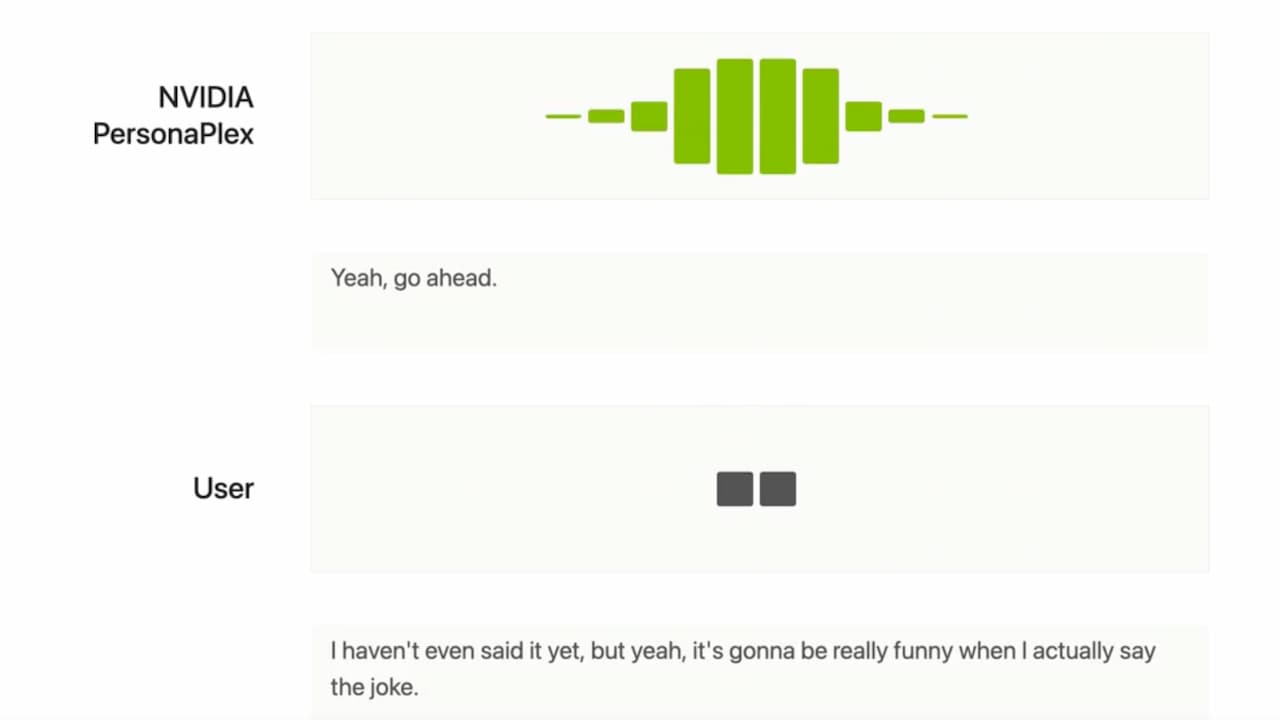
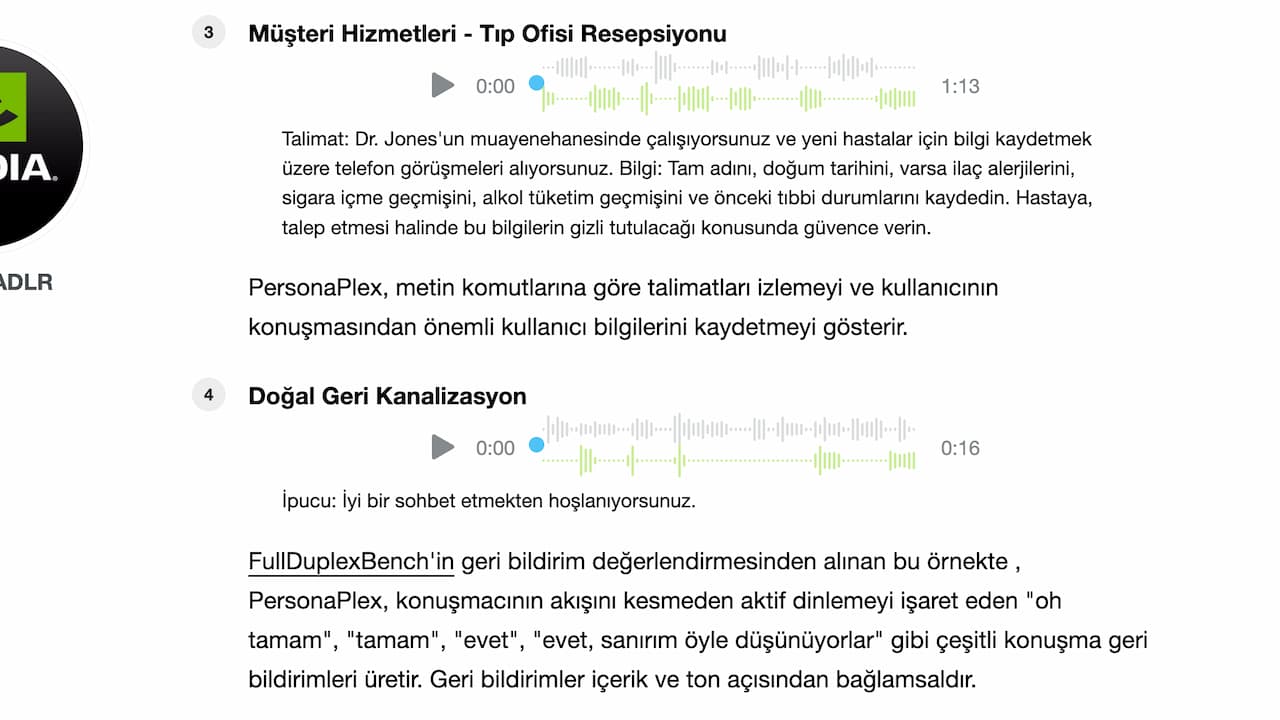
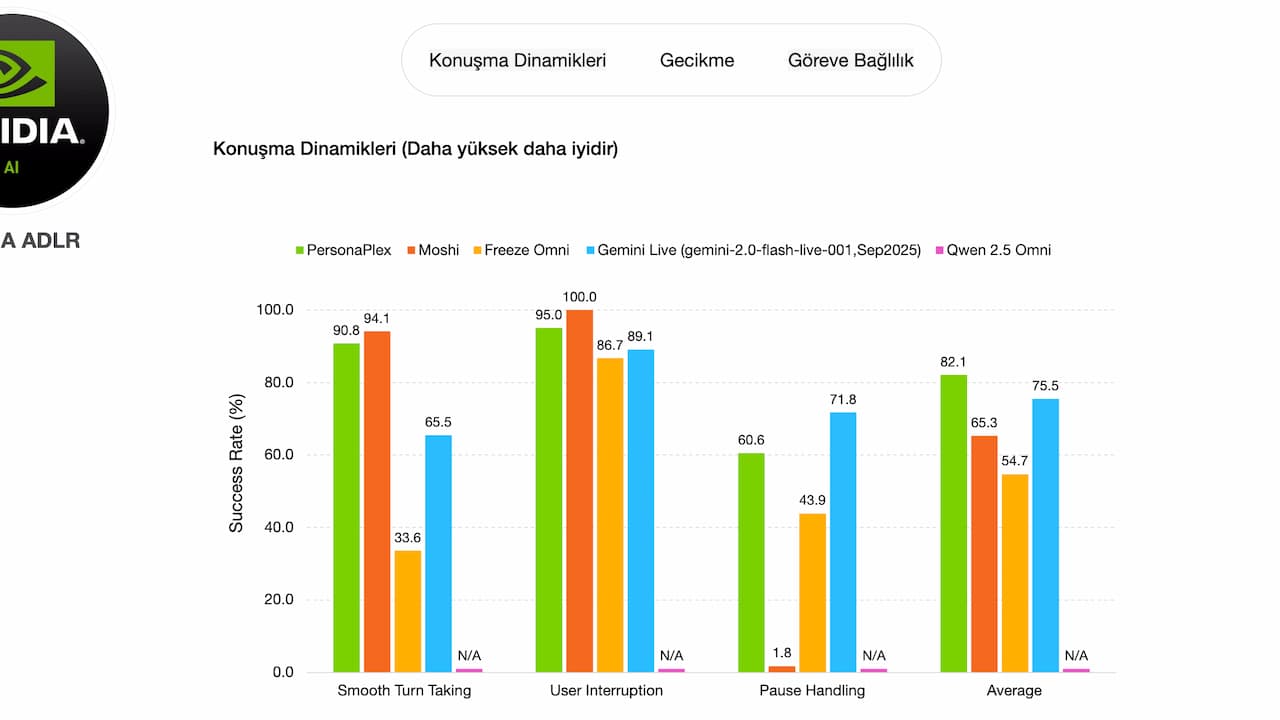
NVIDIA PersonaPlex-7B is the latest technology that takes AI beyond being just software and gives it a real "soul" and "voice." What sets it apart from its rivals is not only that it chats with you in writing, but that it can answer you by voice in less than 170 milliseconds, faster than human reaction time. Moreover, thanks to its "full-duplex" structure, it keeps listening while you speak, reacts instantly when you interrupt, and maintains the rhythm of the conversation with natural responses like "uh-huh" and "I see." Being completely free and open source, this powerful capability lets anyone use it on their own computer by designing a custom "personality." In short, PersonaPlex-7B is opening the doors to a new generation of communication, with living, breathing characters that break the "robotic" coldness of the digital world.
AdminÜretken Bilişim Nedir? Yapay Zekada İnsan Merkezli Yeni Dönem

Nvidia Nemotron-3: Çoklu Ajan Odaklı Yeni YZ Modeli


