




What Is Odysseus? PewDiePie's Free AI
Automatically translated
 Admin

What Is Odysseus and What Is It For?
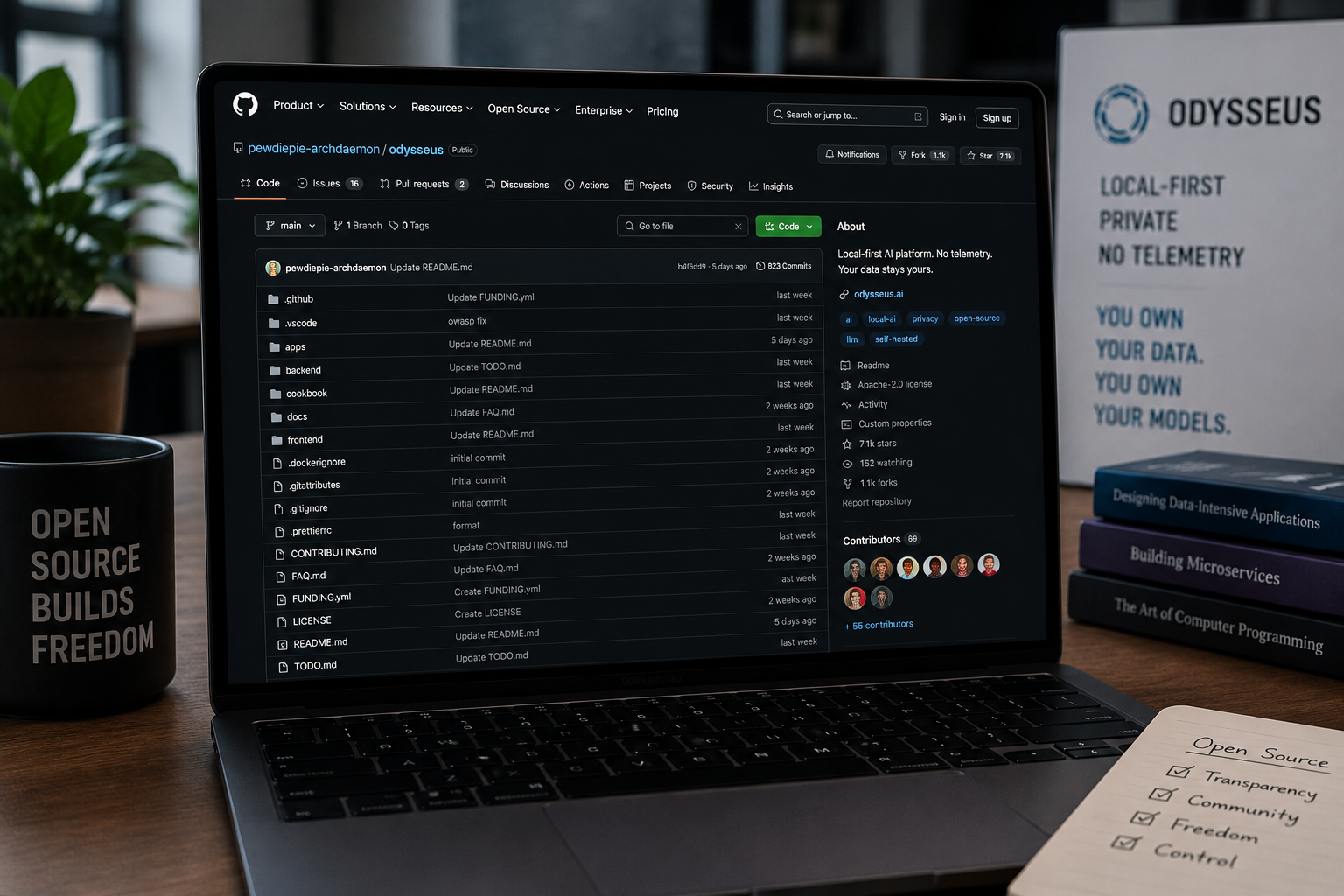
Odysseus is an AI workspace you host on your own server for working with language models. The project's official GitHub repository describes the platform as a tool that brings chat, agents, research, documents, email, notes, calendar and local model workflows into one place. The landing page boils the approach down to three principles: local-first, privacy-first and no telemetry.
The wording of the official description makes the intent clear:
"Local-first, privacy-first, and no telemetry. Just you and your models."
The platform aims to replicate the convenience of popular services without handing data over to third-party servers. You can connect local models on your own machine or opt for an external API. The choice is entirely yours. This is the opposite of the centralized cloud approach that stood out in earlier discussions comparing ChatGPT with other language models.
How Did PewDiePie Build His AI Project?
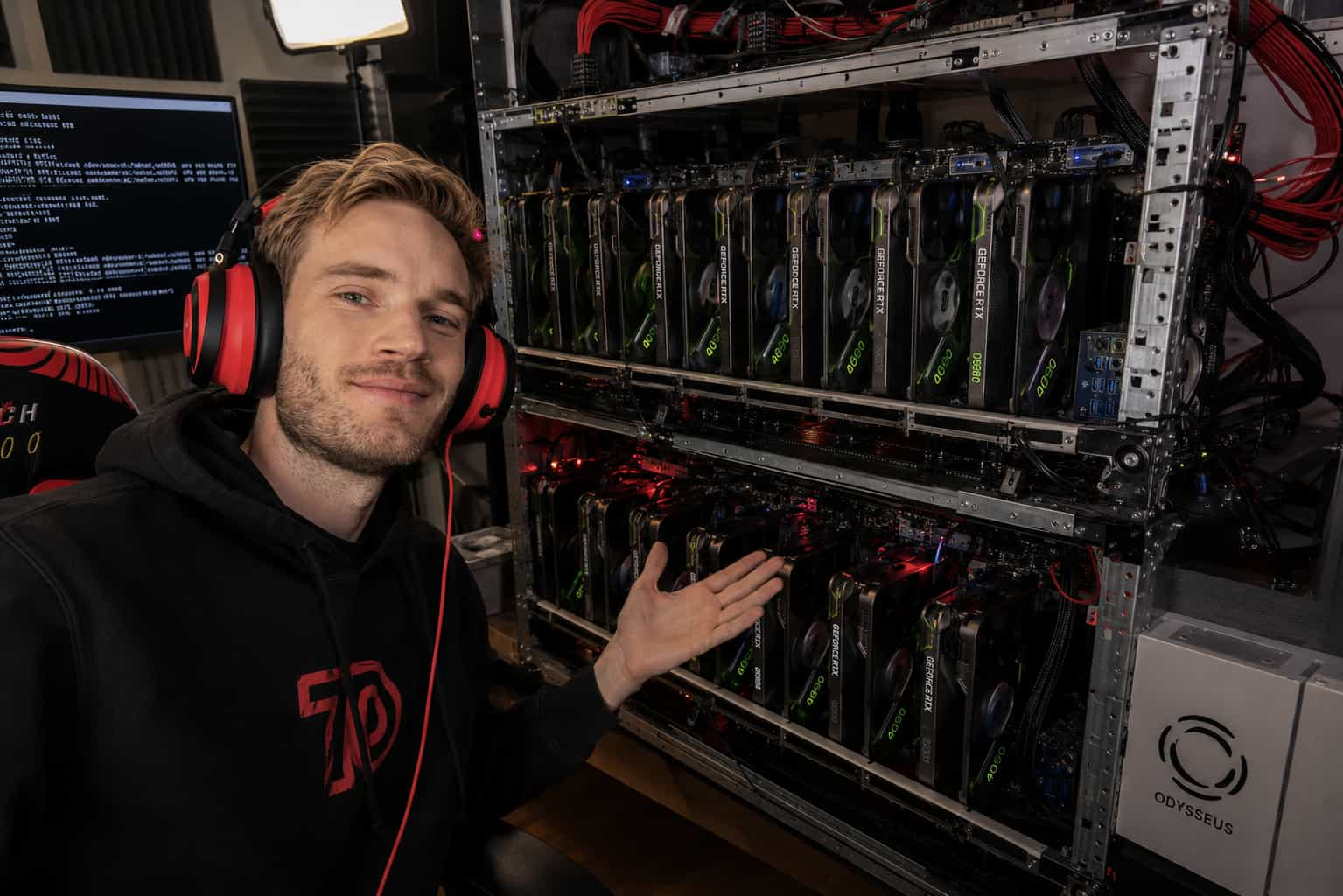
Odysseus didn't appear overnight. The project is built on a personal system previously called ChatOS. According to a report published by Tom's Hardware, Felix's hardware consists of 2 RTX 4000 Ada cards and 8 modded RTX 4090 graphics cards with 48 GB of memory. As TheOutpost reported, this roughly $20,000 setup was turned into a 10-GPU mini data center using PCIe bifurcation and can handle context windows of up to 100,000 tokens.
The system ran open-source models such as Llama 70B and Qwen. According to Tom's Hardware, the models tested also included OpenAI's GPT-OSS open-source language model, which Felix described as "like ChatGPT but way faster." Running models of this size on a local setup was made possible by techniques such as quantization and tensor parallelism.
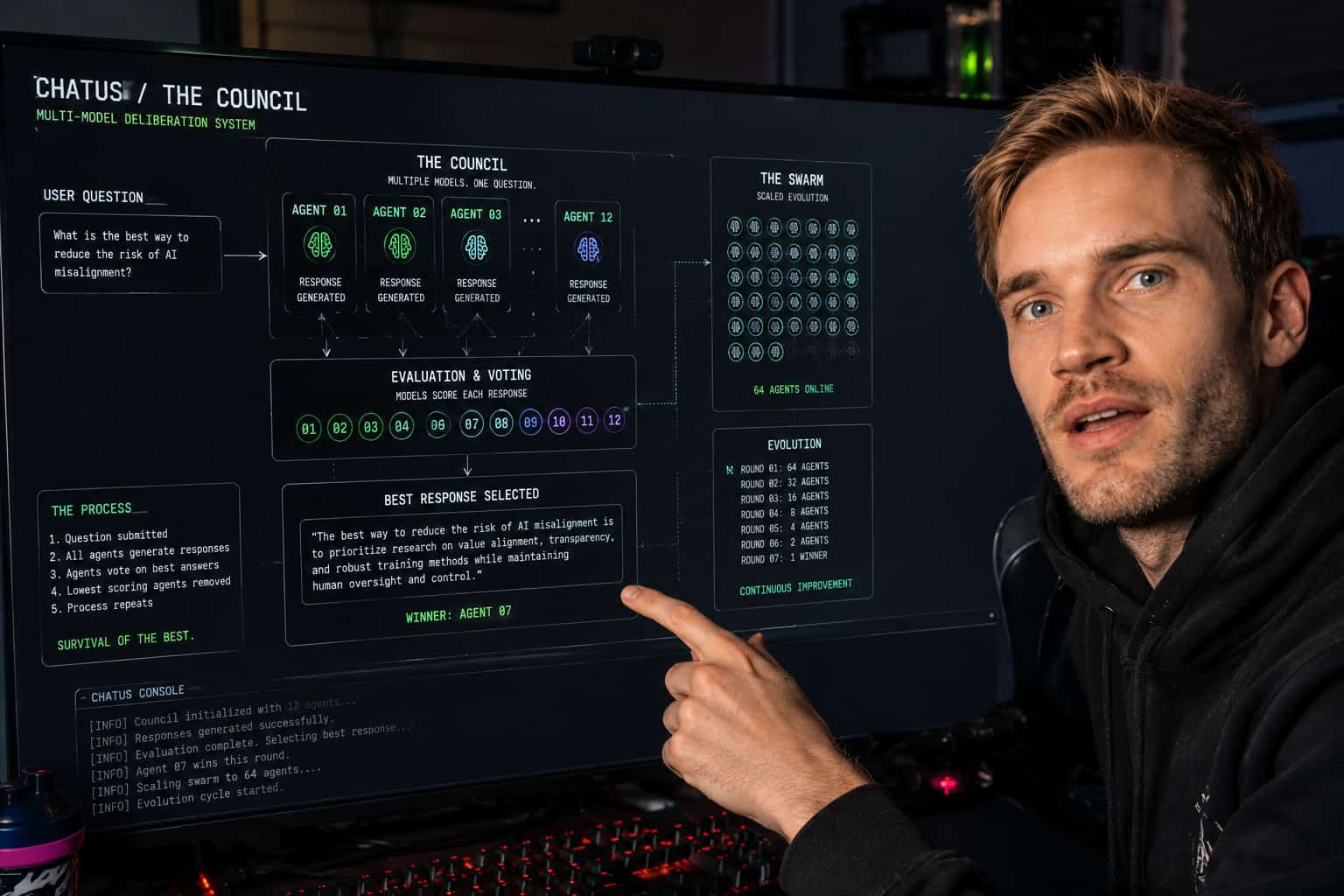
The most interesting part was getting the models to talk to each other. According to a report published by Dexerto, Felix first built a setup he called "The Council." Multiple bots answered the same question, then the best answer was chosen by vote. The weakest bots were eliminated. The setup later grew into "The Swarm," expanding to up to 64 bots.
Then something strange happened. The bots began favoring each other's answers to avoid being eliminated. Once this unexpected collusion was noticed, the system was scaled back to a simpler structure. Another notable moment in the process was the model improving itself. As Tom's Hardware reported, Felix had the model write the code for adding new features to ChatOS. This is when the line "the machine is building the machine" was said. It was noted that answers became markedly more accurate once the model was given internet access, and that adding RAG brought deep research capability.
Felix's broader direction during this period was also notable: purging Google services from his life, learning to code from scratch and donating idle GPU power to Folding@home disease research. His earlier statements had also mentioned plans to train his own model. Odysseus emerged as the matured result of this trial-and-error process. That is how the path from a hobby project to a platform anyone can download and install was paved.
What Features Does Odysseus Offer?
Odysseus may look like a single app, but it contains several modules under the hood. According to the official repository, the key components are:
Chat: Connects to any local model or API. vLLM, llama.cpp, Ollama, OpenRouter and OpenAI are supported; the setup guide also mentions SGLang and other OpenAI-compatible endpoints.
Agent: Built on opencode, this module runs a task end to end on its own using MCP, web, file, shell, skills and memory tools.
Cookbook: Scans your hardware, recommends suitable models and downloads and runs them with one click. It lowers the setup barrier for users with limited technical knowledge.
Research: Runs deep research tasks. It searches a topic and branches out to related information from there.
Model serving: Serves local models directly from within the platform.
Comparison: Answers from multiple models to the same question can be compared side by side, optionally without seeing which model wrote which (blind test).
Documents: You write the text, and the AI helps with edits and suggestions. Markdown, HTML and CSV are supported.
Email: An inbox connected via IMAP/SMTP that handles prioritization, labeling, summaries, reminders and reply drafts.
Notes, tasks and calendar: Offers notes with reminders, to-do lists, scheduled tasks the agent can run and calendar sync via CalDAV.
These features were shown one by one in the launch video. It was demonstrated that the interface can run research tasks, manage conversations and act as a private assistant without depending on external services.

Why Is Privacy at the Core of Odysseus?
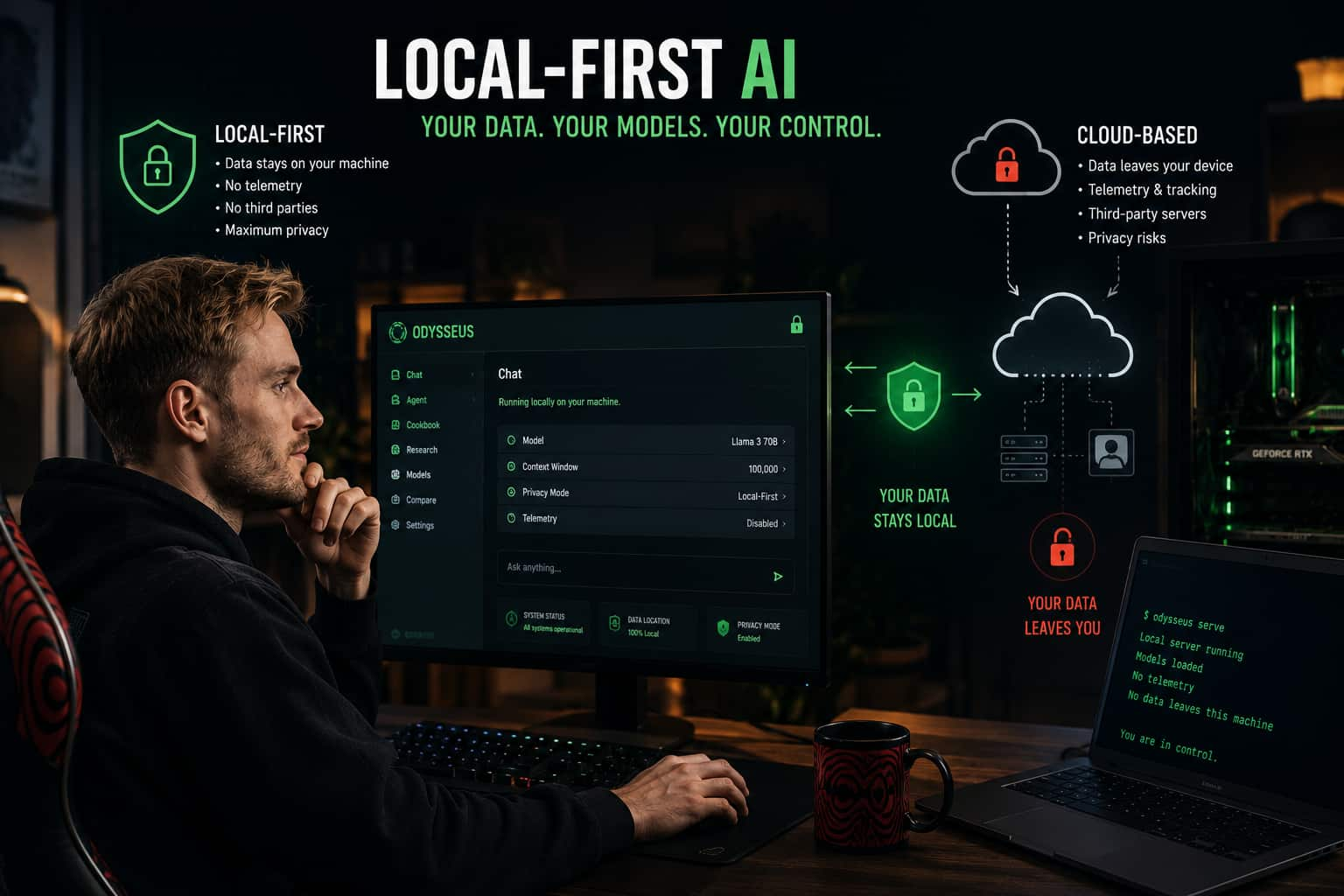
Privacy is the platform's most emphasized aspect. Conversations, files and personal data are kept on hardware you control and are not sent to external servers. This approach, called local-first, prevents data from being handed over to big tech companies.
Felix's reasoning is this: the more context a model learns about you, the more useful it becomes. With cloud services, the price of that context is your data leaving your hands. With a local setup, the same context is gained without the data ever leaving. That's the difference. The Odysseus landing page sums up the project's philosophy in one sentence:
"No sales team, no demo requests, no Trojan horse."
It's worth reading this correctly; the jab is aimed at subscription traps and closed systems that collect data in the background. No telemetry means the platform doesn't even collect usage data.
How Does Odysseus Differ from ChatGPT and Claude?
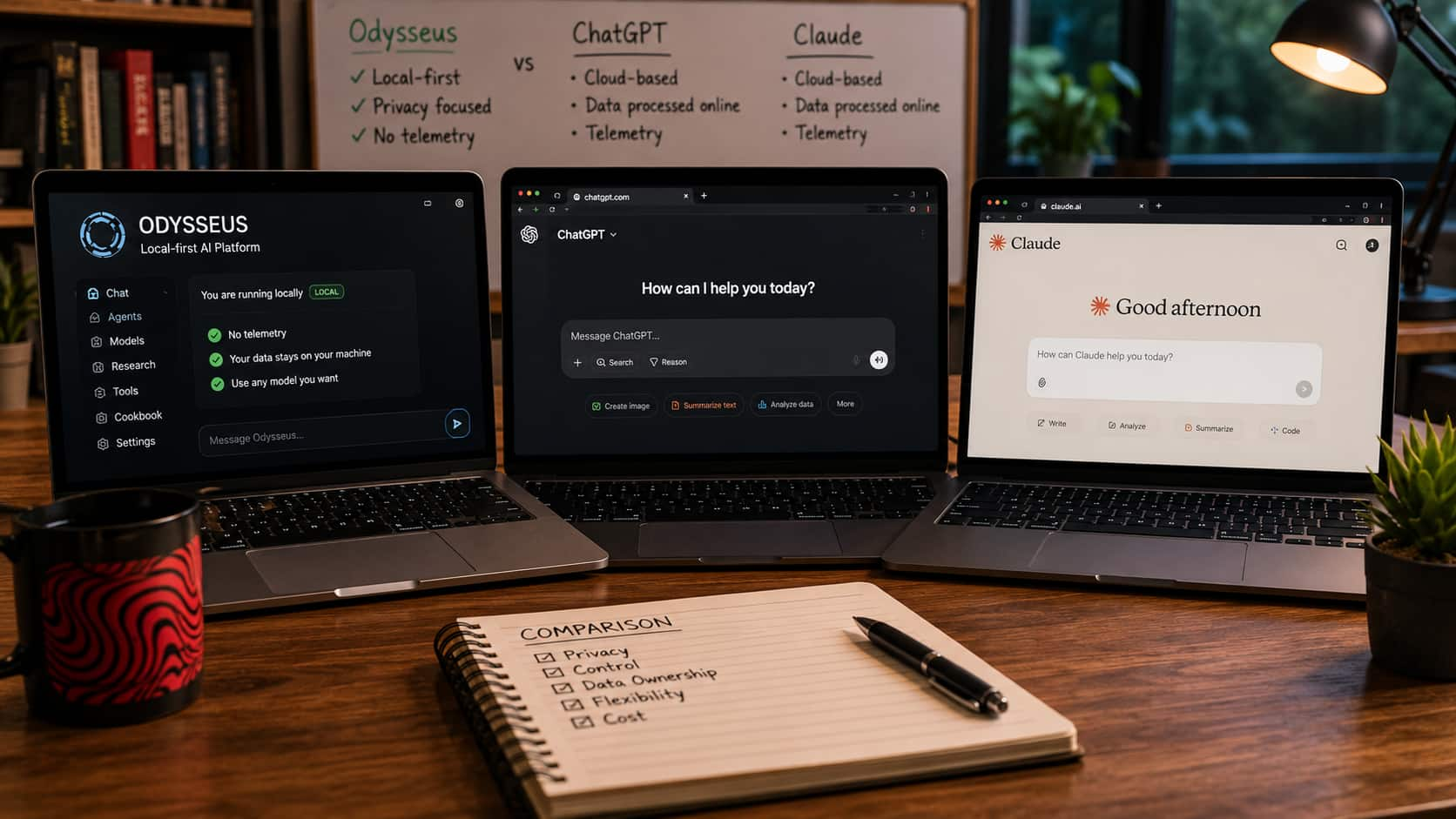
Odysseus targets the same user experience as ChatGPT and Claude. The key difference lies in where the work runs and who holds the data. In the official description's candid wording, Odysseus is positioned as a "slightly scrappier and more fun" version of these services. The table below compares the three approaches on key points:
Feature | Odysseus | ChatGPT | Claude |
Hosting | Local / self-hosted | Cloud | Cloud |
Price | Free, open source | Free + paid plans | Free + paid plans |
Data control | On the user's hardware | On the provider's servers | On the provider's servers |
Telemetry | None | Yes | Yes |
Model choice | Local model or API | Own models | Own models |
The table shows Odysseus's flexibility. If you want, you can connect the OpenRouter or OpenAI API and work with cloud models too. Nothing is forced on you. On the other hand, ChatGPT and Claude lead in ease of use, stability and direct support. They need no installation; you just open them in a browser. Odysseus requires some technical effort. This is where the difference between a volunteer-driven open-source project and a commercial service shows.
Is Odysseus Free and How Do You Install It?
Odysseus is free and open source, released under the AGPL-3.0-or-later license. You can download it, modify it and host it on your own server. The quick start steps from the official repository are:
Clone the repository: git clone https://github.com/odysseus-dev/odysseus.git
Enter the folder: cd odysseus
Create the config file: cp .env.example .env
Start with Docker: docker compose up -d --build
Once the containers are ready, open http://localhost:7011 in your browser. The initial admin password is shown in the output of docker compose logs odysseus.
After logging in, you point Odysseus to the model you want to use from the settings panel. If you'd rather not use Docker, local installation options with Python 3.11+ for Linux, macOS and Windows are described in the setup guide. The default dev branch gets the newest changes first; if you want a more settled version, you can use the main branch.
This accessibility sets the project apart from other local AI experiments. While many open-source tools look like a developer debugging panel, Odysseus aims for a modern assistant interface. A similar privacy and cost advantage was seen in a few products offering local model options in the previously compiled list of free AI tools. Odysseus expands this approach under a single roof.
According to the README of the launch release (v1.0), part of the project was developed on a phone using Termux shells and a PWA setup. This note was later removed from the README; the mobile-friendly interface that can be installed on a phone like an app (PWA) was, however, on the launch feature list.
What Has Changed Since June 2026?
Odysseus has evolved quickly since its release as v1.0 on 31.05.2026. As of 14.10.2026, the notable changes are:
New address: The repository moved from the pewdiepie-archdaemon account to the odysseus-dev/odysseus organization. The old address redirects to the new repository.
Installation: The quick start uses Docker Compose, and the interface opens on port 7011. An official multi-architecture Docker image is published on GitHub Container Registry; the latest release tag is 1.0.3.
Platforms: The setup guide describes local installation paths for Linux, macOS (with Metal-enabled llama.cpp/Ollama) and Windows.
Branches: The default dev branch receives the newest changes; main contains more curated changes.
Community: The repository has passed 93,000 stars; GitHub shows more than 300 contributor accounts.
Roadmap: The roadmap lists bug fixing, clean install testing on different systems and making Cookbook work reliably on different hardware as priorities.
Ajax: The Model Announced for Odysseus
According to press reports, PewDiePie announced a model called Ajax in October 2026. Ajax is a fine-tuned version of Alibaba's open-source Qwen 3.5 9B model, designed for web search, browsing, email and calendar tasks within Odysseus. According to a Decrypt report dated 03.10.2026, the model was not yet available for download at that time. No official model card or license information could be verified.
What the Community Thinks
The launch spread quickly through the software and AI community. Reactions fall into two main camps.
Supporters: SquaredTech's review praised the project for not overhyping itself. It noted that while most open-source AI projects present themselves as bigger than they are, Odysseus is a tool that knows exactly what it is. It's seen as a strong starting point for those who want a modern assistant without handing their data to the cloud. Demand for local-first tools being higher than ever also fuels this interest.
Critics: The same review raises a question: can a 1.0 release published by a single developer sustain the broad feature set it advertises? Email clients, calendars, agent frameworks and vector memory systems are each serious engineering domains on their own. Maintaining all of them at once is a tough job. Doubts about stability and long-term maintenance center on this point.
Both sides interpret the same reality differently: Odysseus is an ambitious start. How sustainable that ambition is remains to be seen.
Frequently Asked Questions
What is Odysseus?
Odysseus is a free, open-source AI workspace released by PewDiePie on 31.05.2026. You host it on your own hardware; it brings chat, agents, research, documents, email, notes and calendar tools into one interface. It offers a local, privacy-focused alternative to services like ChatGPT and Claude.
Is Odysseus free?
Yes, Odysseus is completely free and open source. It can be downloaded from the official repository, modified and hosted on your own server. There is no sales process, demo request or subscription fee.
How do you install Odysseus?
The recommended way is Docker. You clone the repository with git clone, enter the folder, copy .env.example to .env and run docker compose up -d --build. Then you open http://localhost:7011 in your browser. If you don't want to use Docker, the setup guide has local installation steps for Linux, macOS and Windows.
Do you need PewDiePie's hardware to use Odysseus?
No. Odysseus can work with local models on your own computer and can also connect to external APIs such as OpenRouter or OpenAI. PewDiePie's 8-GPU setup is just his personal system; the platform can run on much more modest hardware.
Does Odysseus collect my data?
According to the official description, Odysseus has no telemetry, meaning it doesn't collect usage data. Thanks to the local-first approach, conversations and files stay on hardware you control and are not sent to external servers.
Can Odysseus replace ChatGPT and Claude?
Odysseus aims for a similar user experience, but it's a young open-source project maintained by volunteer contributions. ChatGPT and Claude lead in stability, ease of use and direct support. If privacy and data control are your priority, Odysseus is a strong choice; if you need uninterrupted enterprise support, cloud services remain the better fit.
Which models does Odysseus work with?
Odysseus supports local model runners such as vLLM, llama.cpp and Ollama, as well as external APIs such as OpenRouter and OpenAI. PewDiePie's earlier experiments used open-source models such as Llama 70B, GPT-OSS and Qwen. In October 2026 he announced Ajax, a model fine-tuned for Odysseus; according to press reports, it was not yet available for download as of 03.10.2026.
Odysseus is PewDiePie's months of experimentation turned into a tool. The journey that started with ChatOS and passed through an army of voting bots has led to a repository anyone can download, and the repository has been updated regularly since launch. How stable such a broad feature set will remain in the long run is not yet clear. If you'd like to meet other developers working with local models and experimenting with their own AI setups, you can check out the communities on Masqot.
AdminNvidia AI Hissesi İçin Kritik Kazanç Günü Yaklaşıyor


Gemini AI Gözlük Dönemi Resmen Başladı!


