Artificial Intelligence in Production Industry: 2025 Featured Trends
Automatically translated
 Creator
2025 year is a year expected to become more common in artificial intelligence in the production sector and create an important transformation in the industry. These trends include important developments in topics such as increasing efficiency, automate business processes and sustainability. Here are the highlights of artificial intelligence in the production sector in 2025:
Industrial Artificial Intelligence and Business Processes
Industrial artificial intelligence enables business processes in the production industry to run more efficiently and effectively. This technology optimizes tasks in the production line using tools such as machine learning and deep learning. Industrial artificial intelligence reduces production interruptions by planning the maintenance of equipment with predictive analyses and increases overall efficiency. In addition, with automaticization of business processes, repetitive tasks can focus on more strategic and creative work, while performing by machines.
Advantages:
- Efficiency Increase:Provides more efficiency in production line. This means faster production cycles and higher quality standards.
- Definite Reduction:Due to the predictive maintenance of equipment, production interruptions are reduced. This ensures production continuity and reduces costs.
- Strategic Focus:People can focus on more strategic and creative tasks. This contributes to the increase of innovation and development of new products.
Sustainability and Energy Management
Sustainability and energy management is an important focal point of artificial intelligence in the production industry. Artificial intelligence can create more sustainable production processes by optimizing energy consumption and reducing waste production. Furthermore, with more efficient use of resources, production costs can be reduced and environmental impact can be reduced. This trend can accelerate the transition of companies to a more responsible production model in both economic and environmental aspects.
Application Areas:
- Energy Optimization:Optimizes energy usage in real time. This helps reduce energy consumption and reduces energy costs.
- Waste Reduction:It provides a greener production process by reducing waste production. This reduces environmental impact and helps companies achieve sustainability goals.
- Cost Reduction:Reduce costs with more efficient use of resources. This allows companies to increase competitiveness and invest more.
Automation and Robotic Processes
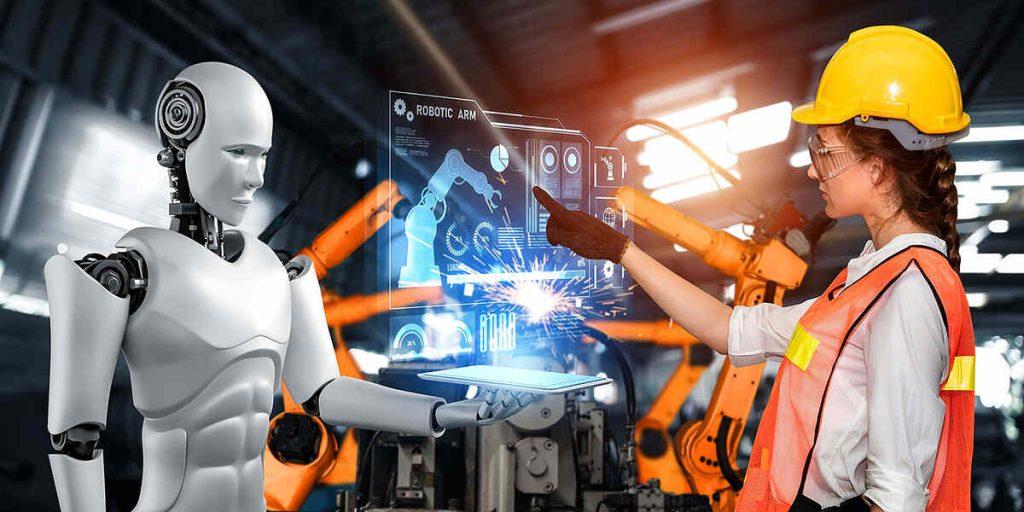
Automation and robotic processes are one of the most prominent applications of artificial intelligence in the production industry. The collaborative robots (cobots) work together with people in the production line, complete assembly and production tasks faster and without error. This improves production efficiency, but also improves work safety. Robotic process automation u (RPA) automate repetitive tasks, allowing businesses to take more time strategic decisions.
Advantages of Cobots:
- Flexibility and Adaptation:Provides flexibility in production line. Cobots can easily adapt to different production tasks.
- Error Reduction:It reduces errors by working with people. This helps achieve higher quality standards.
- Safety Increase:It provides a safer working environment by increasing work safety. Cobots allows human labor to move away from more difficult and dangerous tasks.
GenAI and Work Power
GenAI has the potential to reshape business power in the production industry. GenAI-supported systems convert workshop employees and lead to faster decision-making processes. This technology helps employees focus on more creative and strategic tasks, making routine work done. GenAI contributes to the formation of a hybrid work force model, increases human abilities and makes operations more efficient.
Effects of GenAI:
- Fast Decision Making:Faster decisions are made with access to data.
- Creative Focus:Enables employees focus on more creative tasks.
- Efficiency Increase:Make operations more efficient.
Ethics and Privacy Problems
With the fact that artificial intelligence is becoming more common in the production sector, ethical and privacy issues becomes more important. Issues such as data security, algorithm bias and transparency will be a big focal point in 2025. With the broader use of these technologies, you will need strong legal regulations to protect personal data and improve fair algorithms. These regulations will increase user’s trust and allow technologies to be used more ethically.
Ethics Applications:
- Data Protection:Powerful legal regulations for protection of personal data. This helps prevent data leaks.
- Algorithm Transparency:It is transparent and fair for algorithmic. This passes in front of biased decisions.
- Safety Increase:ethical applications to improve user trust. This helps technologies to accept more widely.
As a result, 2025 will be a year that artificial intelligence will be more integrated in the production sector and transform efficiency, sustainability and business processes. These developments will help companies get competitive advantage and make smarter decisions. Artificial intelligence technologies will not only increase productivity, but also enable the development of innovative business models and the emergence of new technologies.
CreatorYapay Zeka ile Siber Güvenlik: Gelecekte Bizi Neler Bekliyor?


Türkiye’nin İlk Yerli Yapay Zeka Dil Modeli: Aigency