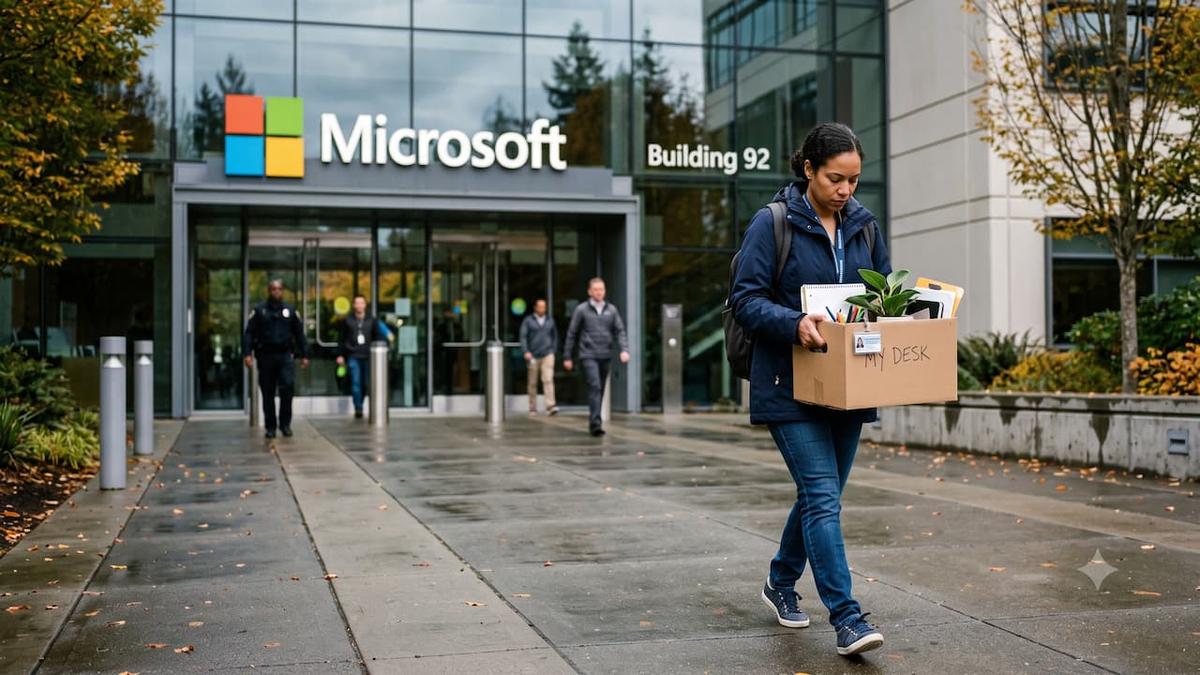
Microsoft Is Cutting 4,800 Jobs: AI Transformation Accelerates
Automatically translated
 Admin
Microsoft announced one of the most closely watched decisions in the tech sector in the first week of its new fiscal year. The company said it will eliminate 4,800 positions, roughly 2.1% of its global workforce. The decision affects the Xbox and Commercial teams in particular, and the company says it is not just a cost-cutting move but part of a broader organizational transformation.
At first glance, this news can be read as "thousands of people laid off because of AI." But the official statement Microsoft published does not paint such a simple picture. Amy Coleman, the company's Chief People Officer, uses a very clear phrase in her note to employees:
"The roles eliminated today are not being replaced by AI. But the reality is that AI is changing how work gets done."
Why Is Microsoft Cutting 4,800 Jobs?
Coleman's message to employees supports this view. She specifically states that the eliminated roles are not directly being replaced by artificial intelligence, while noting that AI is fundamentally changing how work is done inside the company. This matters because layoffs at many tech companies recently have been widely interpreted as "AI is replacing workers." Microsoft is pointing to a different aspect: AI does not take over existing jobs one-to-one, but it does redefine how teams need to work.
This approach also aligns with what Satya Nadella has said in recent years. Microsoft no longer focuses only on Windows, Office, or enterprise software. The company has placed Azure, Copilot, AI infrastructure, and enterprise AI solutions at the center of its growth. Adjusting the organizational structure to fit this strategy is therefore seen as a natural part of management's long-term plan.
Is AI Really the Reason Behind These Layoffs?
The most debated question after this news has been whether the layoffs are directly tied to AI investments. On social media in particular, many people read the decision as "AI has started taking workers' jobs." Microsoft's official statement, however, does not paint such a clear picture.
The company specifically emphasizes that the eliminated positions are not being replaced by AI. At the same time, it openly acknowledges that AI is changing how work gets done internally. In other words, Microsoft believes it can sustain the same work with different team structures and higher efficiency. This leads to some roles disappearing and others being redefined.
This approach is not unique to Microsoft. Over the last two years, tech giants such as Meta, Amazon, Google, and Salesforce have made similar statements. The common thread is quite notable: AI is not directly replacing people, but teams that use AI effectively are becoming able to do the same work with smaller headcounts. The transformation happening across the tech sector today rests precisely on this understanding.
Microsoft Is Not Actually Shrinking!
Layoff news naturally generates a lot of attention. However, the data Microsoft shared shows that the company is not pursuing a strategy focused only on shrinking. Over the past year, more than 4,000 employees moved into new roles across different teams, and in the last month alone about 500 people were placed into other positions within the company.
The company also says participation in its voluntary retirement program has increased significantly compared with previous periods. Taken together, these data points suggest that Microsoft's main goal is to reshape its organizational structure rather than simply reduce headcount. Some teams are shrinking so that more resources can go to strategic areas such as AI, cloud computing, and enterprise solutions, while high-growth divisions continue to invest.
The Biggest Impact Is on the Xbox Side
Among the units most affected by the layoffs, the Xbox organization stands out. Over recent years, Microsoft has made very aggressive investments in gaming. The Activision Blizzard acquisition, the growth of the Game Pass ecosystem, cloud gaming services, and new hardware projects were important parts of that strategy. However, this growth also brought a more complex organizational structure.
The company now aims to simplify that structure. According to the statements made, some game studios are being reorganized, with the goal of reducing management layers and making teams more efficient. Although this decision is difficult for employees in the short term, it is considered an important part of Microsoft's long-term strategy.

Where Do AI Investments Fit In?
This is where the most critical point of the news begins. Microsoft is going through what is arguably the largest AI investment period in its history. The company is expanding its Azure data centers, investing billions of dollars in NVIDIA-based GPU infrastructure, and integrating the Copilot product family into nearly all of its services. AI solutions for enterprise customers are also at the center of the company's growth strategy.
It is not surprising that the company aims to operate more efficiently in other areas while making such large investments. Tech companies are no longer trying to grow only by hiring more employees. Instead, they aim to increase productivity per employee with AI-powered tools. Microsoft's latest decision can be seen as one concrete example of this transformation.
What Does This Mean for Software Developers?
For software developers in Turkey, reading this news only as a layoff story would be incomplete. The key point to watch is which skills tech companies now prioritize in hiring.
Today, writing good code alone is often not considered enough. Companies increasingly need developers who can effectively use tools like GitHub Copilot, build applications with large language models, design AI agents, and manage automation processes. For teams working in the Microsoft ecosystem especially, Copilot and Azure AI services are no longer optional tools; they are becoming a natural part of daily development workflows.
For this reason, developers who can integrate AI tools into their workflows are expected to gain a significant advantage in both hiring and career growth in the coming period.
What Is Microsoft's Message?
Reviewing Amy Coleman's message to employees closely, Microsoft's intended message is quite clear. The company is trying to explain that this decision is not a temporary step aimed only at reducing costs, but an important part of a long-term transformation plan.
Management's core goal is to adapt the organization to the new way of working that the AI era requires. For this reason, it would not be surprising if similar restructurings continue to appear not only at Microsoft but across the industry. Tech companies now compete more on agility and efficiency than on size.
What Should We Take Away From Turkey's Perspective?
For developers, entrepreneurs, and tech professionals in Turkey, this news carries an important message. In the next few years, one of the skills companies will value most will be the ability to make AI a natural part of production processes. It is no longer enough to simply use ChatGPT. Integrating large language models into products, building AI agents, creating automation scenarios, and managing these systems securely are becoming increasingly critical skills.
Microsoft's restructuring decision also shows the direction this transformation is taking. The business world is not giving up on people altogether; on the contrary, it needs a new generation of professionals who can create more value with AI. For this reason, the best investment for developers will not only be learning new programming languages, but also strengthening their skills in AI-assisted software development.
AdminLenovo AI Student Phone: Ders Odaklı Yeni Telefon


NATO Zirvesinde Teknoloji ve Yapay Zeka Gelişmeleri