Phi-4-reasoning-vision: Microsoft's Visual Reasoning Model Arrives
Automatically translated
 Creator
As the AI ecosystem keeps moving toward ever larger and more expensive models, Microsoft is taking a different approach. Phi-4-reasoning-vision, one of the strongest representatives of the multimodal reasoning models of the 2026 landscape, challenges the belief that "the bigger, the better" and is starting what looks like a real shift in visual reasoning. This open-weight, 15-billion-parameter (15B) model does more than passively perceive images. It can also perform multi-step, logical and complex inference over them. Developers can access it immediately through the Microsoft Foundry AI models catalog, the Hugging Face platform and GitHub. By reducing dependence on data centers with high compute requirements, this new architecture brings strong analytical capabilities even to edge devices.
Why Phi-4-vision? Less Data, More Intelligence
The most notable detail of Phi-4-vision 15B, and the one that has surprised AI researchers, is the extreme data optimization in its training process. Large vision-language systems such as Qwen 3 VL, Kimi-VL and Gemma 3, which are among the strongest competitors in the field, are usually trained on more than 1 trillion tokens. In contrast, Phi-4-reasoning-vision was trained on only 200 billion multimodal tokens and manages to perform on par with its rivals, and even clearly better in certain areas.
So how does it reach this level of intelligence with one-fifth of the data? The answer lies less in the quantity of data than in the care taken during data curation. Instead of pulling training data randomly from the internet, the researchers manually classified it and corrected faulty questions, logical errors and formatting problems in open-source datasets. Where necessary, data was enriched synthetically using models such as GPT-4o, producing a clean data pool. Trained in about 4 days on just 240 NVIDIA B200 GPUs, the model pushes the Pareto frontier in energy efficiency and compute use.
The following table summarizes the structural differences between the model and its competitors:
Feature | Phi-4-reasoning-vision-15B | Competing Models (Qwen/Gemma) |
|---|---|---|
Training Data | 200 Billion Tokens | 1 Trillion+ Tokens |
Standout Area | Scientific Reasoning & UI Understanding | General Visual Recognition |
Hardware Requirements | Low / Modest Hardware | High / Datacenter |
Reasoning | Hybrid (Reasoning + Non-reasoning) | Usually single-mode |
Technical Architecture: Mid-Fusion and SigLIP-2 Integration
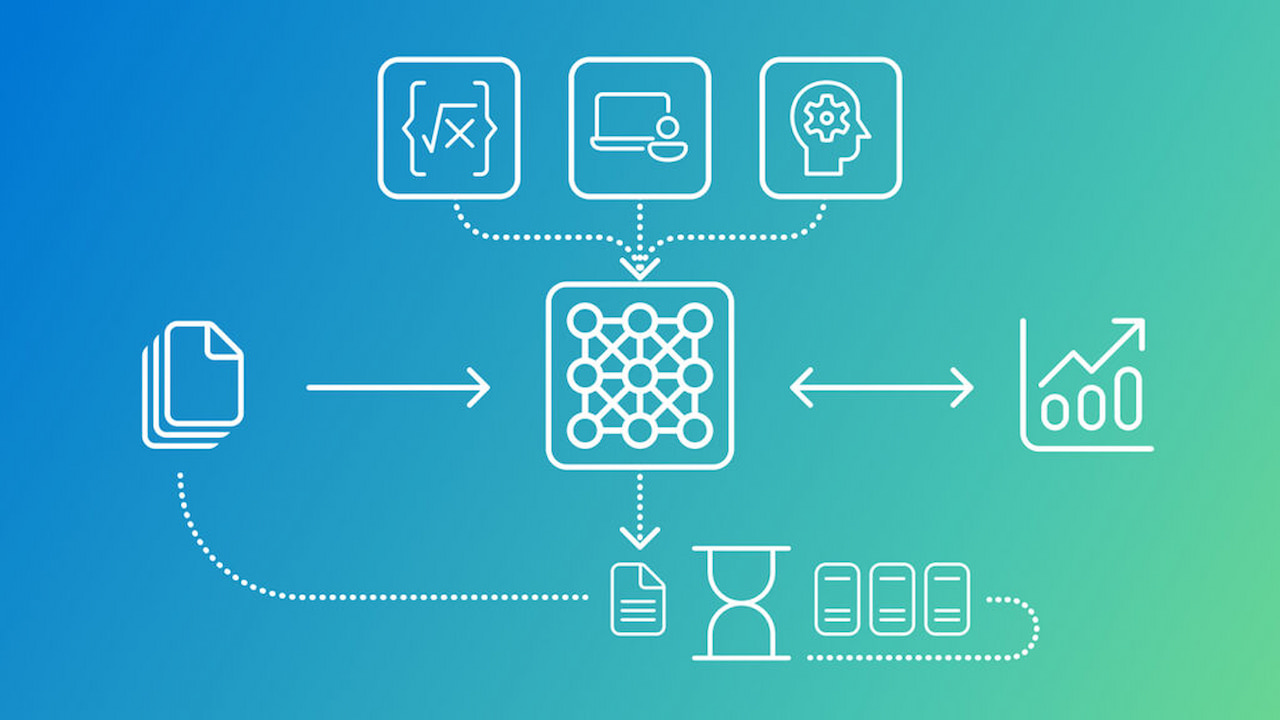
How visual and text data are combined in an AI model directly determines the model's efficiency. Early-fusion models, which process images and text together in the same transformer from the very beginning, require very large compute and memory capacity. Phi-4-reasoning-vision instead uses a mid-fusion architecture to offer high expressive power at lower cost. In this design, the advanced SigLIP-2 vision encoder developed by Google handles image processing. Images are first converted into visual tokens, then passed through a multilayer perceptron (MLP) projection layer into the embedding space of the Phi-4 model, where they are blended with language tokens.
The most important aspect of this integration is its dynamic resolution handling. Thanks to the NaFlex variant of SigLIP-2, images are processed without distorting their original aspect ratios. The number of visual tokens can rise up to 3,600 (roughly 720p HD resolution), depending on the need. This dynamic structure prevents the loss of the smallest icon on a computer screen or the fine details of a chart in a scientific paper, giving it a unique level of visual precision.
Hybrid Data Strategy: Reasoning and Perception
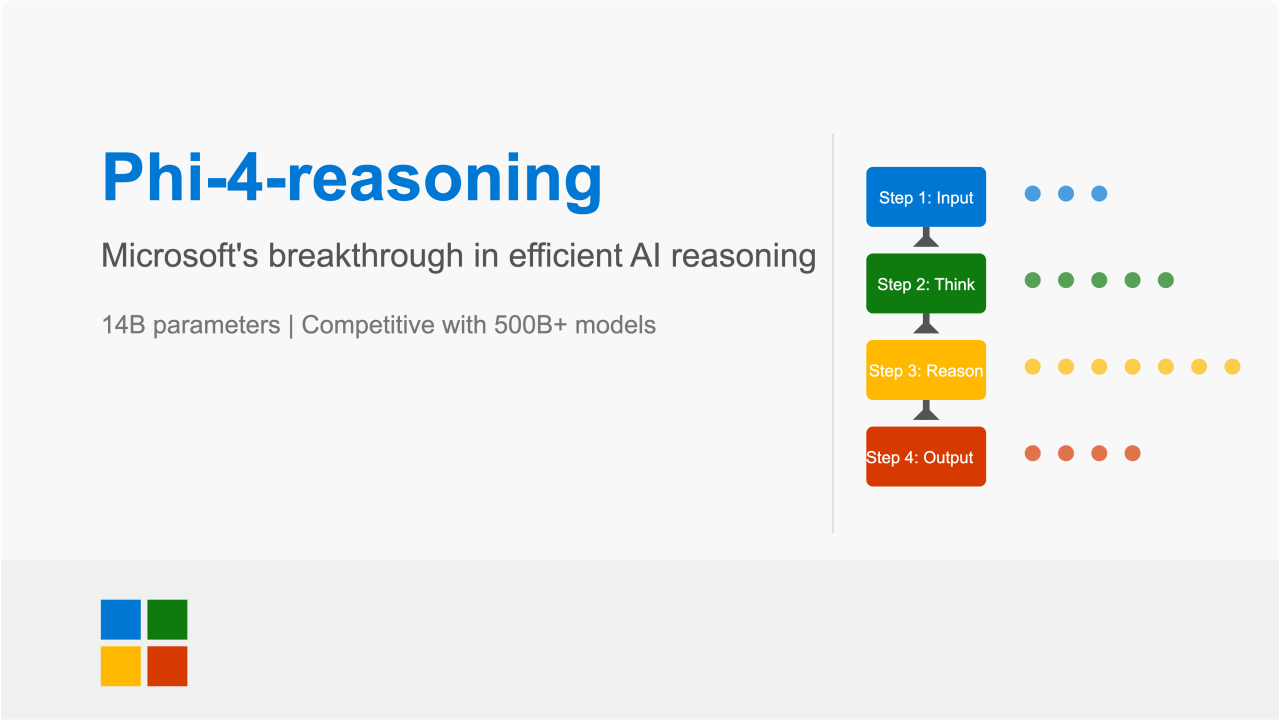
Unlike uniform models that try to solve every problem the same way, Phi-4-reasoning-vision has a hybrid reasoning engine that gives users "Think" or "Don't think" options. About 80% of the system's training data focuses on perception, while 20% consists of data requiring deep reasoning.
Users can explicitly steer the model's behavior. If you only need a document transcribed, a receipt read, or the coordinates of an object on screen located, using the <nothink> tag produces a direct result within seconds without wasting processing power. However, when given a complex physics problem, a math question that requires a proof, or a multi-step analytical task, the model places its reasoning between <think>...</think> tags, breaks the problem into logical parts, evaluates intermediate steps and reaches the most accurate answer through a chain of thought. This flexibility lowers latency while maximizing accuracy.
2026 Use Cases: Screen Reading and Scientific Analysis
Beyond being an academic achievement, Phi-4-reasoning-vision is a practical tool designed to solve industrial and personal problems. Among the Microsoft Foundry AI models, its main use cases are:
Computer Use (CUA): The model can read smartphone, desktop and web browser interfaces with high precision. Its record score of 88.2 on the ScreenSpot v2 benchmark shows that it can not only recognize buttons, menus, cart icons and text fields on the screen, but also locate the (x,y) coordinates of these elements with millimeter-level accuracy. It provides a solid "vision" layer for autonomous AI agents, such as e-commerce bots.
Scientific Reasoning: The model's mathematical reasoning ability puts it ahead of much larger systems. It analyzes math equations full of scribbles, crossed-out wrong operations and complex handwriting. By ignoring incorrect parts and focusing on the correct steps, it offers step-by-step solutions and explains where the error occurred, much like a teacher would. It can also interpret dense academic charts and statistical tables well. Its score of 75.2 on the MathVista mini benchmark is evidence of this strength.
Visual Language Tasks: To speed up everyday operational workflows, the model can instantly read invoices, receipts or complex PDF documents and convert them into text or structured data formats such as JSON. It is also well suited to robotics and agent applications, where it can compare consecutive photos in "What changed?" scenarios and detect temporal and spatial differences between them immediately.
In the world of AI, Phi-4-reasoning-vision once again shows that size does not always mean better performance, and that high-quality data and an optimized architecture matter much more. With its efficiency, reasoning capacity and low hardware requirements, this model is a strong candidate to be one of the most strategic AI assistants of 2026 and beyond.
CreatorOpenAI Anthropic Savaşı: İhanet, Sızıntı ve Halka Arz!
LLM ile Eşli Programlama: Google Destekli Ücretsiz Kurs 2026