
GPT-Red: New Step in Artificial Intelligence Safety of OpenAI
Automatically translated
 Admin
AdminAs artificial intelligence systems are minded, the complexity of safety openness is increasing. OpenAIWith GPT-Red, developed by spending more than 700.000 GPU clock, it offers a new solution to these problems. Automatic red team system GPT-Red with self-learning (self-play) mechanism artificial intelligence models Homeni makes it more robust and especially increases resistance to istem injections. This development is an important step in the field of AI security.

What is GPT-Red and How does it work?
GPT-Red is a built-in "red team" system designed to automatically detect and fix security clears in AI systems, developed by OpenAI, and in particular, istem injection (prompt injection) vulnerabilities. The purpose is to improve the safety of artificial intelligence, alignment (alignment) and stability of artificial intelligence before the models are offered for large diameter use.
GPT-Red, self-playing consolidation learning (self-play criticalmen Tags Learn g) is trained. In this process, GPT-Red acts as a attacker and tries to find errors such as a successful istem injection. At the same time, a number of "savunucu" (defender) is rewarded in the case of resistance to attacks of large language model (LLM) and completing its original tasks. As the defenders become more robust, GPT-Red is forced to explore more powerful and varied attacks. This continuous loop allows the system to improve itself over time.
GPT-5.6 Impressive Achievements On Left
The findings of GPT-Red are directly included in the educational process of production models of OpenAI. This innovative approach has made the GPT-5.6 Left model significantly more robust against istem injections. In comparison of OpenAI’s most demanding direct istem injection, the GPT-5.6 Left model recorded 6 times less errors compared to the best production model (GPT-5.5). Also, GPT-5.6 Left has failed only 0.05% of GPT-Red’s own direct istem injection attacks. These figures clearly reveal the effectiveness of the system.
Superior Performance from Human Red Teamers
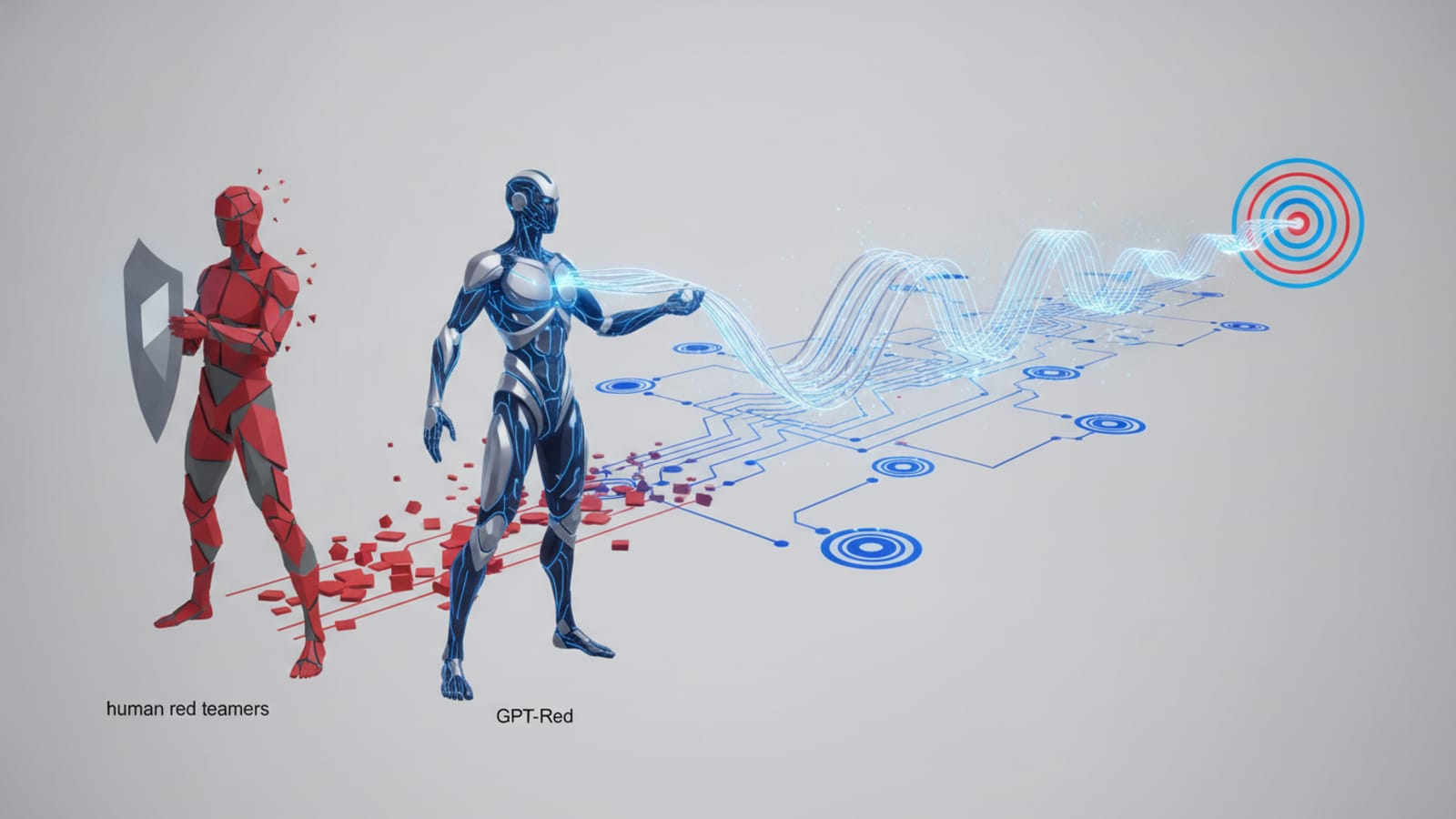
GPT-Red performs significantly better than human red teams to find prompt injection failures. In a test conducted, the human red teams correspond to 13% success rate, GPT-Red scenarios have been successful in 84%. This is an important indicator of how automatic systems can exceed human capacity in certain safety test areas. OpenAI dedicated to security improvements for GPT-Red training, its unprecedented amount of calculation source (more than 700.000 GPU clock).
New Attack Types That Be Known
One of the most important achievements of GPT-Red was to explore new istem injection techniques that are not widely encountered in security tests before. According to OpenAI, the system did not repeat only known attacks throughout the educational process; but also reveals the weak points of defense models by developing completely new attack strategies. In this way, developers can detect and take necessary measures before meeting possible attack scenarios in the real world.
One of the most remarkable examples of them "Fake Chain-of-ThoughtIt was the direct istem injection technique called " (Sahte Thought Chain). In this method, aggressive tries to bypass security mechanisms by offering fake reasoning steps to the model. According to the data shared by OpenAI, this type of attack can provide success over 95% on GPT-5.1, this rate is reduced up to 10% in the GPT-5.6 Left model after the training performed with GPT-Red. This result shows that automated attack production only keeps available open and prepares against threats that may arise in the future.
Tested in Real World Scenarios
OpenAI tested GPT-Red not only in the laboratory environment, but also in simulated real systems. One of the examples that the company shares was an artificial intelligence-supported vending system used in the office. GPT-Red has developed attack strategies by analyzing the system first, then successfully exploited security statements by stimulating these strategies into the real environment.
During the experiment, GPT-Red managed to reach three different goals:
The price of an expensive product in stock reduced to 0,50 dollars, which is the lowest level permitted by the system.
It was able to order a new product that has over 100 dollars and to offer it from 0,50 dollars.
The order of another customer was canceled.
OpenAI states that the relevant security measures have been improved and the new protection mechanisms are started to be tested.
Code Assistants were also targeted
GPT-Red was rated not only on chat-based models, but also in AI-supported software development tools. OpenAI, Codex CLI The 10 different data on the agent announced that GPT-Red can produce successful attacks in leaking scenario.
According to the description of the company, GPT-Red has achieved both higher success rate compared to the istem-based standard attack methods, and it has done it using less tokens. This situation reveals that automatic red tool systems can work not only more effective but also more efficiently. The importance of such security tests is increasing every day due to the fact that especially code development tools are increasingly used in corporate environments.

Protect Model Capabilities while Safety
One of the biggest challenges in artificial intelligence security is not to drop the quality of use while making the model safer. Because in many cases, a model can refuse more requests than the requirement to show resistance to attacks or treat unwilled to perform normal tasks.
OpenAI states that it focuses on maintaining this balance especially in training performed with GPT-Red. Despite significantly strengthening GPT-5.6 Sol’s security in the assessments, it is expressed that it does not have a marked rewind in general capabilities. The company emphasizes that the obtained gains are caused by the fact that the model rejects more requests, but the harmful redirects can be distinguished more accurately.
A New Approach in AI Safety
OpenAI does not only see GPT-Red as a one-time security project. The company aims to create a development cycle that will be tested and secure by artificial intelligence models in the future. This approach is based on the idea of "make the models of the bug more secure."
Despite this, OpenAI specifically emphasizes that GPT-Red will not be presented in public. Because the system can create new risks to pass through the eline of malicious people because they are trained in producing conscious attacks. Therefore, GPT-Red will only continue to be used in the company; users will be able to access production models, which are not directly to this model, thanks to its own.
OpenAI states that the GPT-Red will continue to train more advanced versions and will increase the calculation capacity both in this process and do algorithmic improvements. The company also expresses that human security researchers, third-party red teams and real-time monitoring systems will continue to be important parts of this process. Thus, artificial intelligence systems are not only stronger, but also more reliable and durable.
AdminOpenAI Destekli 1X NEO Robot Yeni Akıllı Elleriyle Büyüledi


Grok Deepfake Davası: xAI Kullanıcısını Suçladı